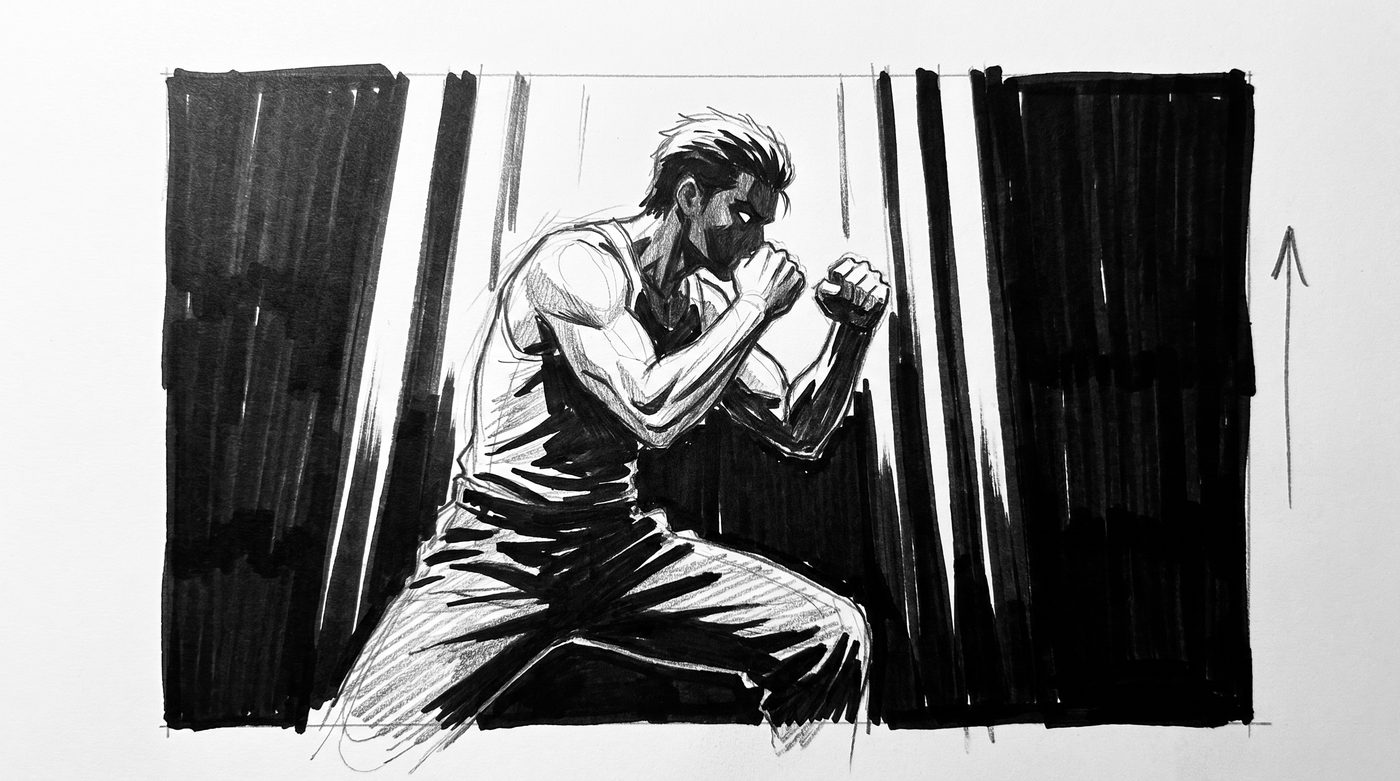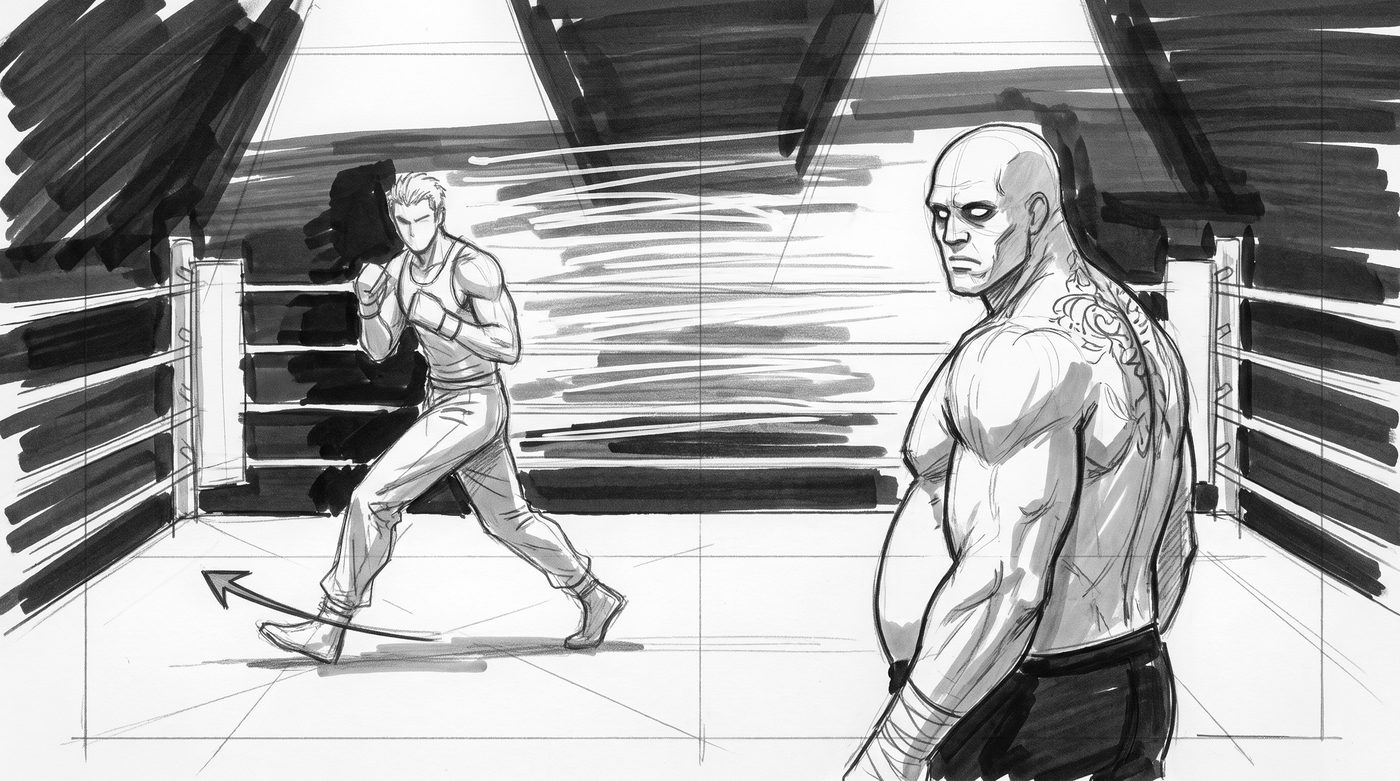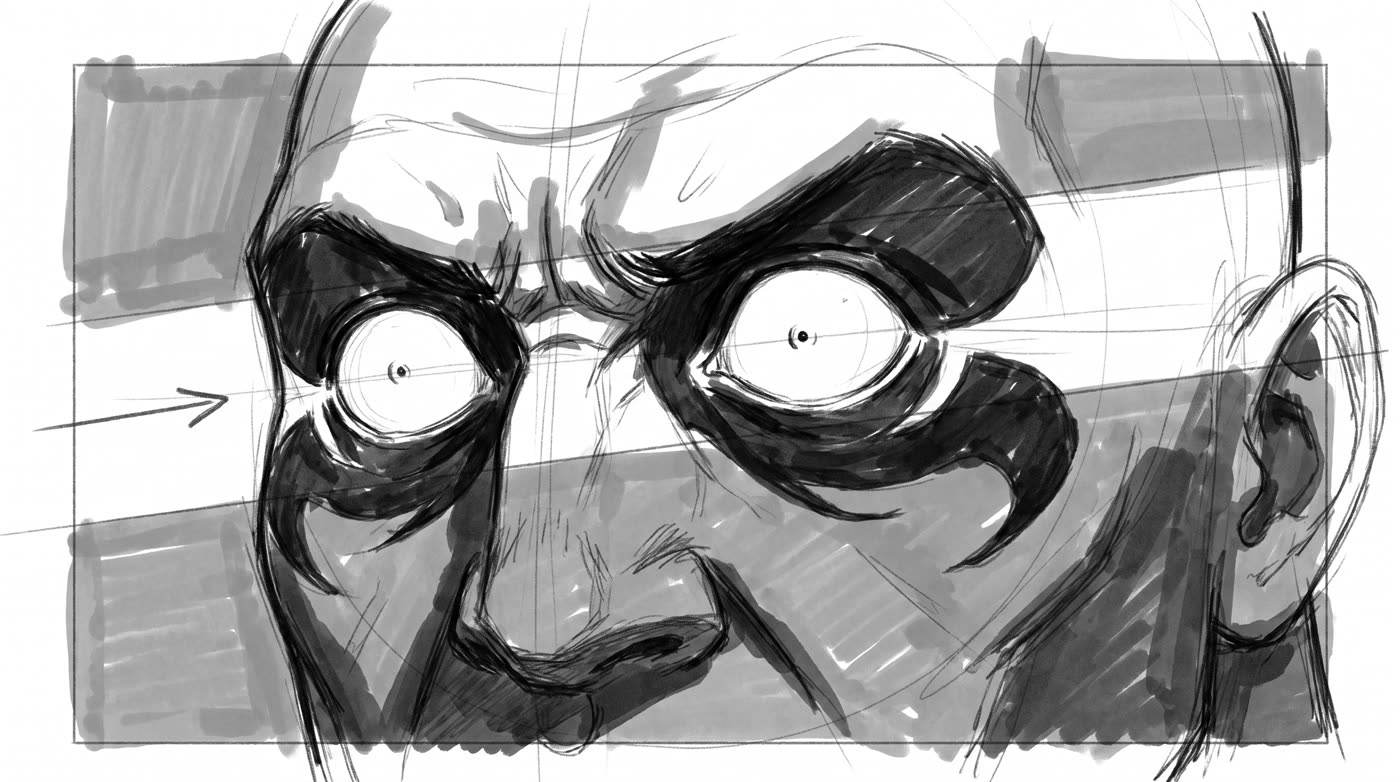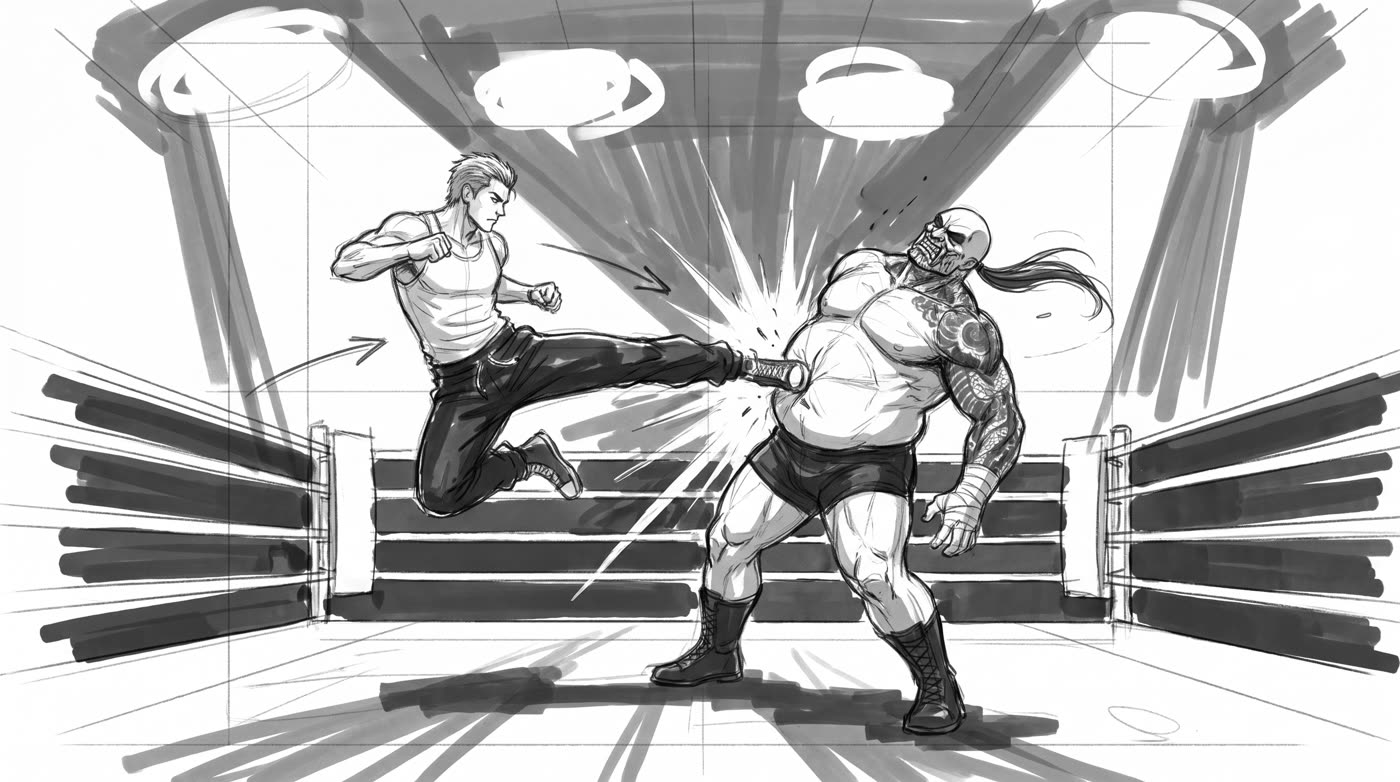
Title
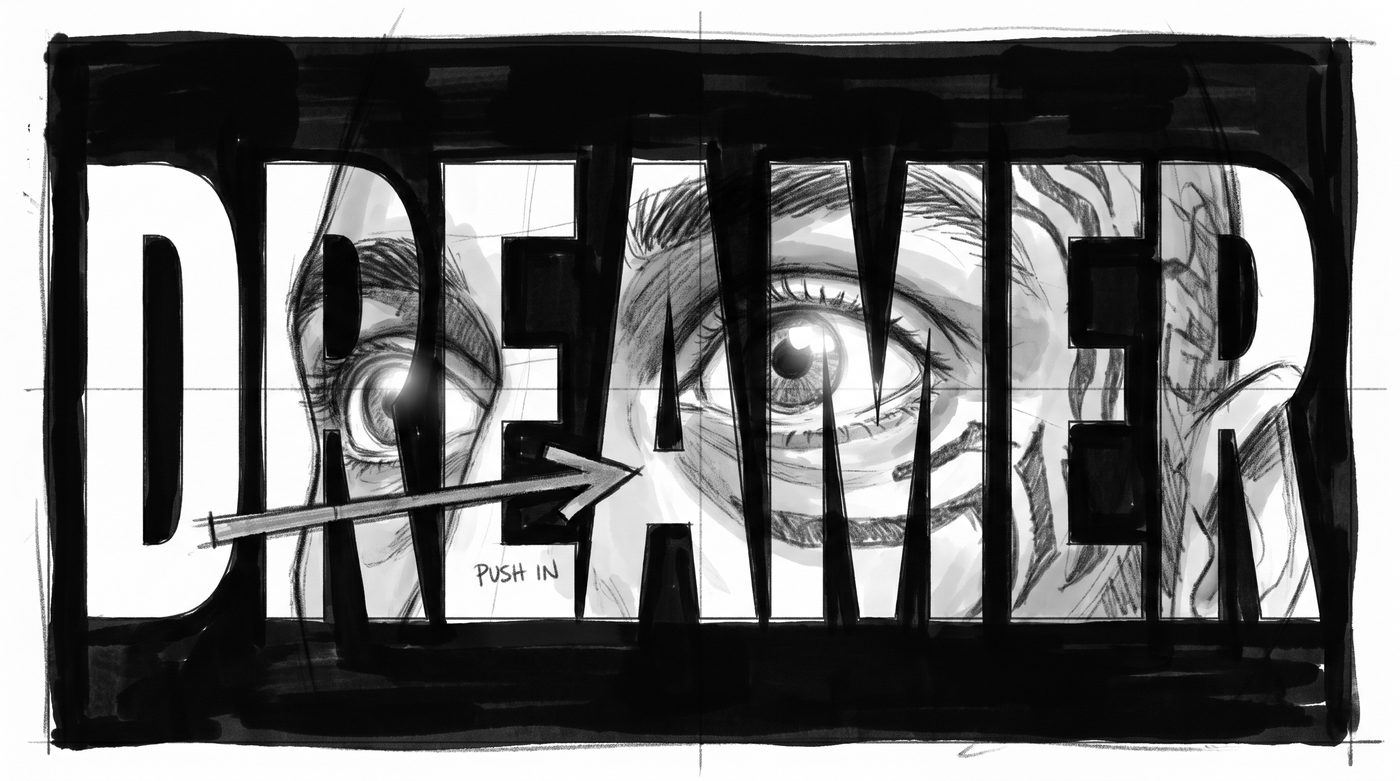
Black plate with lettering cut out in heavy, tightly kerned block sans. Fight inserts flash behind the letters as glitching CRT close-ups. Hold two seconds, push into the A's left stroke, then a white flash to the city.
Light, sound & shot notes
- Visual state
- Uncertain → Intense
- Light
- All of it comes from the inserts, flickering through the letters and speeding up with the push.
- Sound
- The city, unchanged: rain, a train, a siren, dogs. The fight is seen, not heard.
References (13)
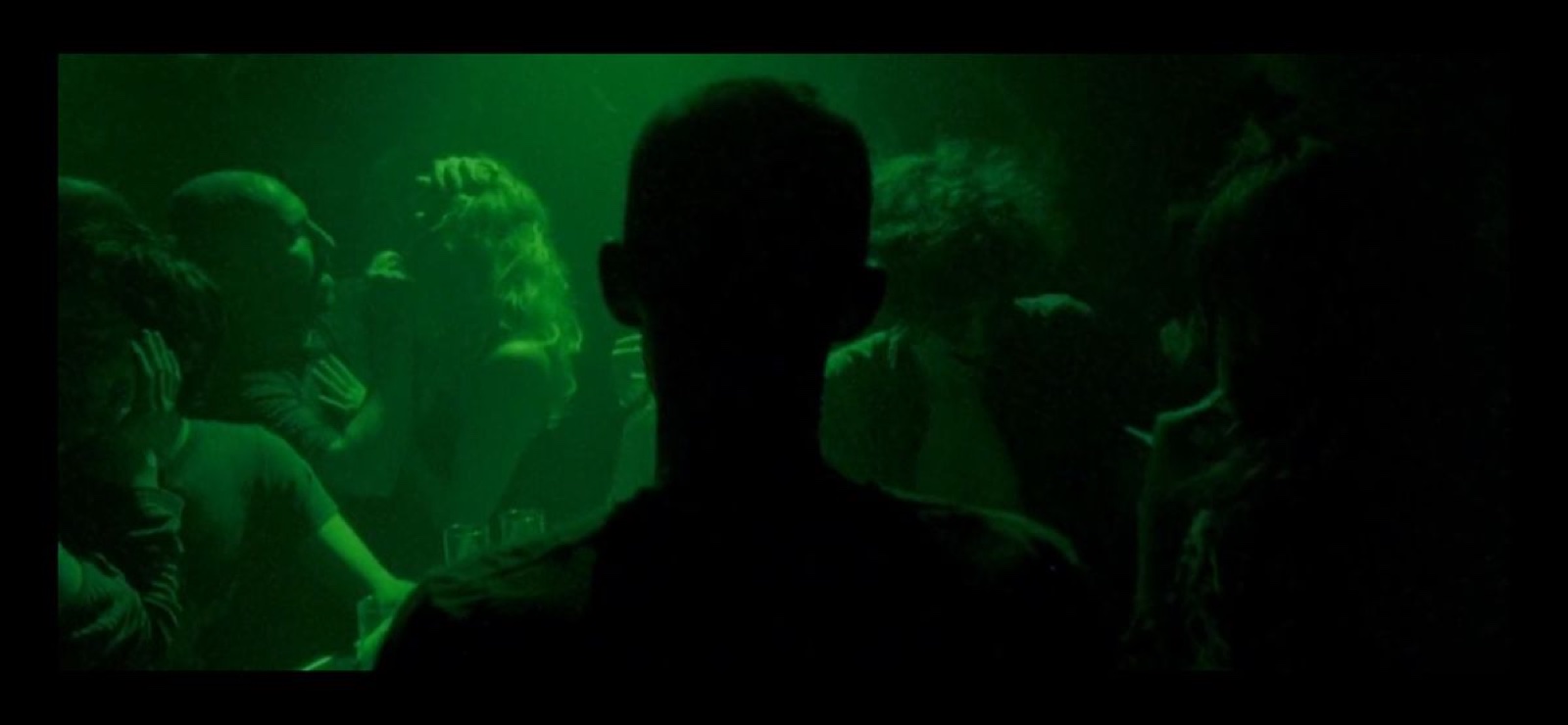
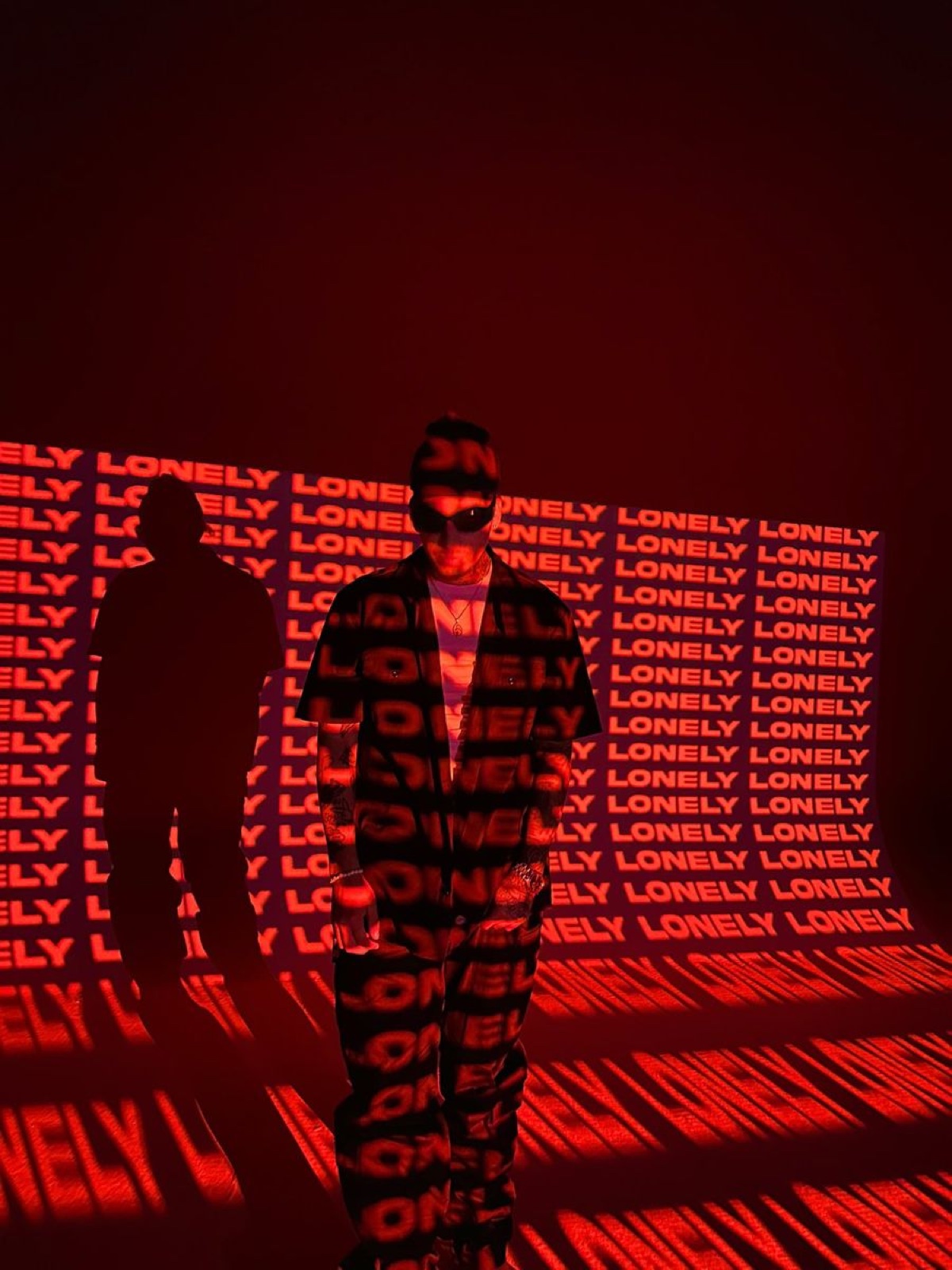
Enter the Void, opening titles ↗
Gaspar Noé, 2009; titles by Tom Kan. Take the kinetic type and the flash cutting, not the colour or the strobe rate.
Art of the Title: Enter the Void ↗
Background on how the title sequence was designed.
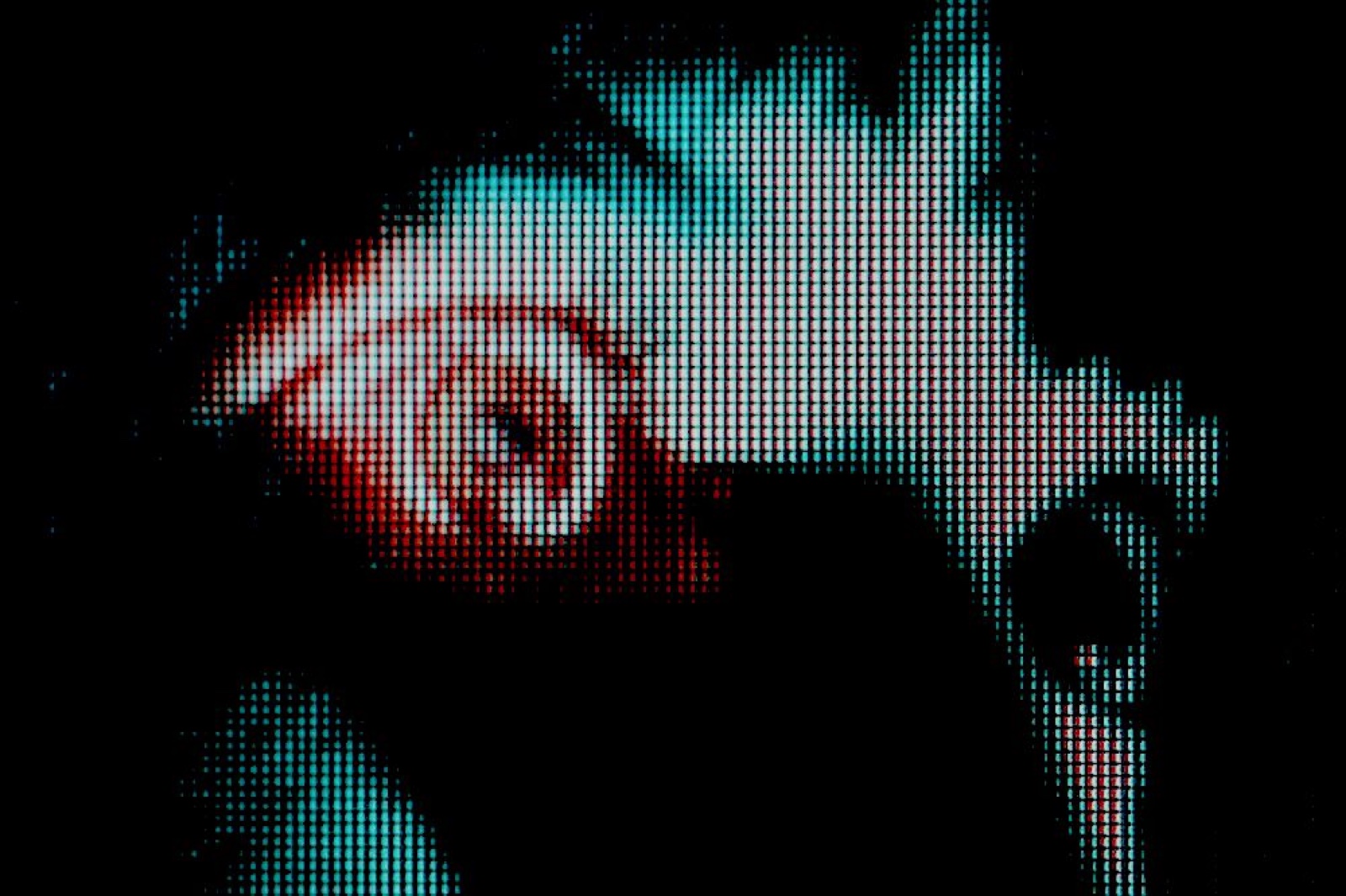
CRT dot-matrix sample
View larger ↗
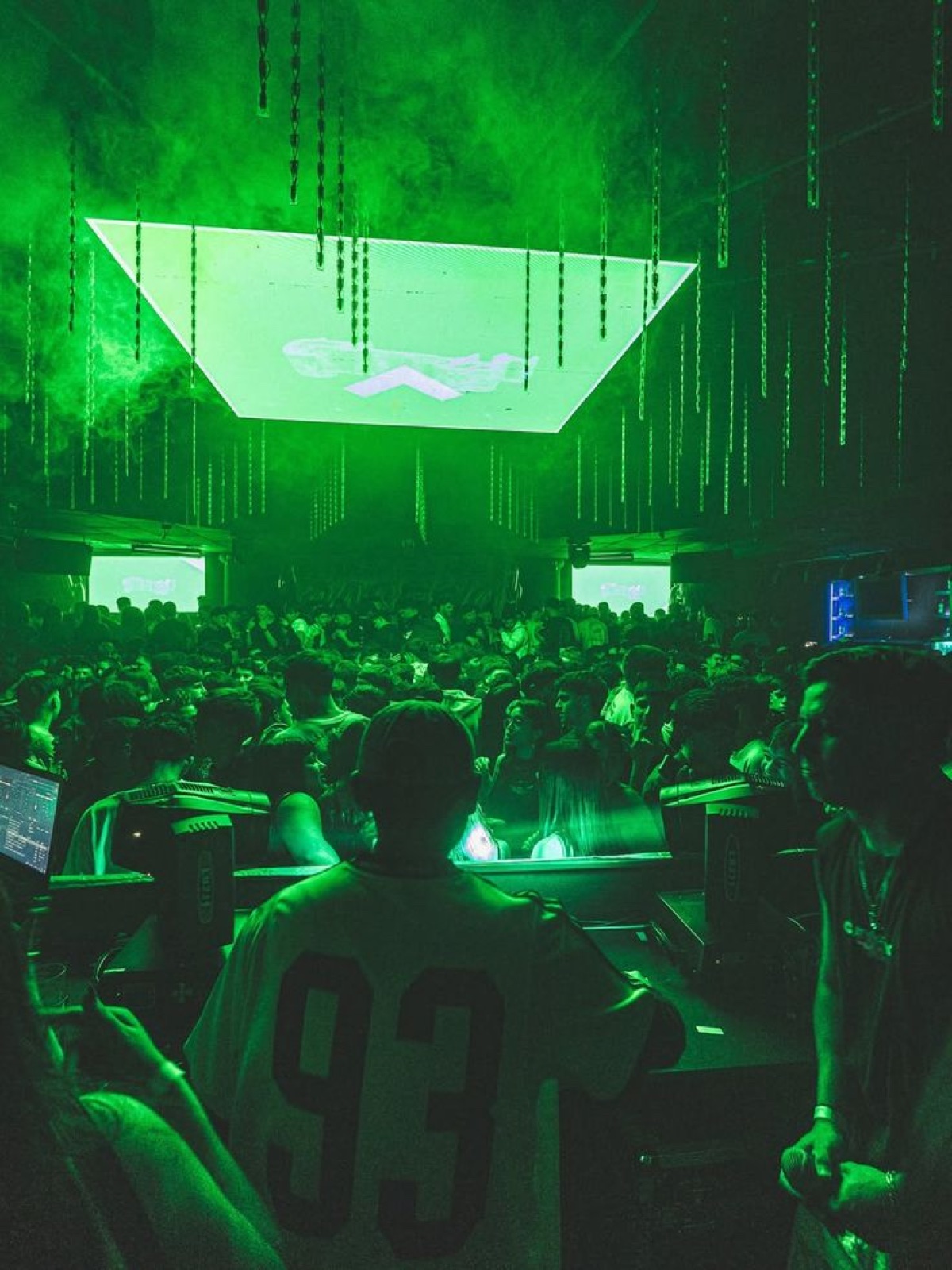
The screen texture for the inserts: LED dot grid, bloom, dropout to black. The cyan and red fringing is still an open question (storyboard question 7).
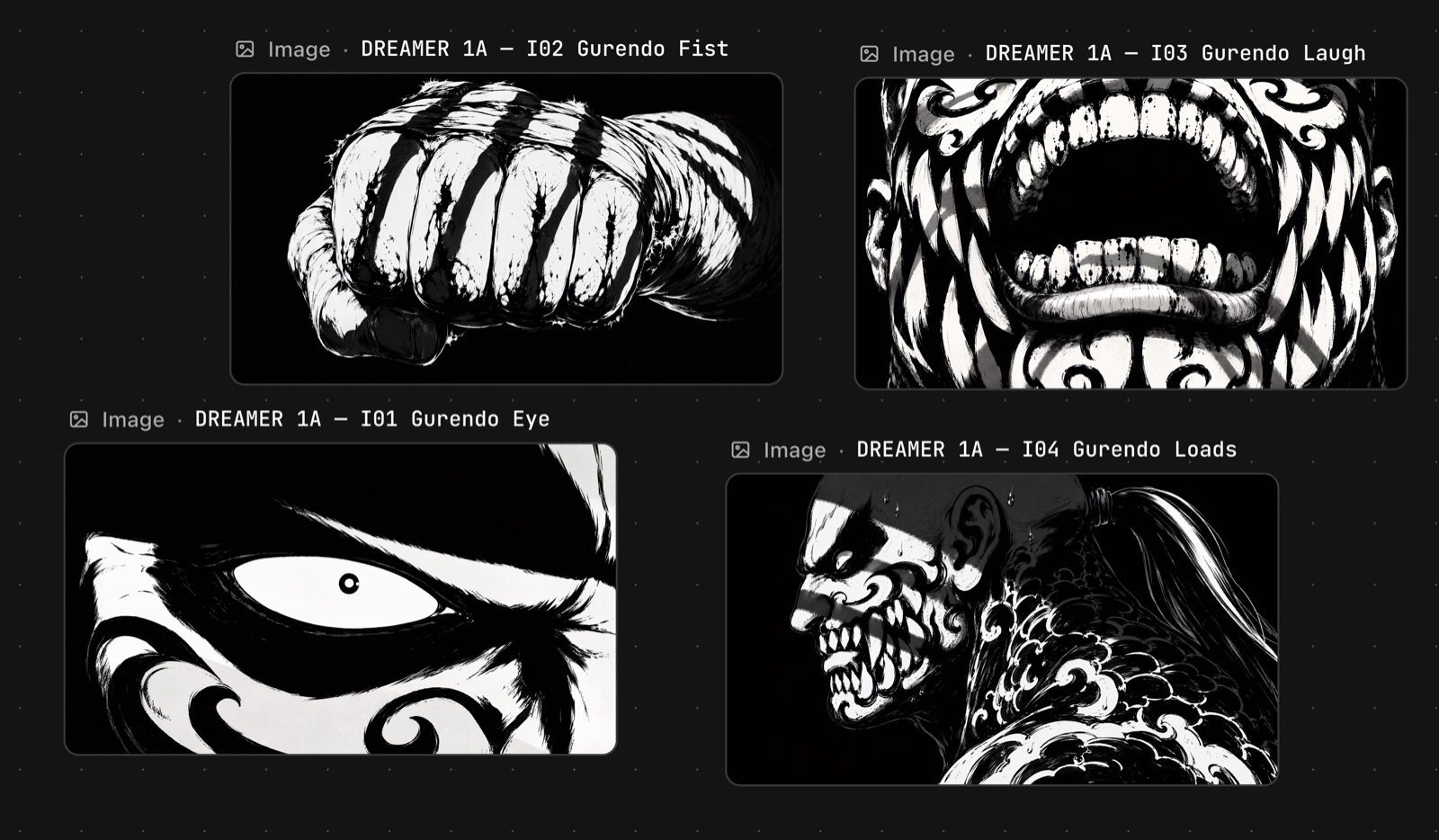
First plates: I01–I04
View larger ↗
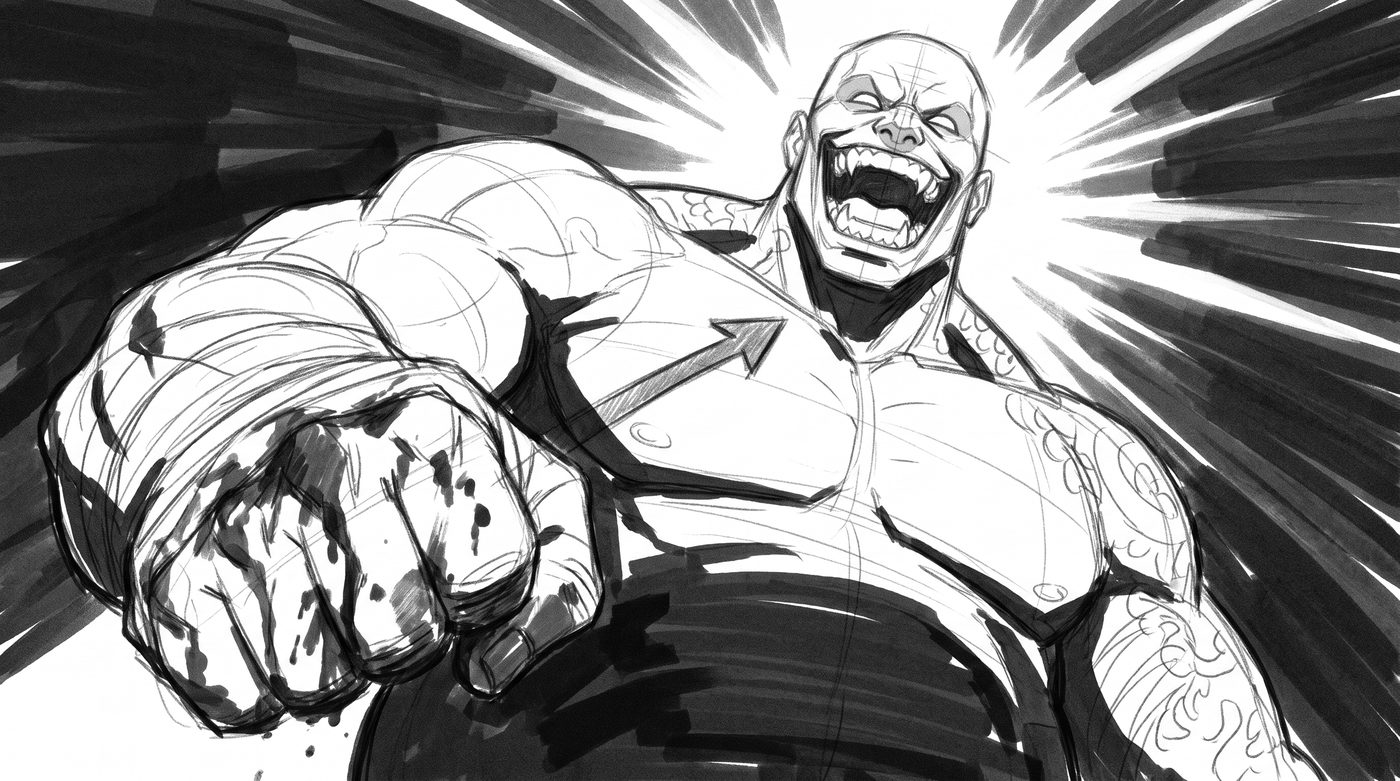
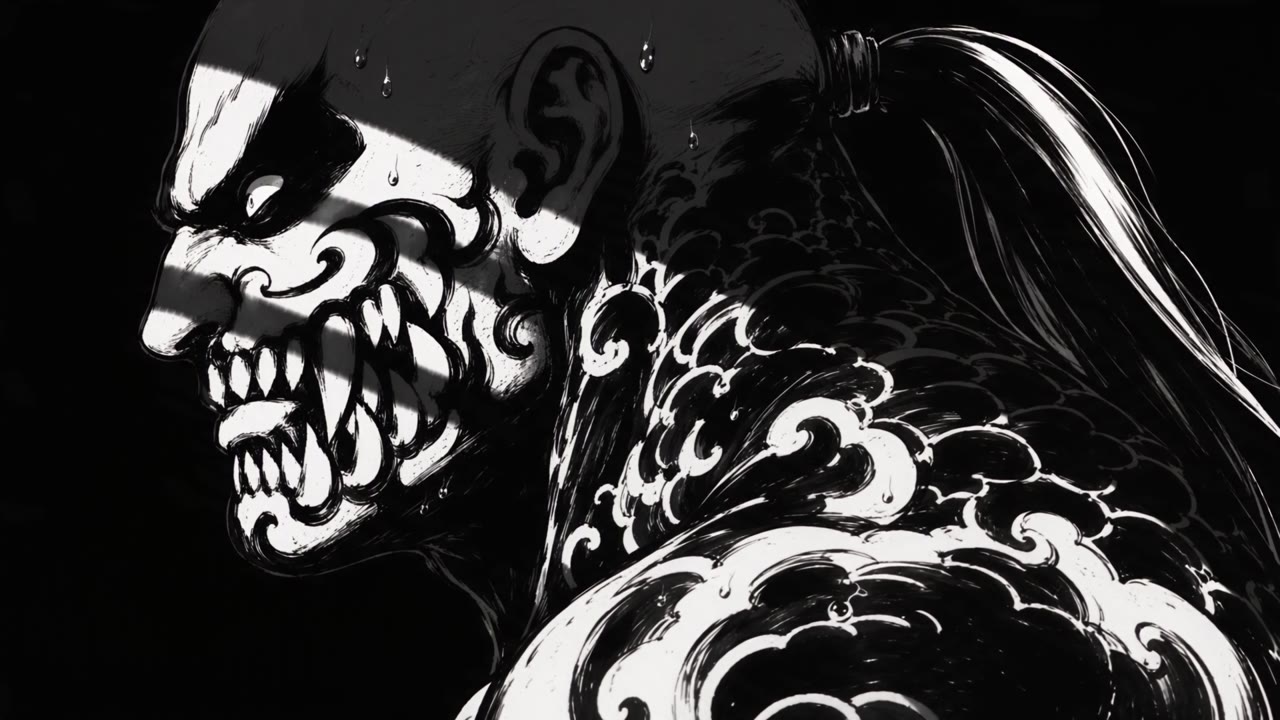
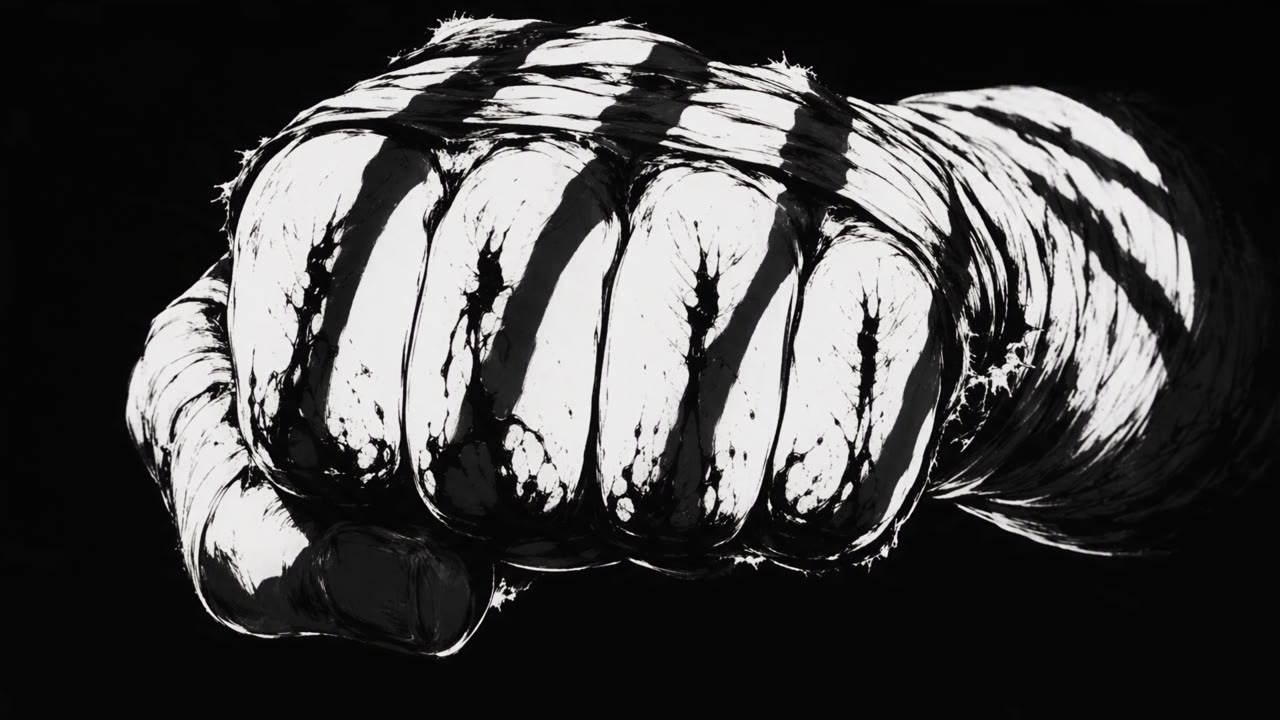
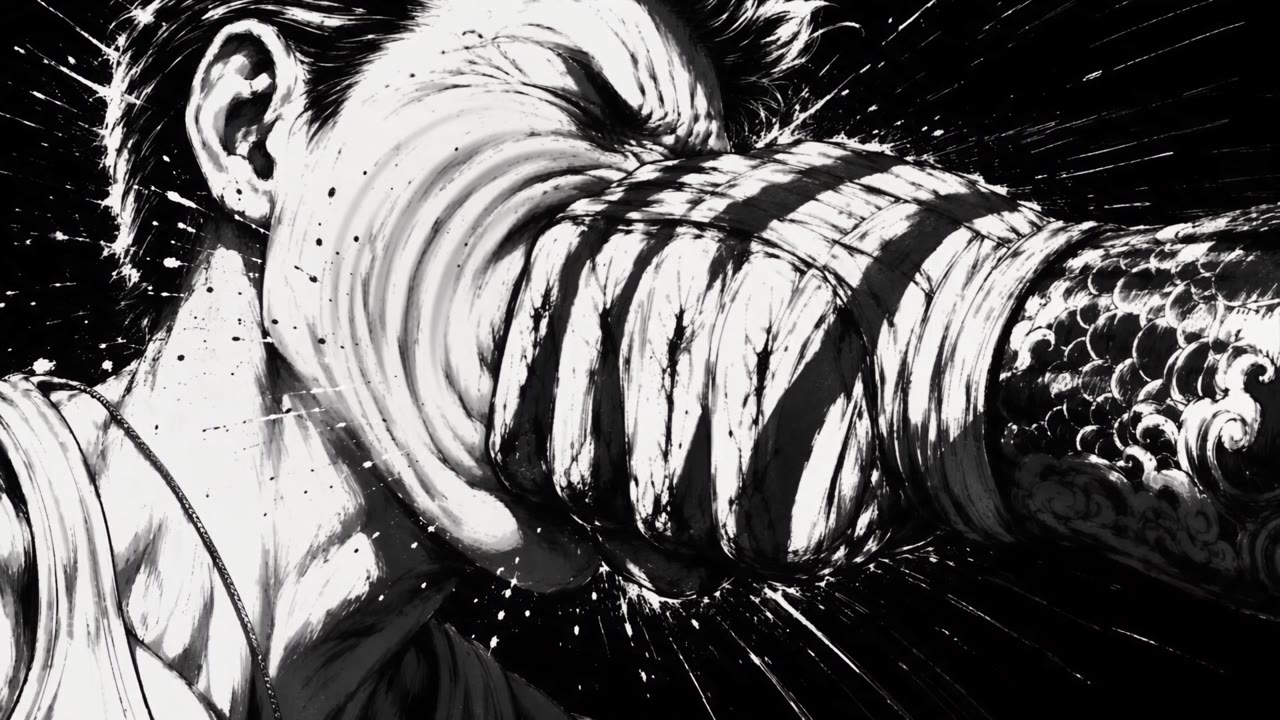
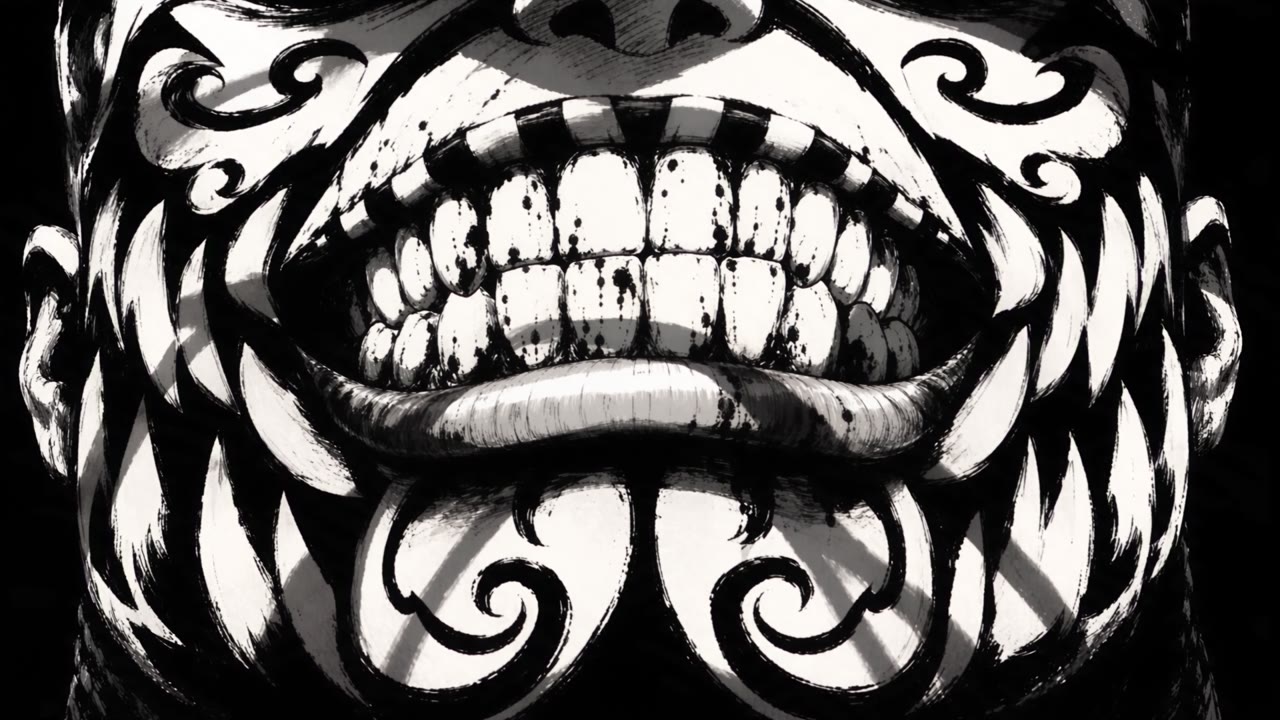
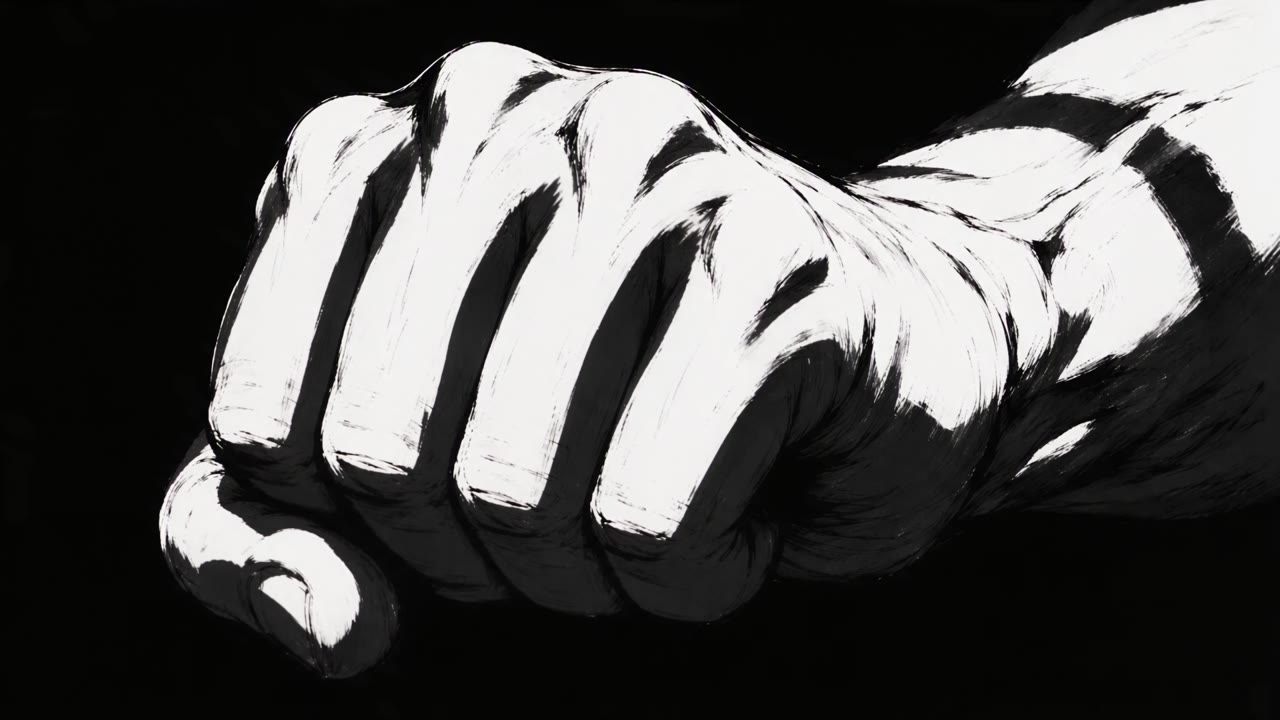
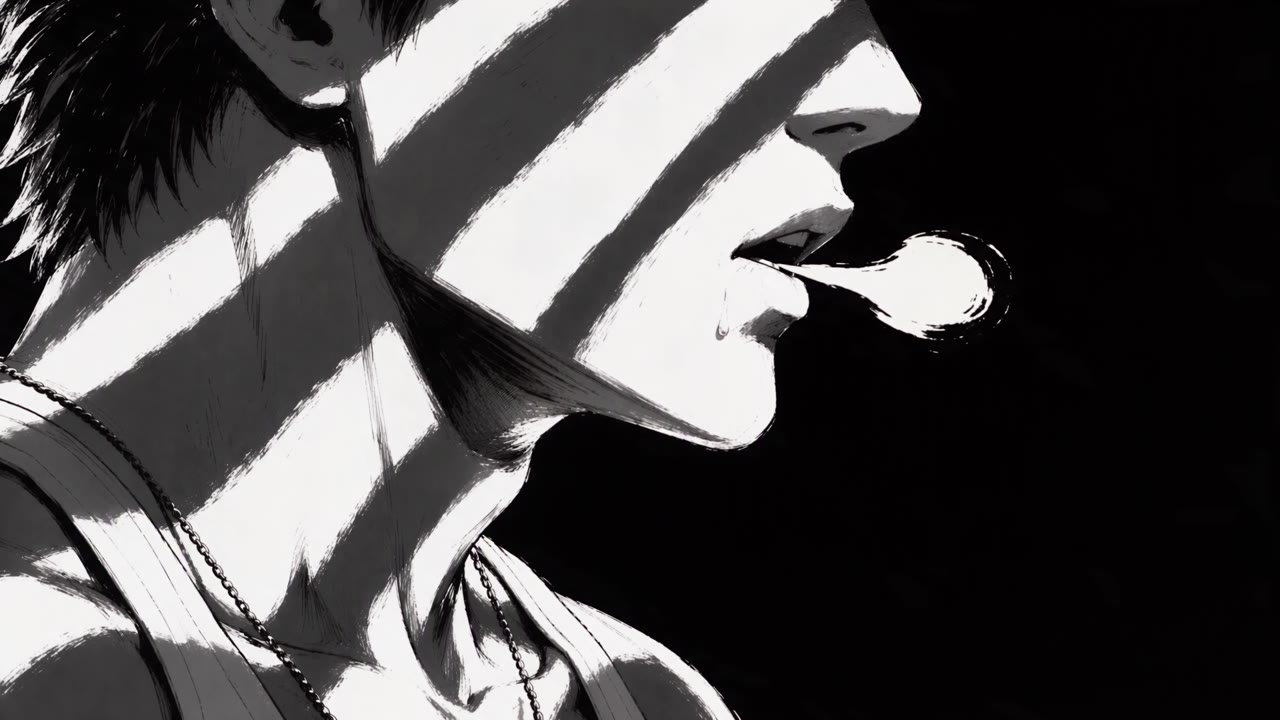
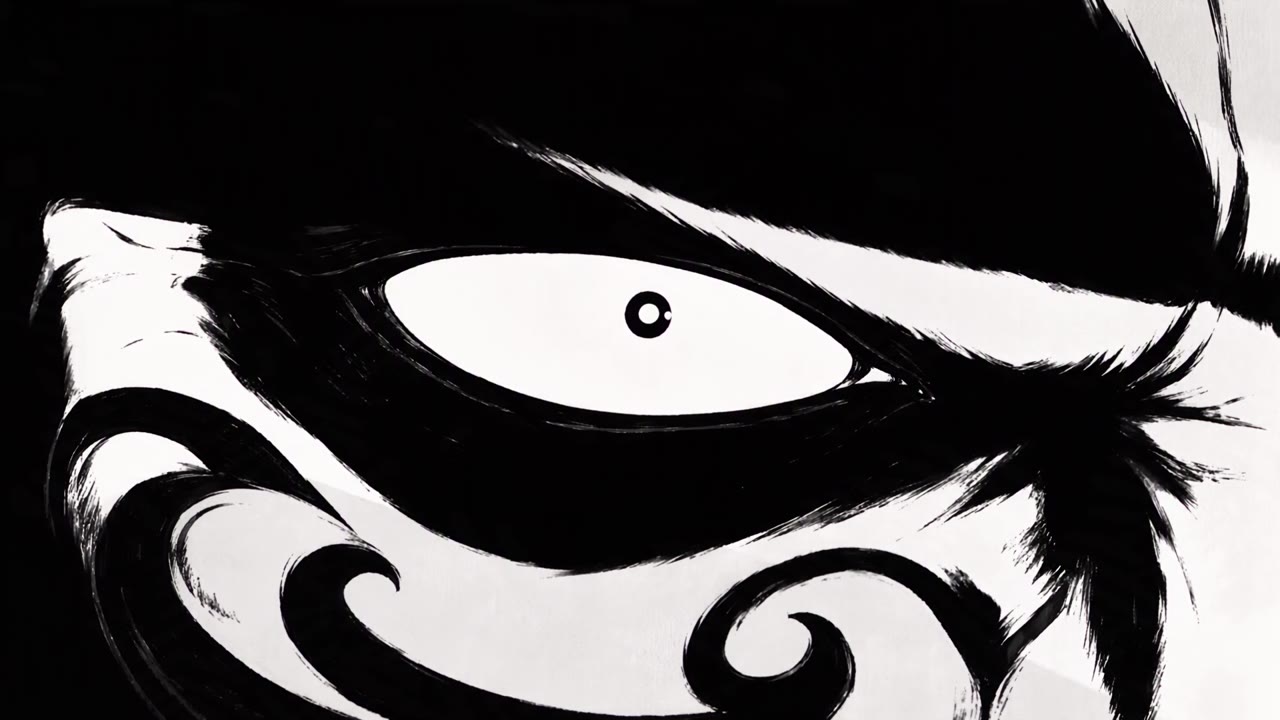
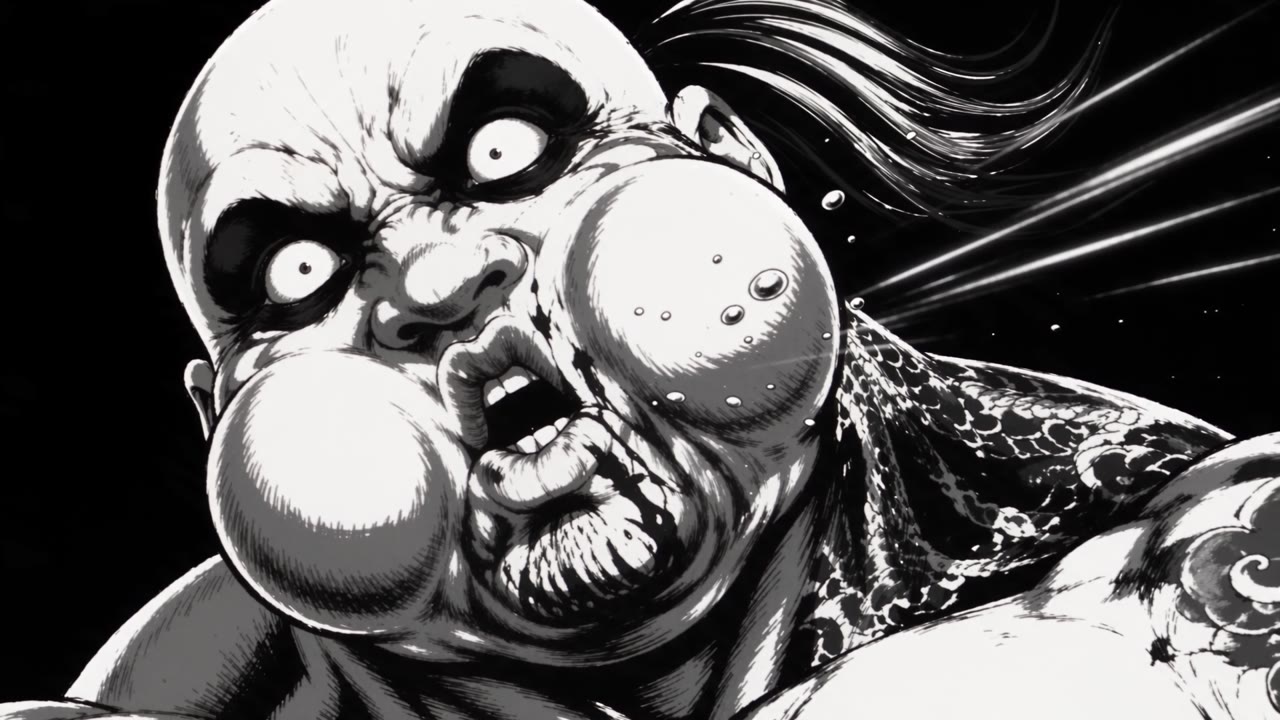
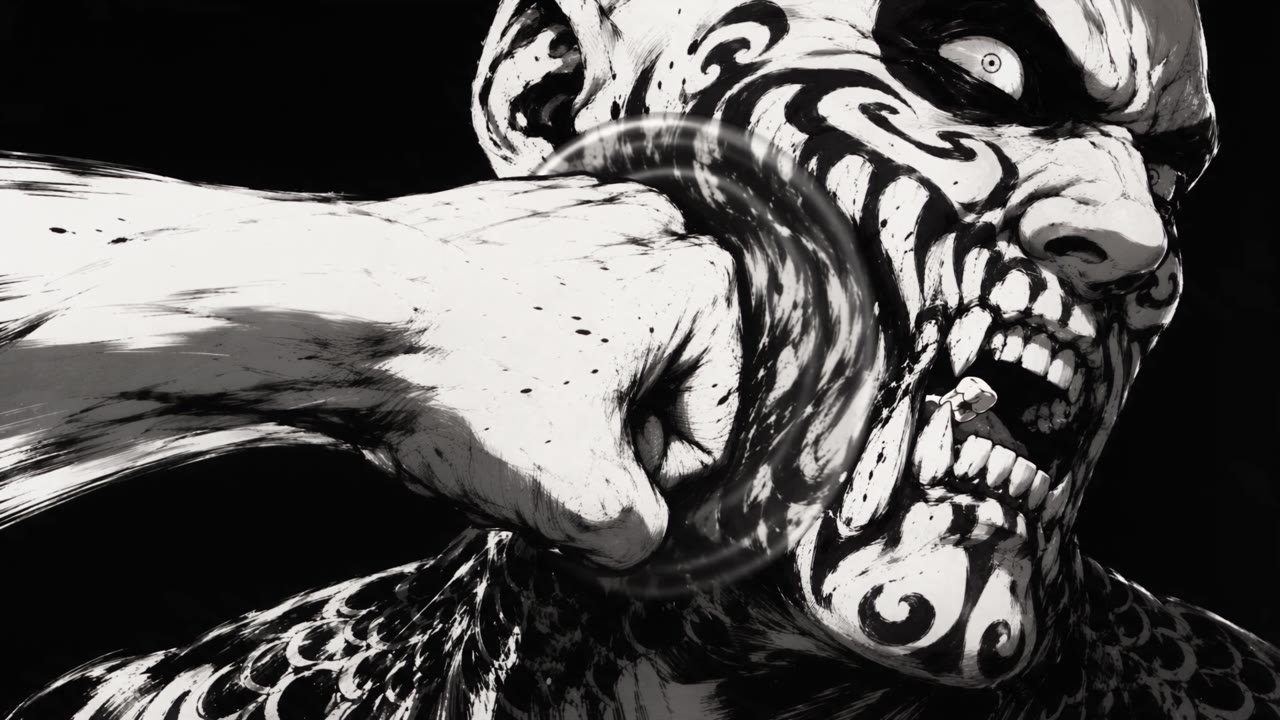
The first plates from the plate pack: Gurendo's eye, fist, laugh and loading. The look to match: stark ink, slatted light across the forms. Use I02 and I03 as style references for the contact inserts.
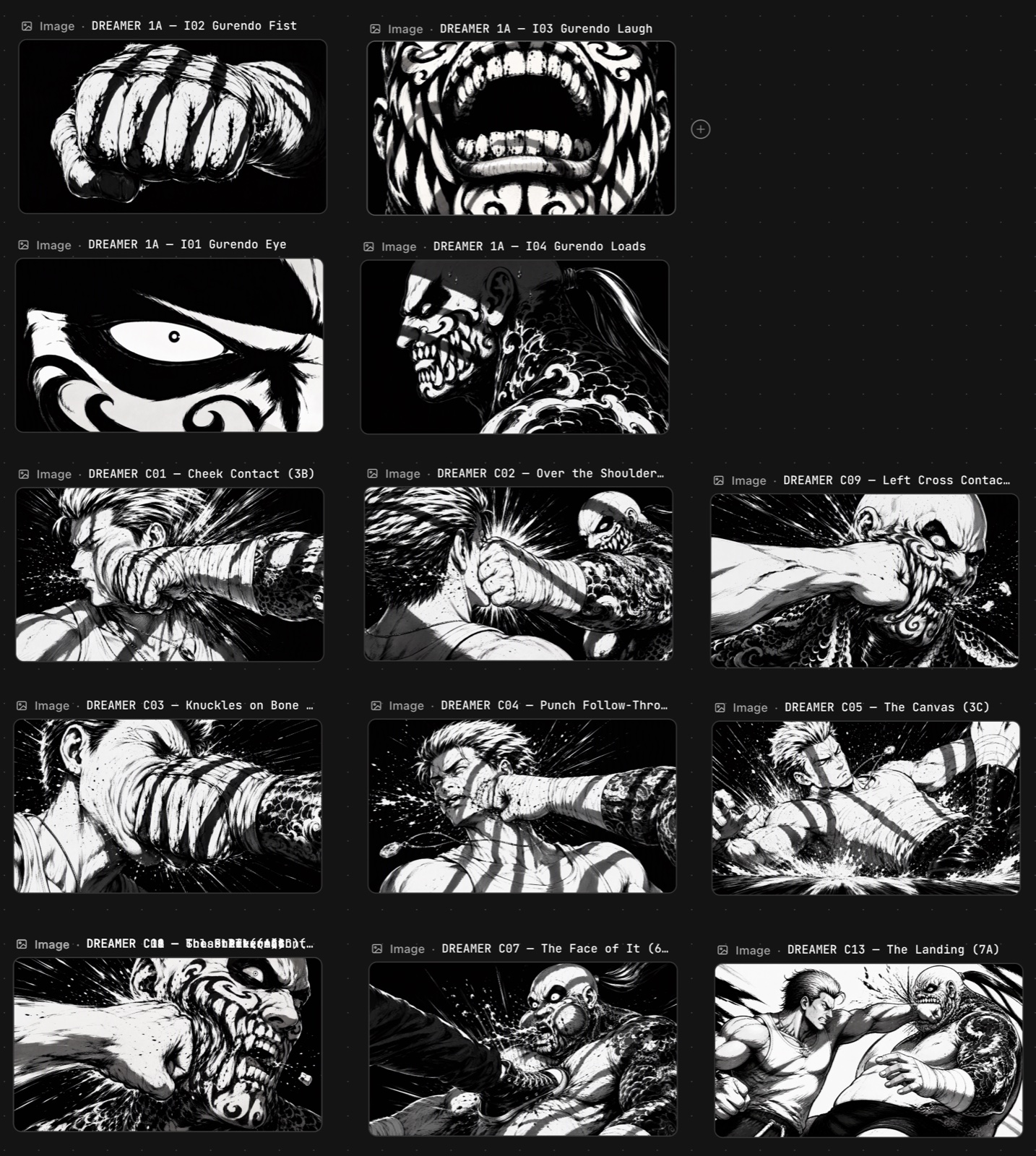
Plates so far: I01–I04 and C01–C13
View larger ↗
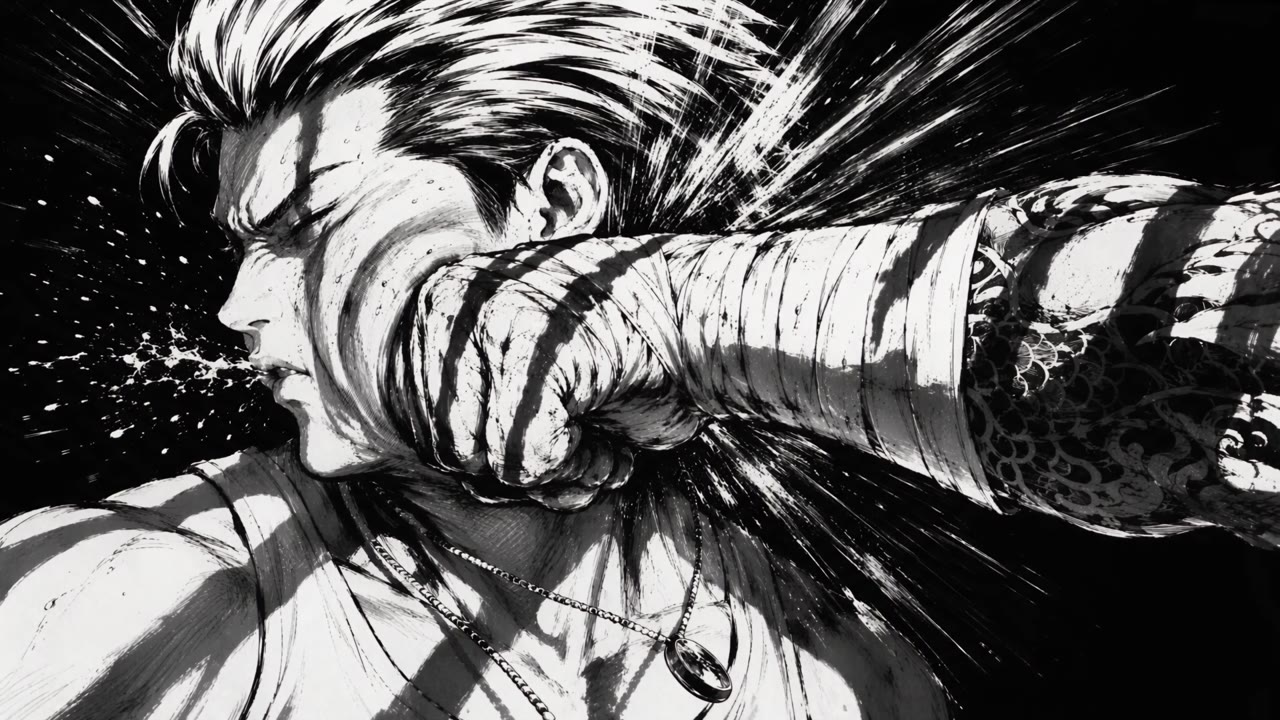
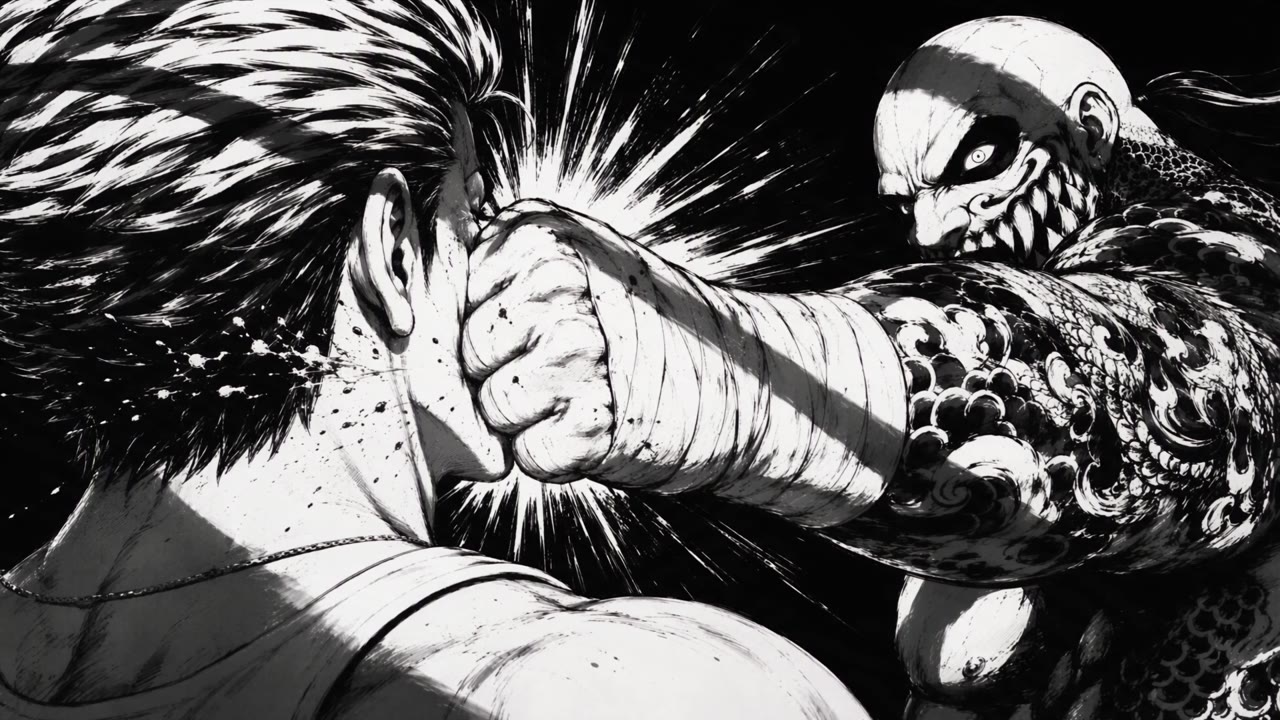
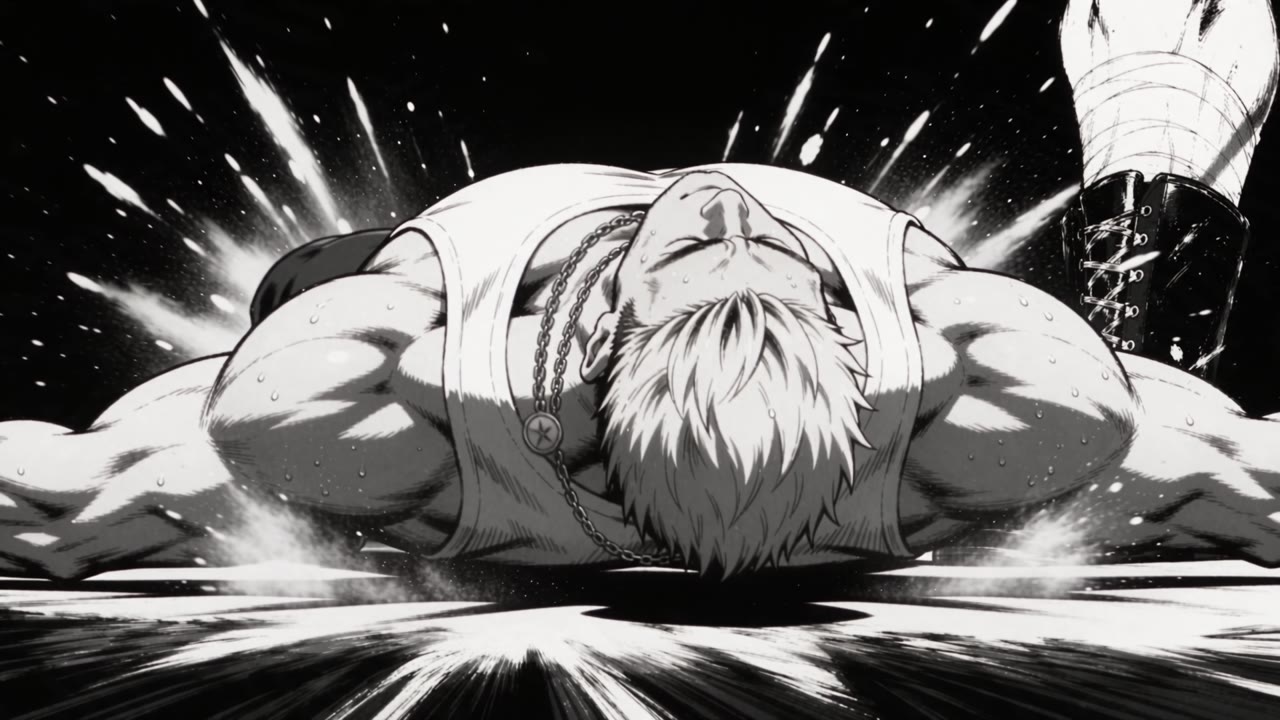
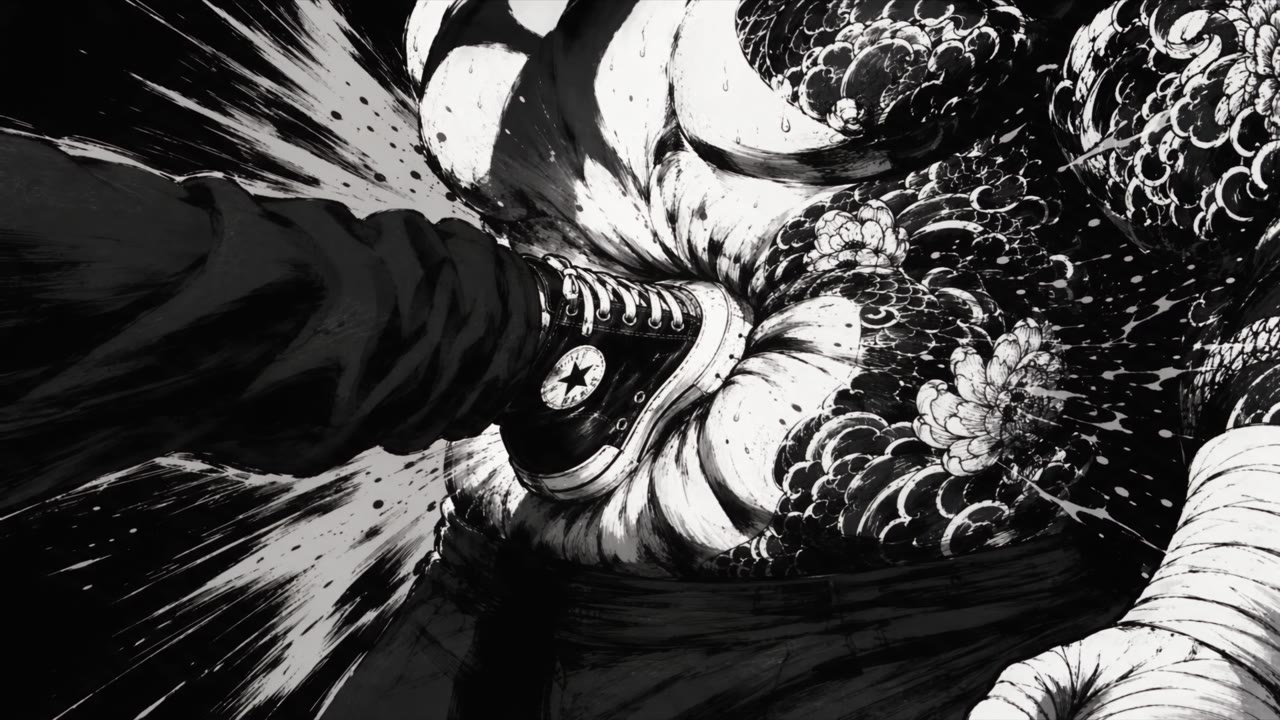
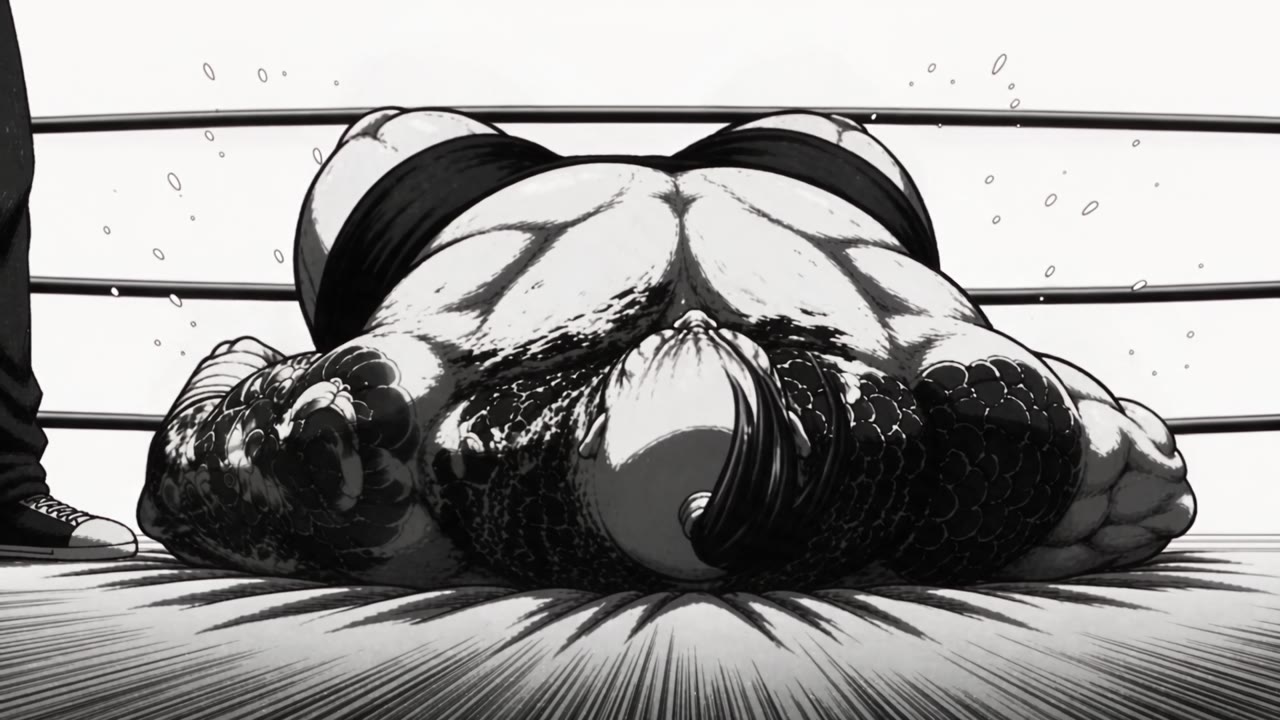
The title plates made so far. C13 came back as a wide cross rather than Gurendo hitting the canvas; rerun it for the landing.
Plate pack: 4 title plates and 17 fight inserts
DREAMERS — TITLE SEQUENCE PLATES (SHOT 1A)

Create a set of still plates for the opening title of Dreamers, a black-and-white manga noir animated short. The plates are references for animating the title, so each is a separate, clean, finished image: 16:9, highest available resolution. Black and white only, with no colour anywhere. Do not add CRT, scanline, glitch, pixel, chromatic or screen effects; those are added in post.

THE SHOT THESE PLATES SERVE: a flat black plate with DREAMER cut out of it. Through the letters we see a rapid-fire edit of extreme close-ups from a brutal underground fight. The camera pushes in on the A until its thick left stroke fills the frame, then the frame flashes to white.

PART 1: TITLE PLATES

Typography, for every title plate: DREAMER in big, heavy, modern sans-serif block capitals, in the spirit of the Enter the Void opening titles. A black-weight grotesque or geometric sans, in the family of Helvetica Neue Black, Akzidenz-Grotesk Super or Futura Extra Bold: uniform stroke weight, flat terminals, sharp square corners, no serifs. Tight kerning: the letters almost touch, separated only by thin slivers. One line, centred, spanning about 90% of the frame width, the letters tall and heavy so that each stroke is a wide window. Perfectly clean, crisp vector edges. The type is not hand-painted, brushed, distressed, stencilled, outlined, italic or decorative.

T1. Title matte. A pure flat black frame with DREAMER in pure flat white, set as described. Nothing else in the frame: no texture, gradient, glow, shadow or grain. The white letters will be used as a compositing matte.

T2. Title frame. The same pure black plate, with DREAMER cut out of it so the letter shapes are openings. Behind the plate, filling the frame, is insert I01 (below), visible only through the letters. Bright white highlights glow through the openings; the plate itself stays flat, pure black. The frame reads first as type, then as the image inside it.

T3. The push, halfway. The camera has pushed in toward the A. The A is centred and about twice its height in T2; the R and M are cropped by the frame edges, and the other letters are out of frame. Through the openings: insert I02.

T4. The push, at the end. Closer still: the A's thick left stroke fills almost the whole frame, with only slivers of black plate at the edges, so the frame is nearly all image: insert I03, its brightest points blowing out toward white.

PART 2: FIGHT INSERTS

Style, for every insert: a hand-drawn 2D animation keyframe in the visual language of an adult black-and-white manga and noir graphic novel. Black ink and white paper only. Extreme close-up, the subject filling the frame edge to edge, its key shapes in the middle band of the frame, where the letters will sit. Built from big, simple shapes: large solid black shadows, bright white highlights, confident brush contours with rough dry-brush edges, and very little fine detail. One hard light, extreme chiaroscuro, the background lost to pure black. No grey wash, gradients, screentone, photographic texture or 3D-render look. No text except where an insert says so. No logos, borders or panel lines.

Cast. Attach the matching character sheet where one is named.
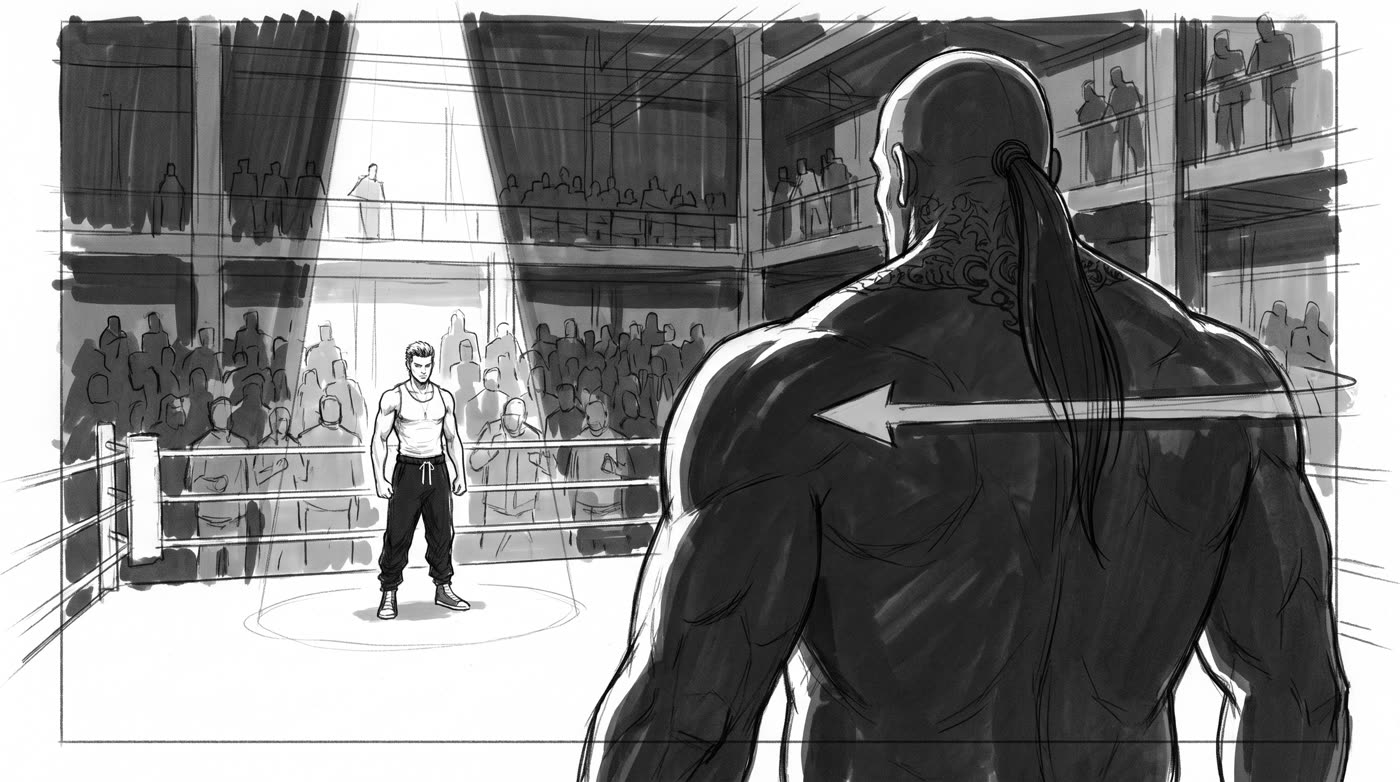
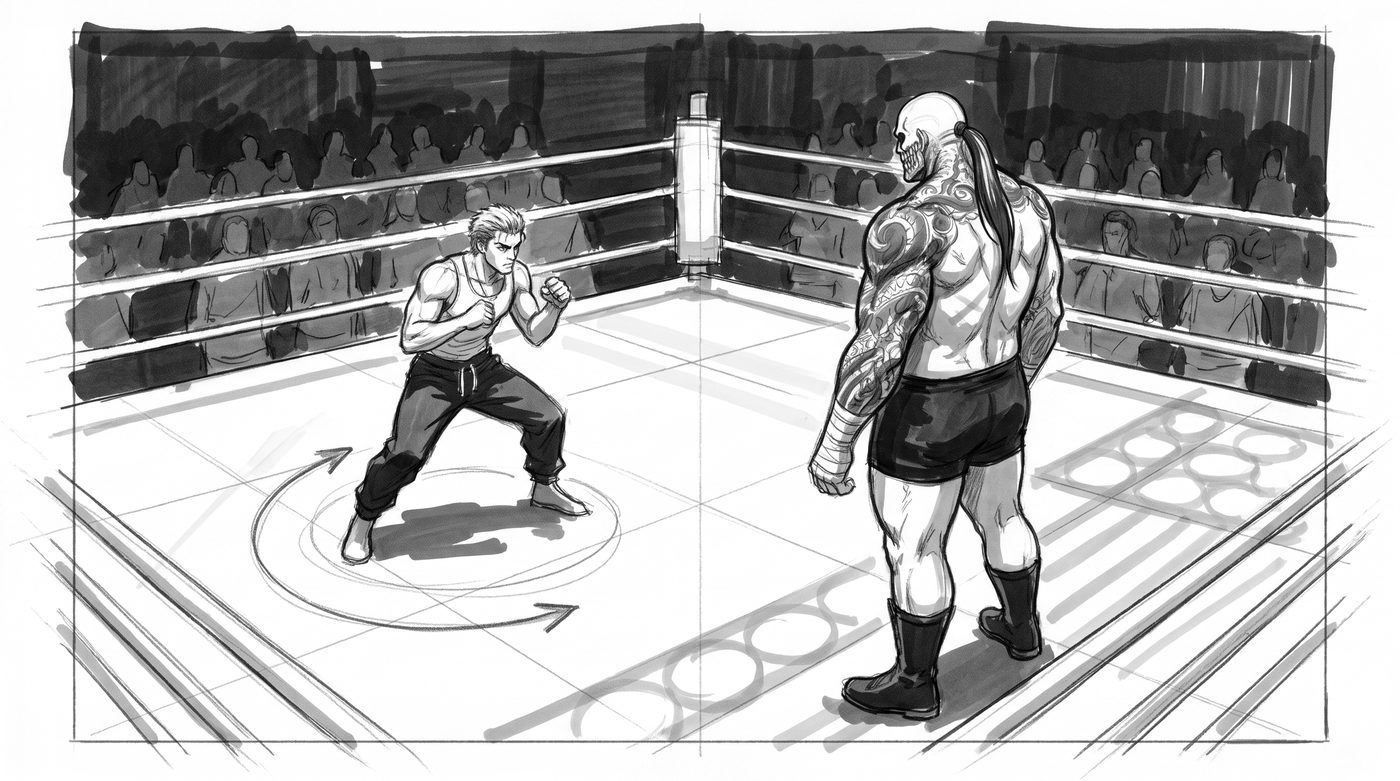
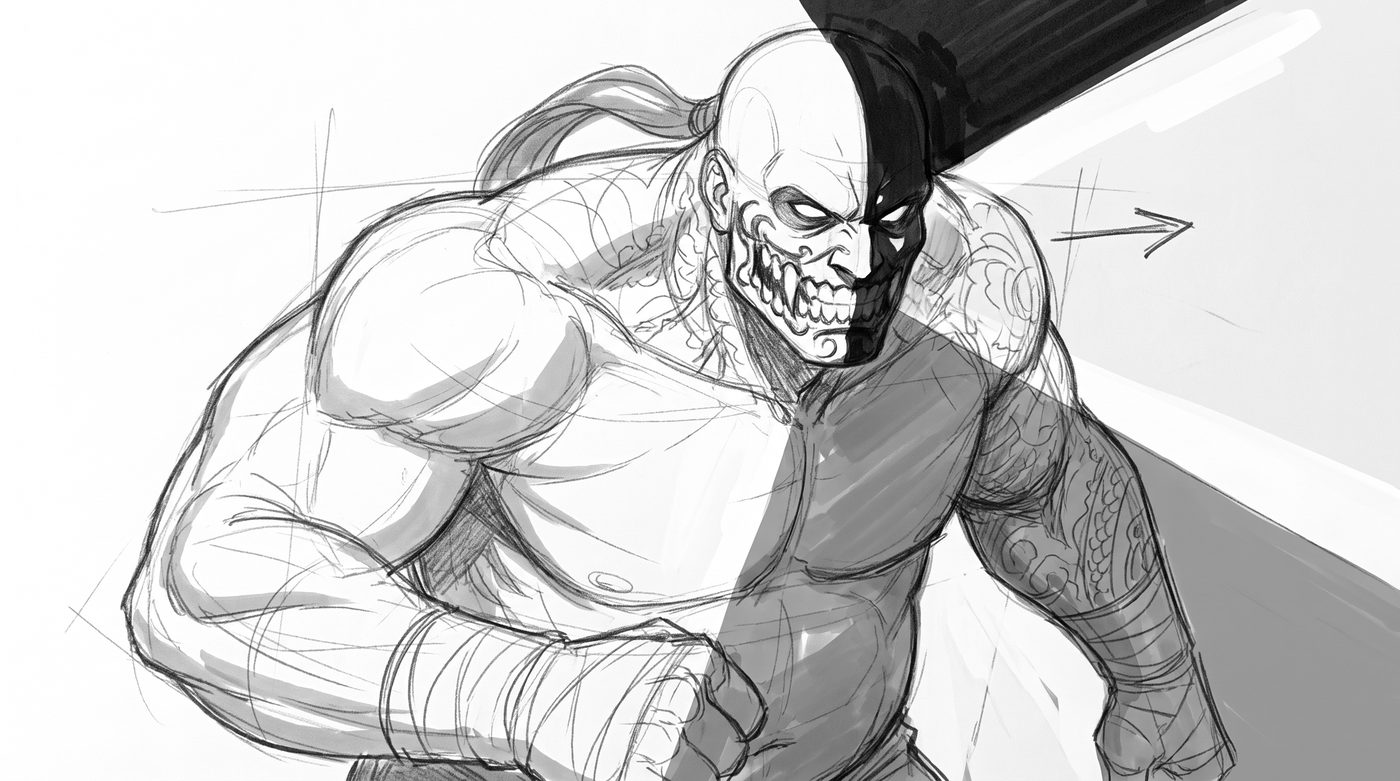
- Gurendo: a heavyweight with a tattooed face and body, black tattooed patches around the eyes, a ponytail and wrapped wrists.
- The protagonist: tall and lean, white tank top, frosted slicked-back hair, a gold pendant on a chain.
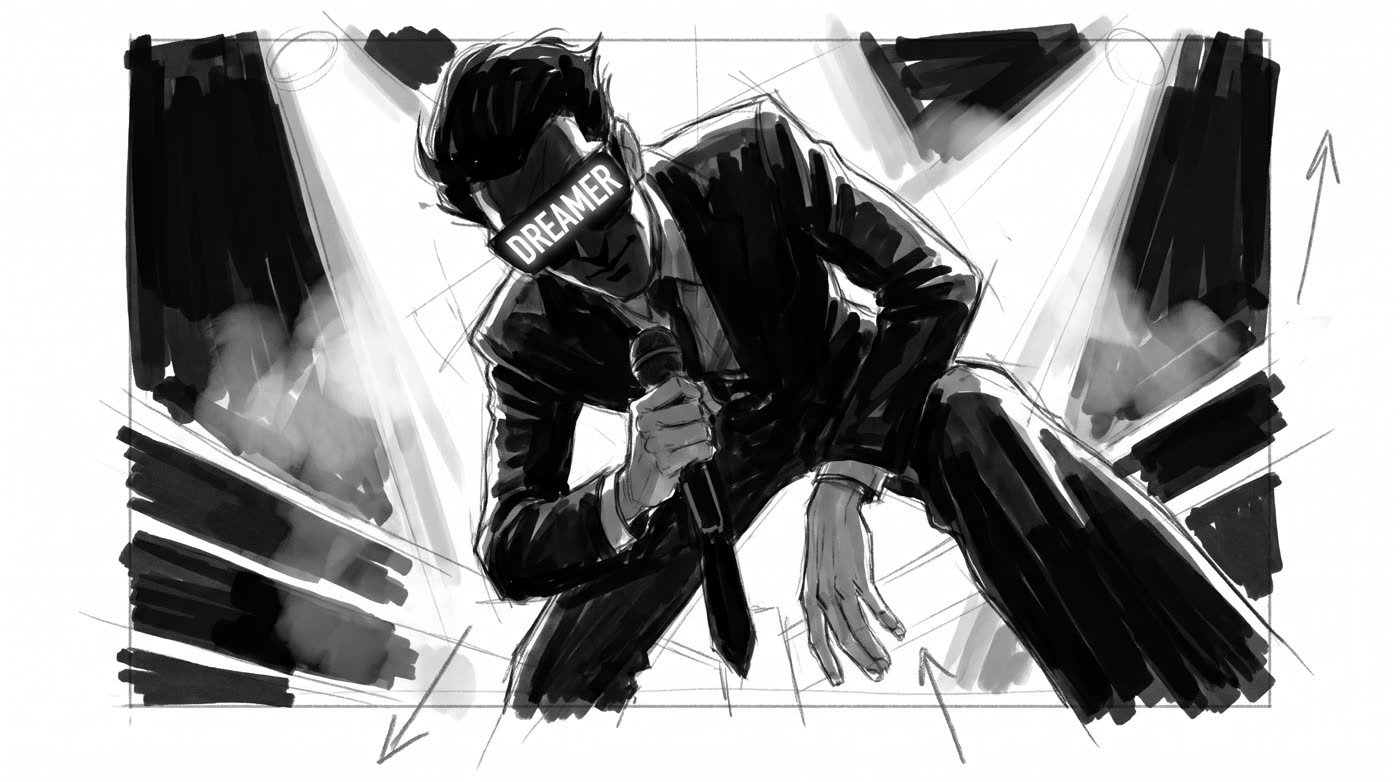
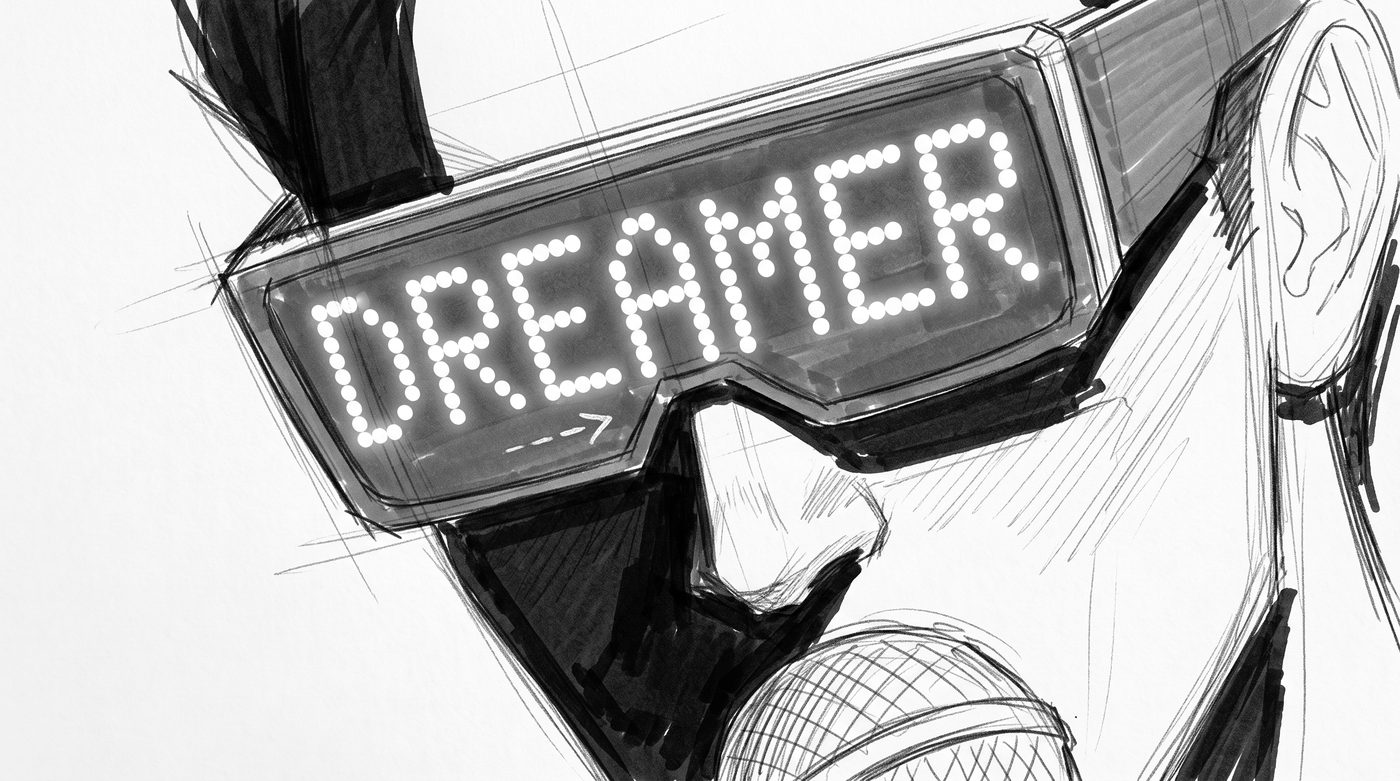
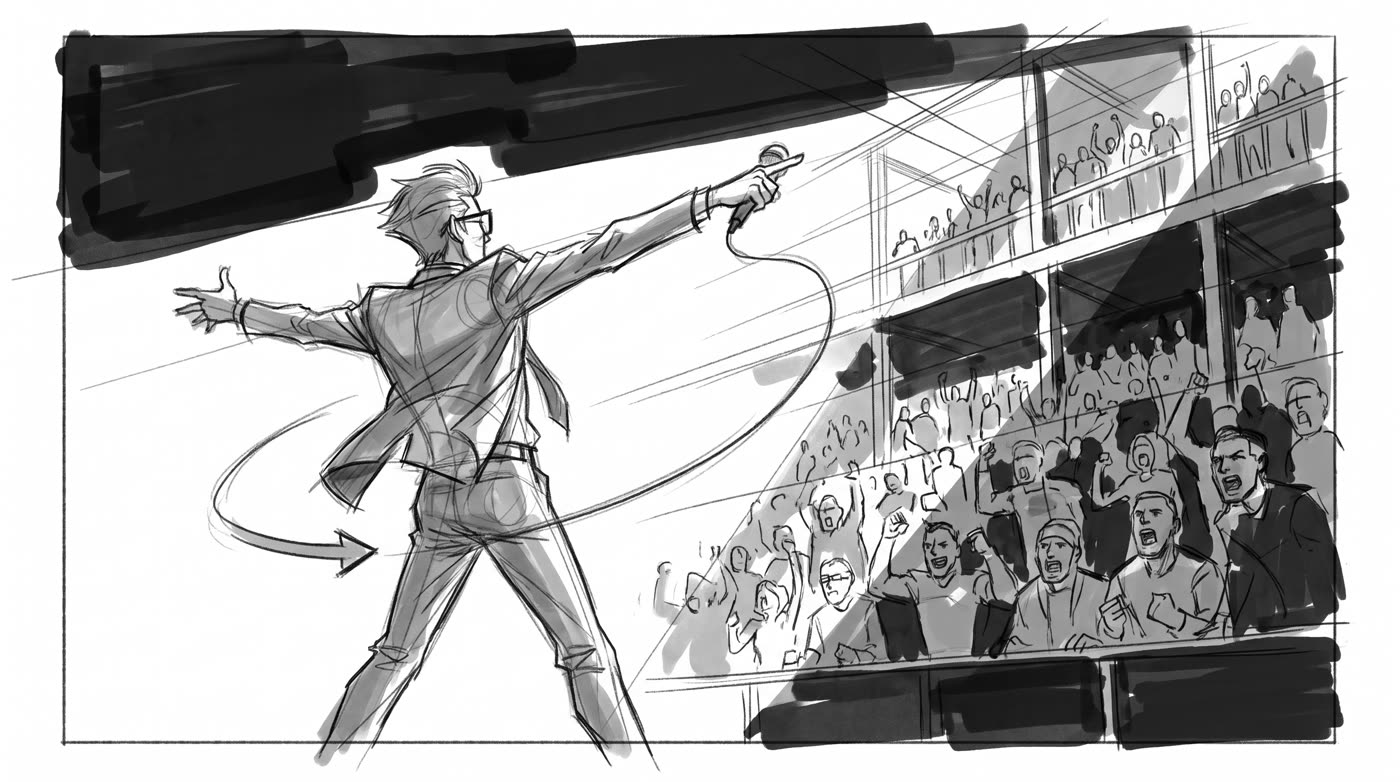
- Mr. Zig: the ring announcer, black suit, microphone, glasses with DREAMER lettered in white LED dots across the lenses.

Each insert gives the subject, then a line on how it will move when animated.

Gurendo
I01. Gurendo's eye. One eye, wide open, ringed by a black tattooed patch, a thin bright catchlight, brow and cheekbone cropped by the frame. A band of hard light lies across it. Moves: the pupil snaps to the lens; the band of light slides off.
I02. Gurendo's fist. A huge wrapped fist driving straight at the lens, the forearm foreshortened behind it, the wraps frayed and stained with black blood, the knuckles split. Moves: surges forward in three or four frames into a smear.
I03. The laugh. Gurendo's open mouth mid-laugh, teeth bared and bloodied, tattooed lips and chin, light raking across the teeth from above. Moves: the jaw drops wider; the head tips back.
I04. Gurendo loads. His tattooed jaw, neck and one shoulder in profile, sweat on the skin, the ponytail behind, a spot of light crossing his face. Moves: the shoulder rolls back; the light leaves his face.

The protagonist
I05. His eye. One eye in deep shadow under frosted, slicked-back hair, narrowed and fixed, one band of light across it. Moves: the eye opens from narrowed, finding its focus.
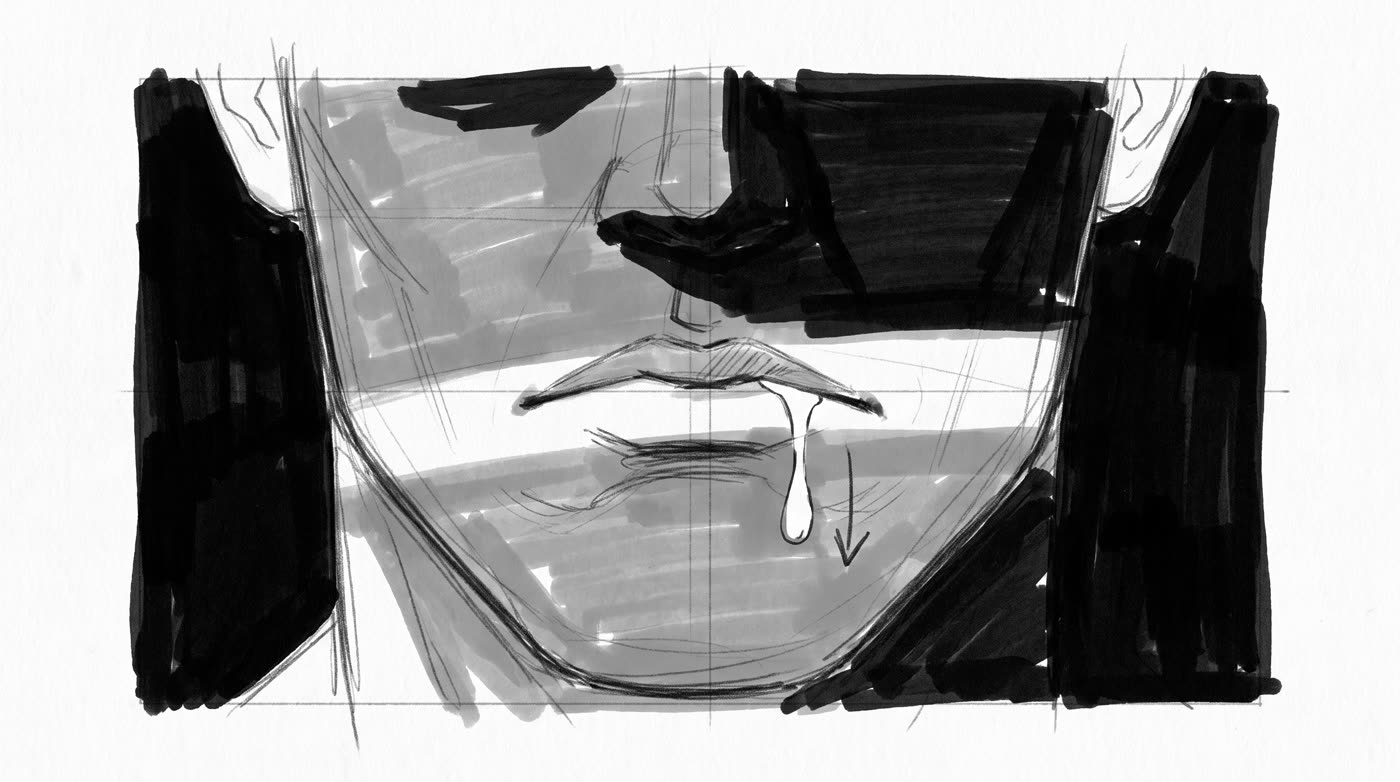
I06. Blood. His split lower lip, one drop of black blood falling from it, caught in a thin band of light. Moves: the drop gathers and falls.
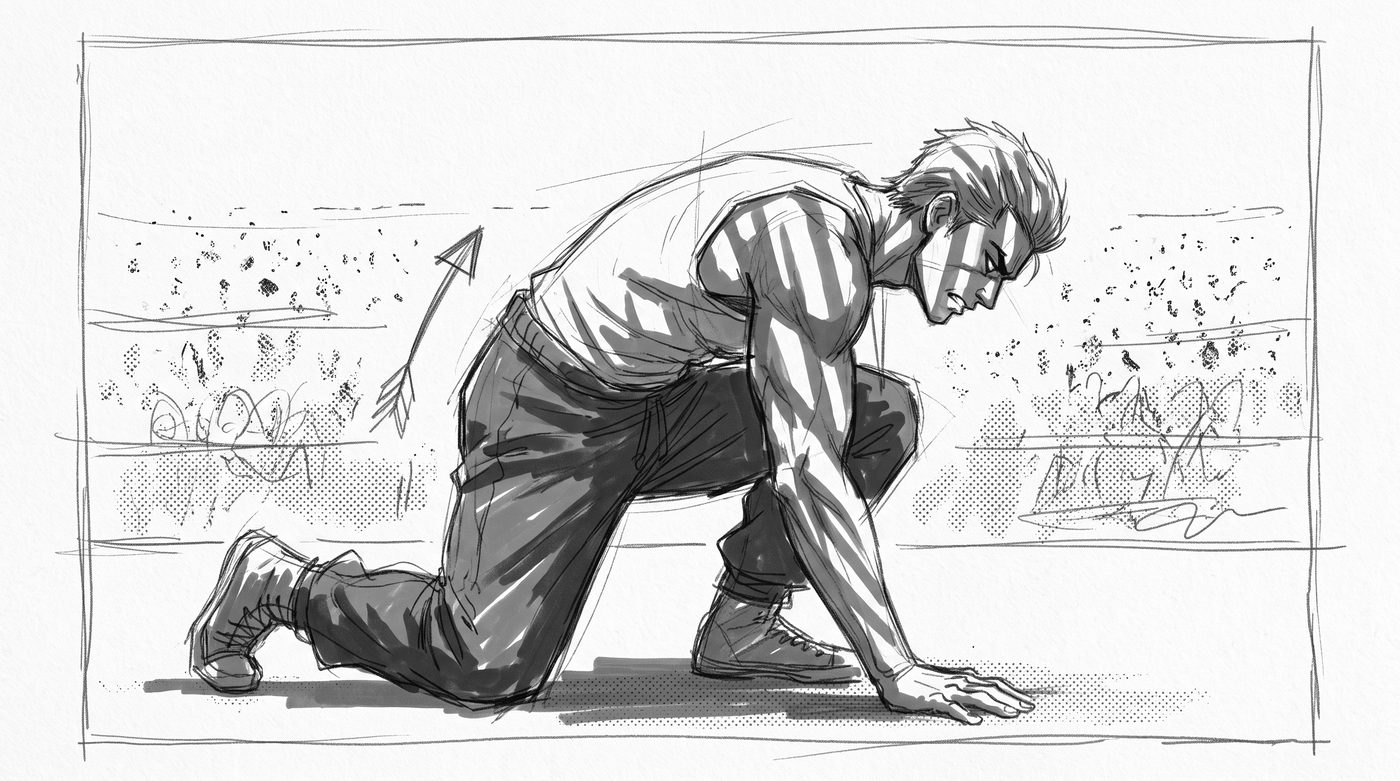
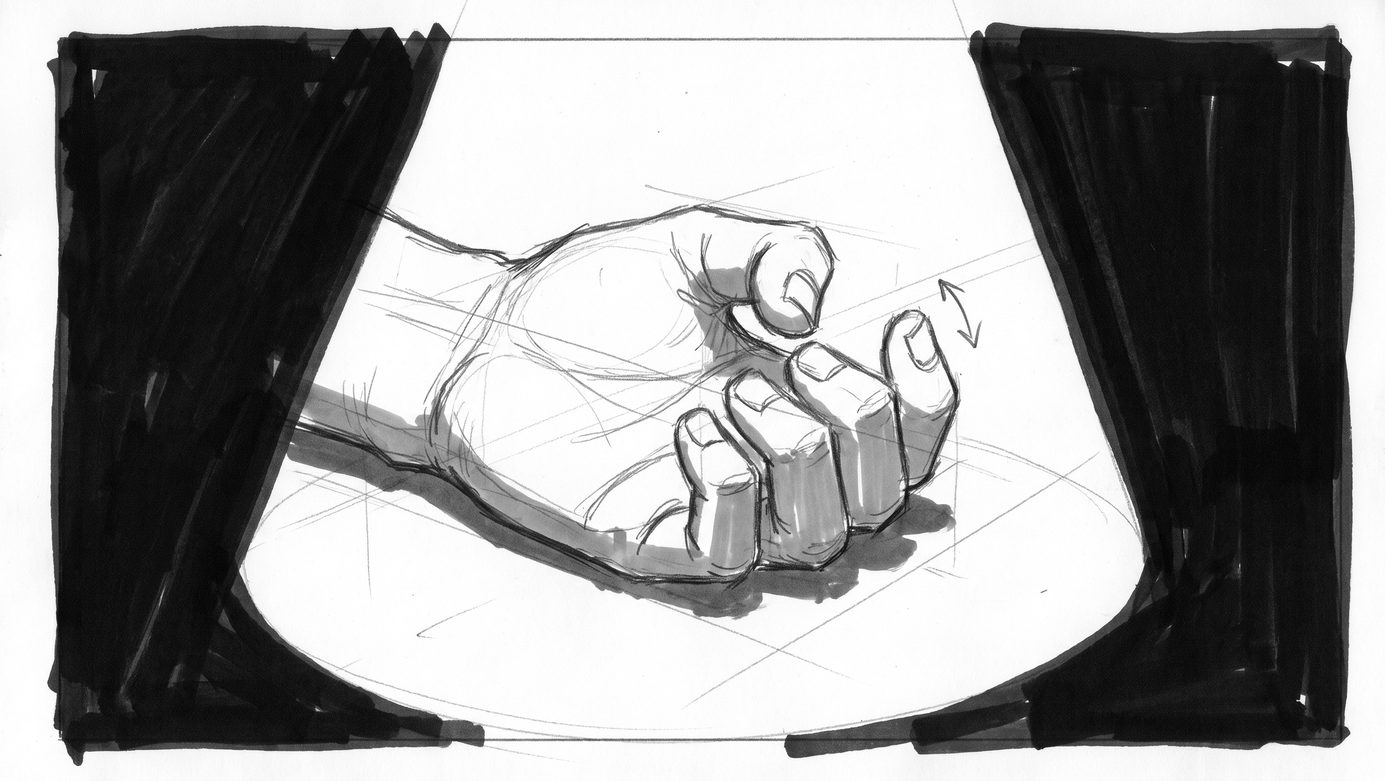
I07. The clench. His hand flat on the canvas, the fingers beginning to curl, light on the knuckles. Moves: release, gather, clench.
I08. The pendant. A pendant on a chain flying up off his chest mid-fall, flaring white as it catches a spotlight. Moves: swings and flashes.
I09. The step. A high-top sneaker planting hard on the canvas, a rope's shadow across it. Moves: slams down; a puff of dust.

Mr. Zig
I10. The glasses. Zig's glasses, DREAMER glowing white across both lenses in LED dots, a microphone grille rising into the bottom of the frame. This is the only insert with text. Moves: the lettering scrolls.
I11. At the mic. Zig's mouth at the microphone mid-shout, lips stretched, the mic cord whipping across the frame. Moves: the shout; the cord whips.

The crowd and the arena
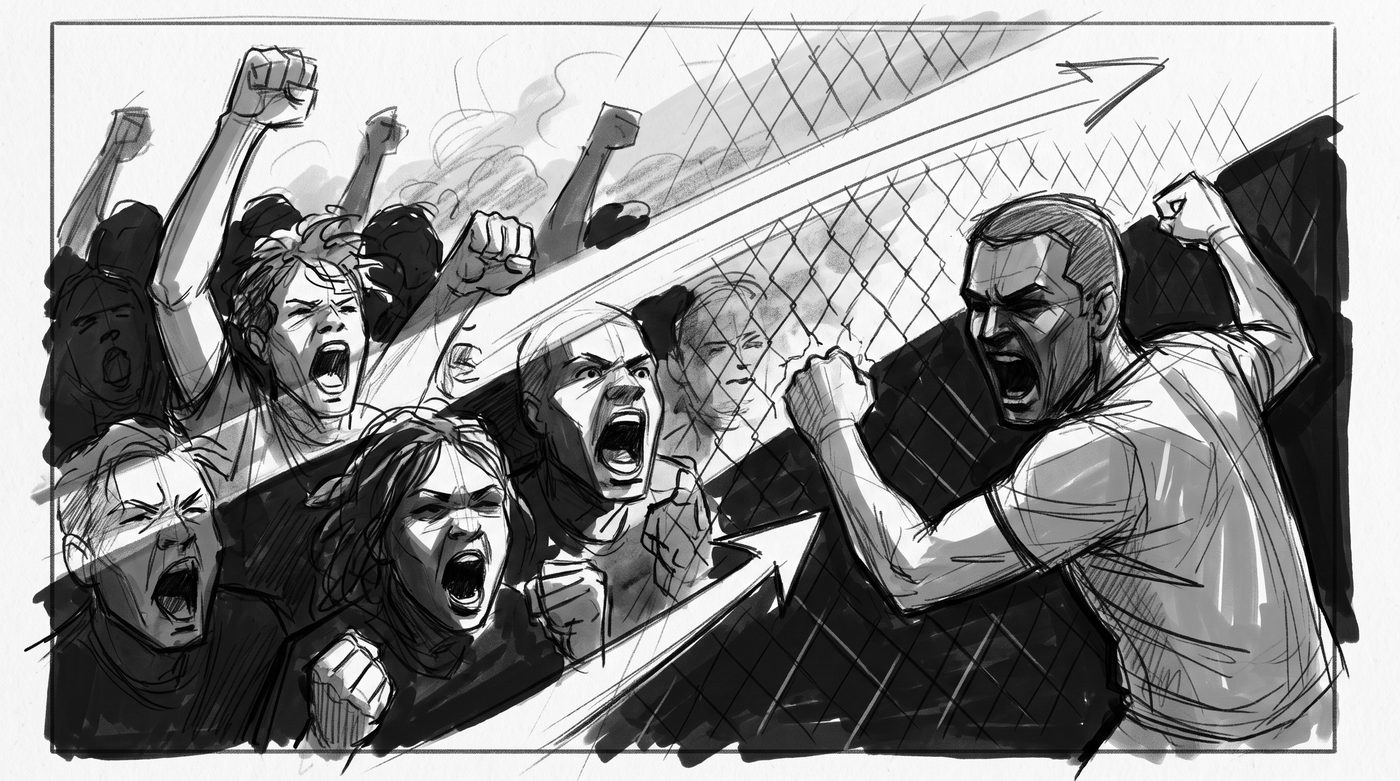
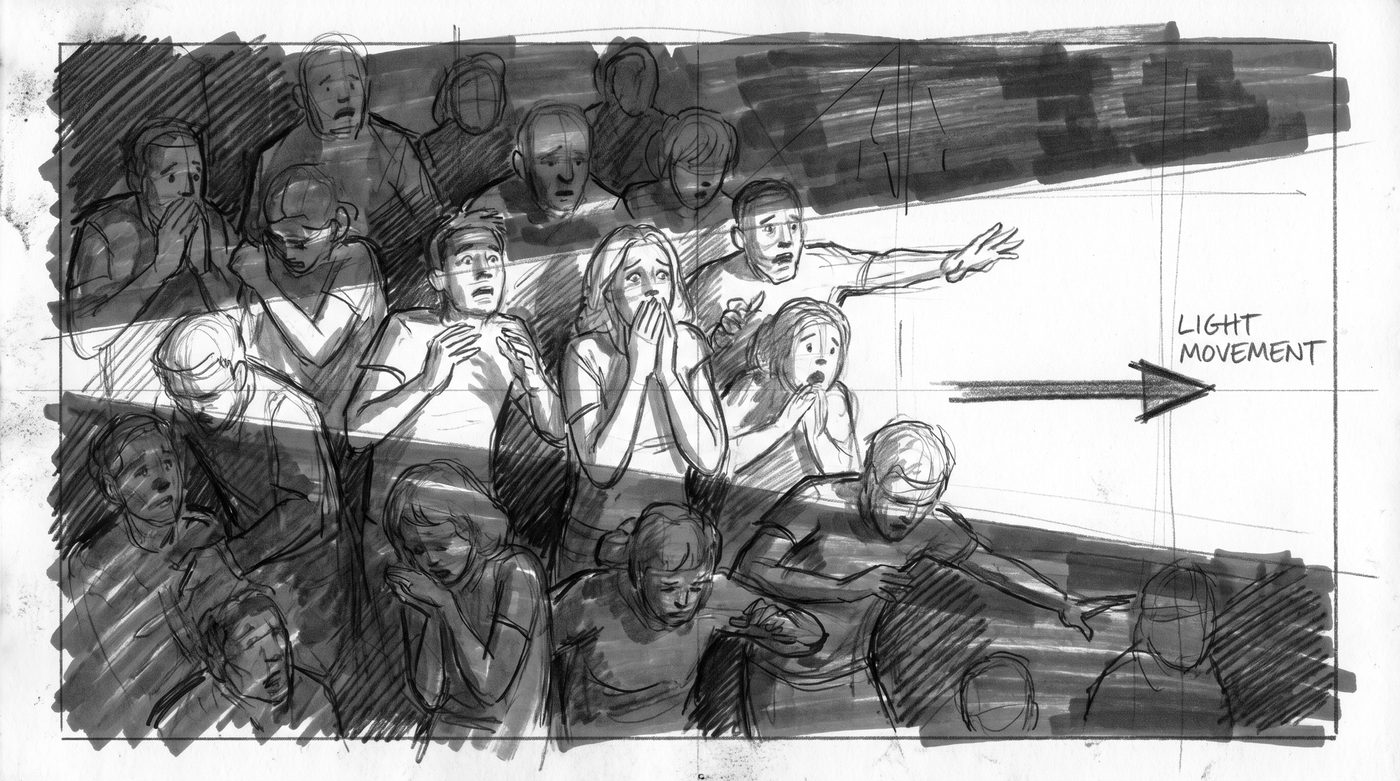
I12. The crowd. Three or four men screaming against a fence of square wire mesh, mouths wide, fingers hooked through the wire, faces cut out of the dark by a band of light. Moves: they surge against the wire.
I13. Fist on the fence. A fist hammering the square wire mesh, the mesh bowing, hard light behind it. Moves: the fist hits; the mesh shudders.
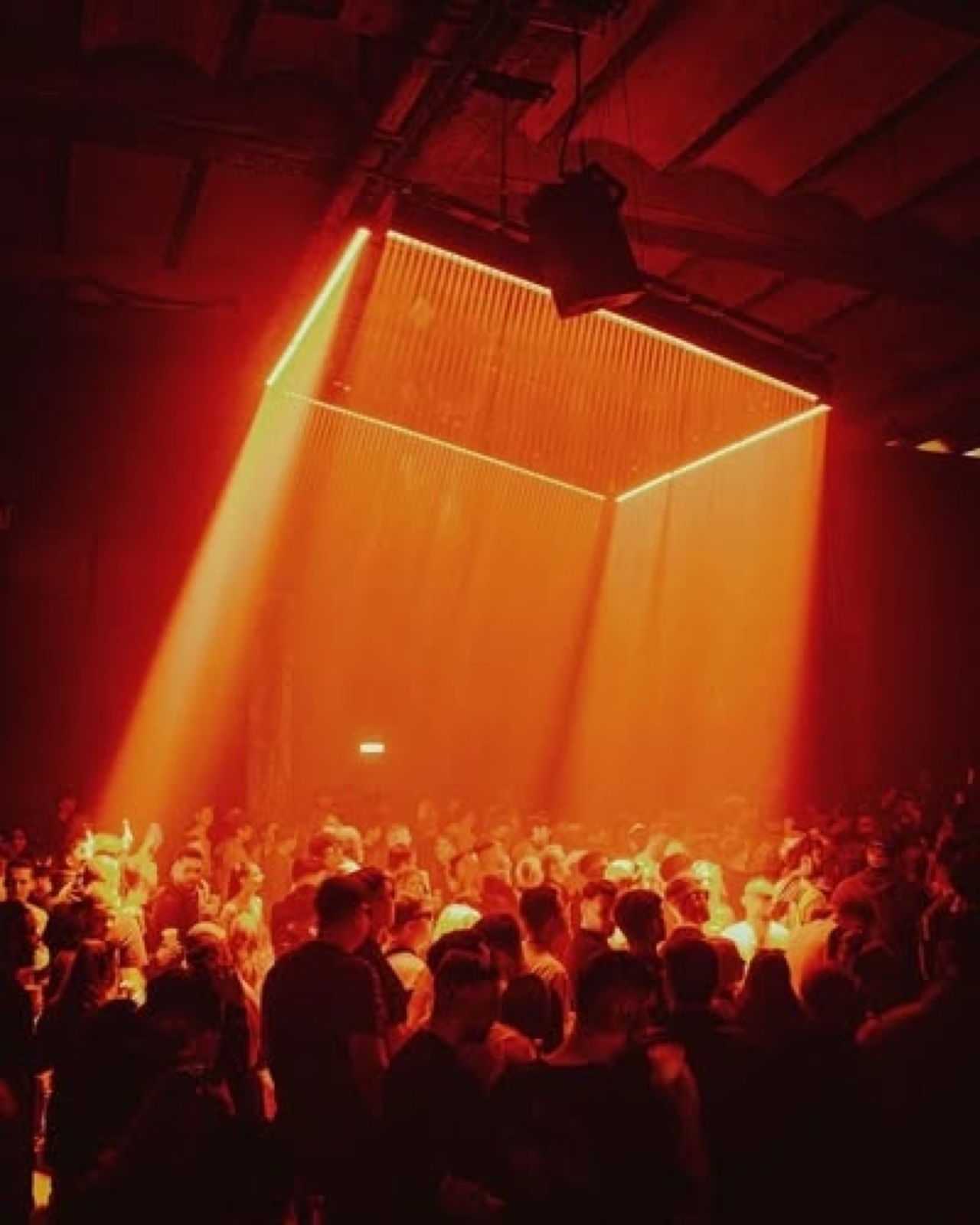
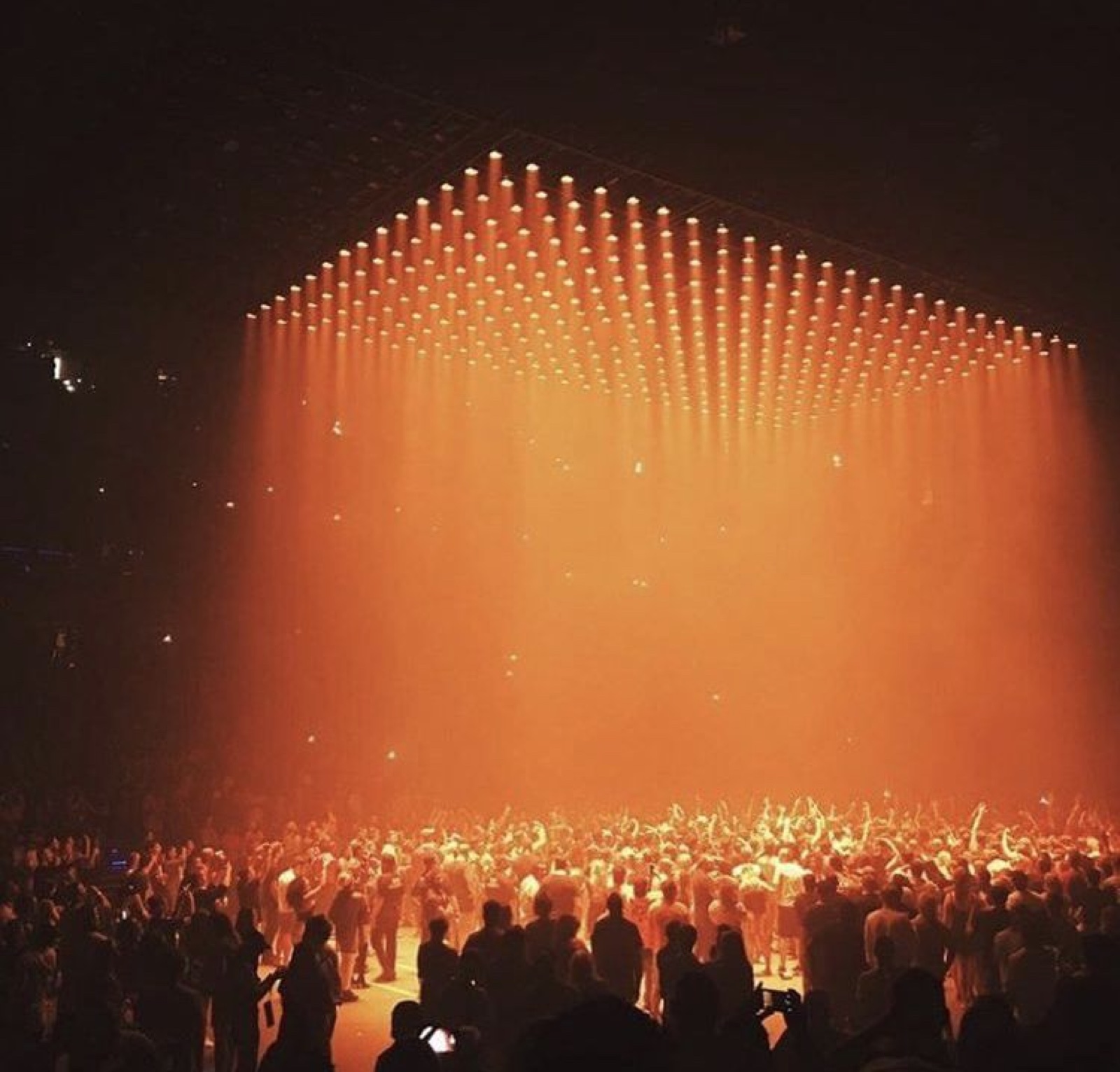
I14. The rig. Looking straight up into a rig of industrial spotlights through haze, the beams flaring into hard white rays. Moves: one spot swings on its cable.

The strikes (optional: flash-forwards to the knockout)
I15. The kick. A shin driving into a heavyweight's stomach, the body folding around it, white rays bursting from the contact. Moves: holds at contact while the rays pulse.
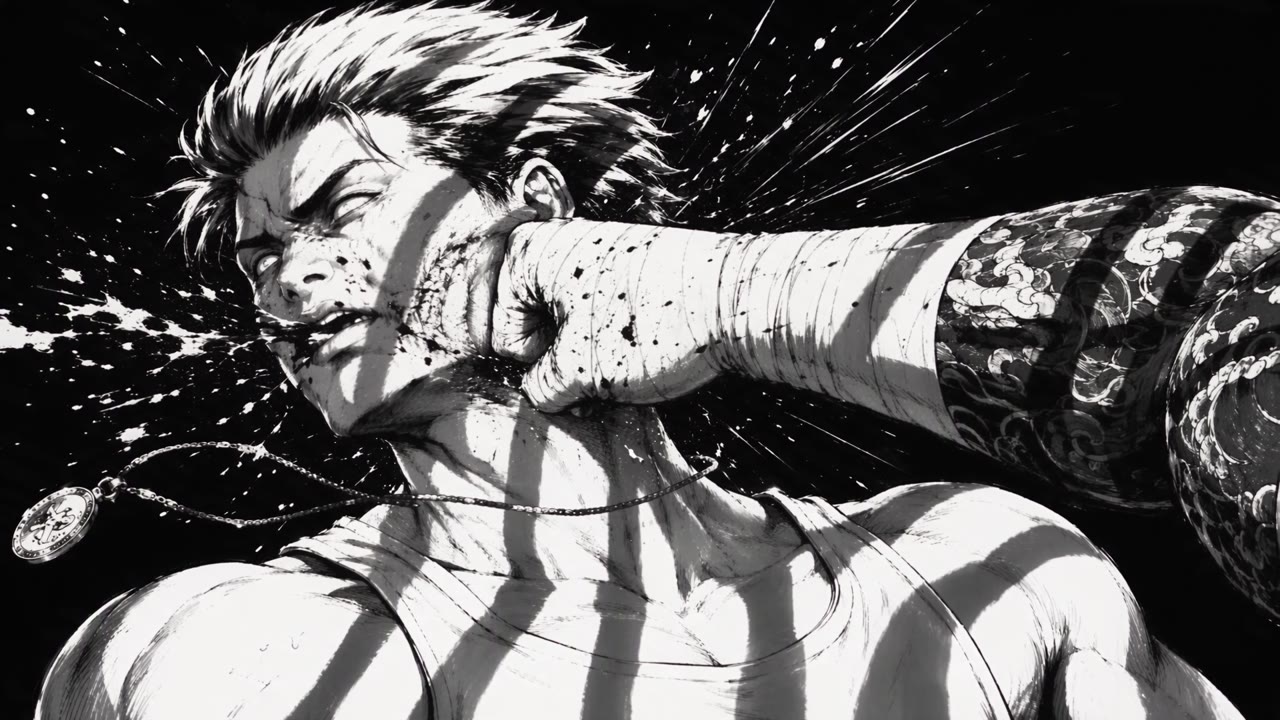
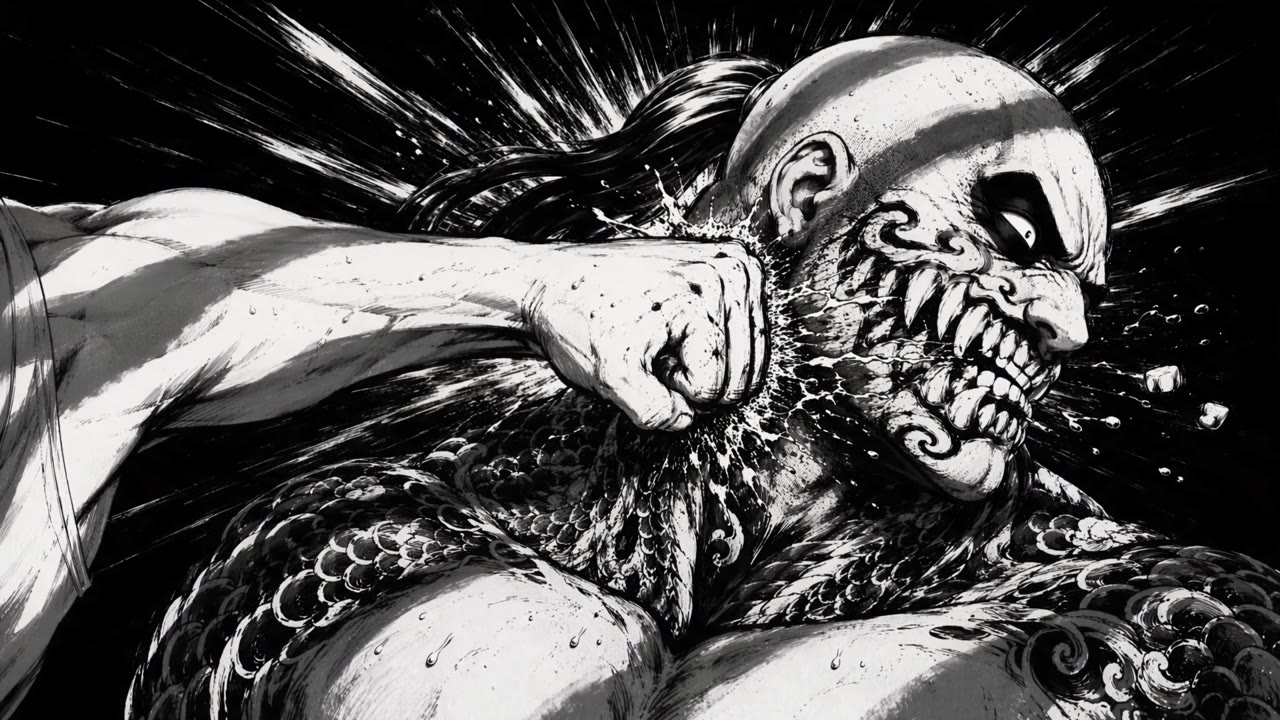
I16. The cross. A fist sinking into a heavyweight's cheek, the face deforming around it, teeth and droplets thrown out the far side. Moves: the deformation, in slow motion.
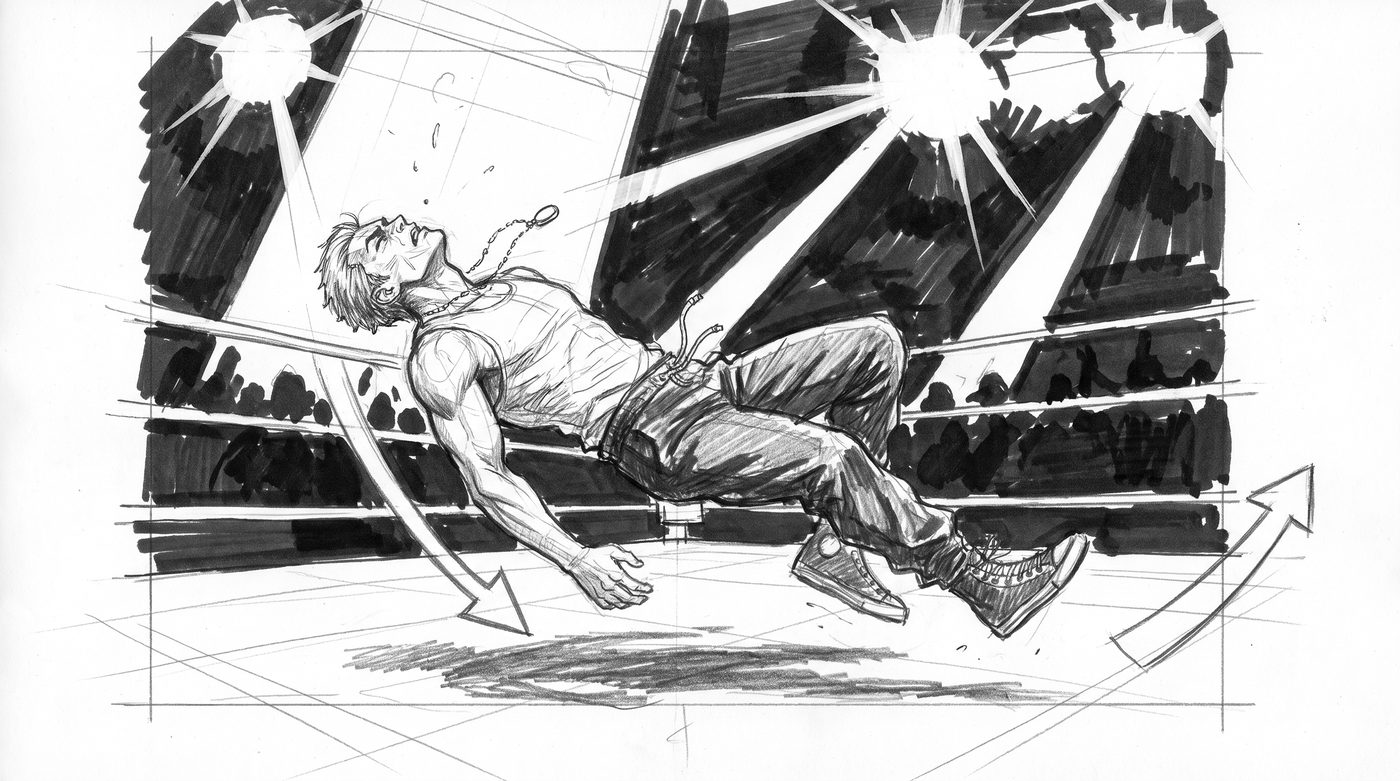
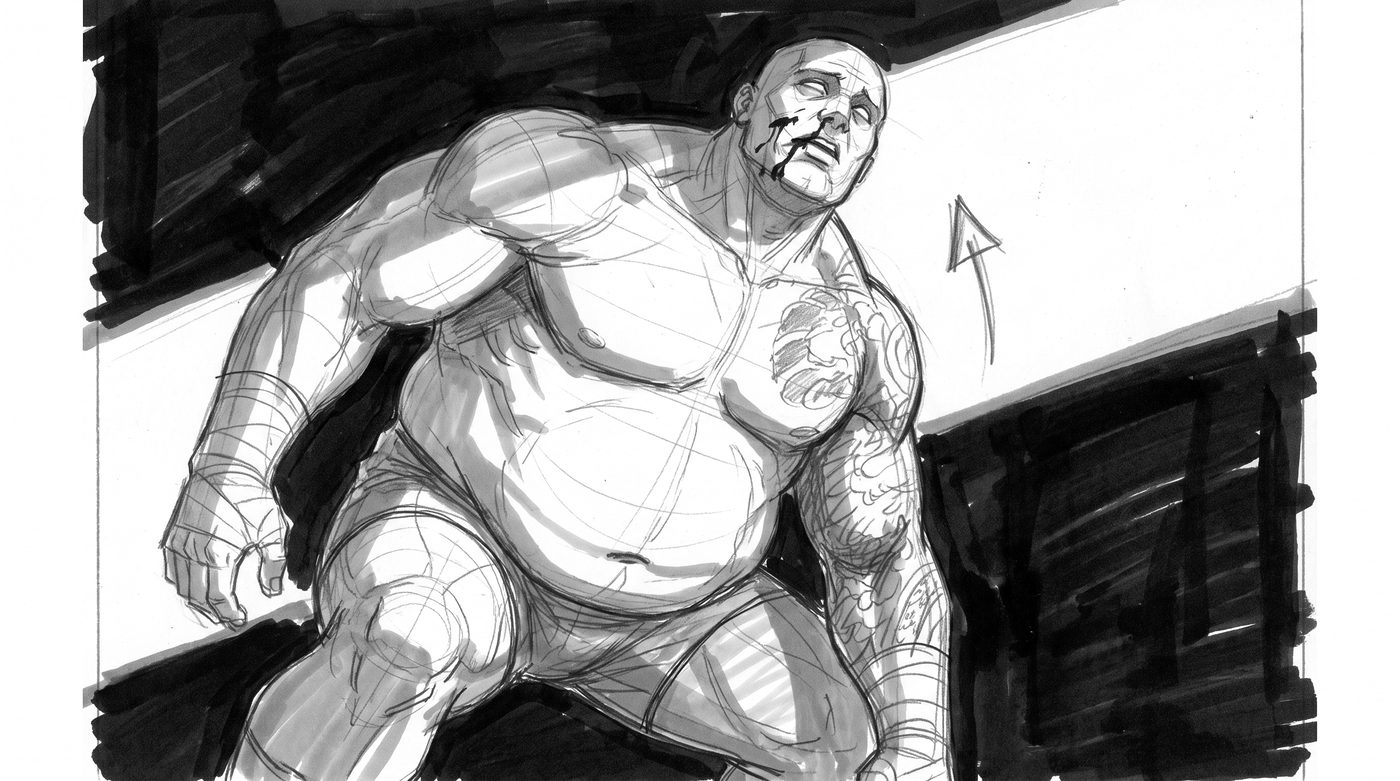
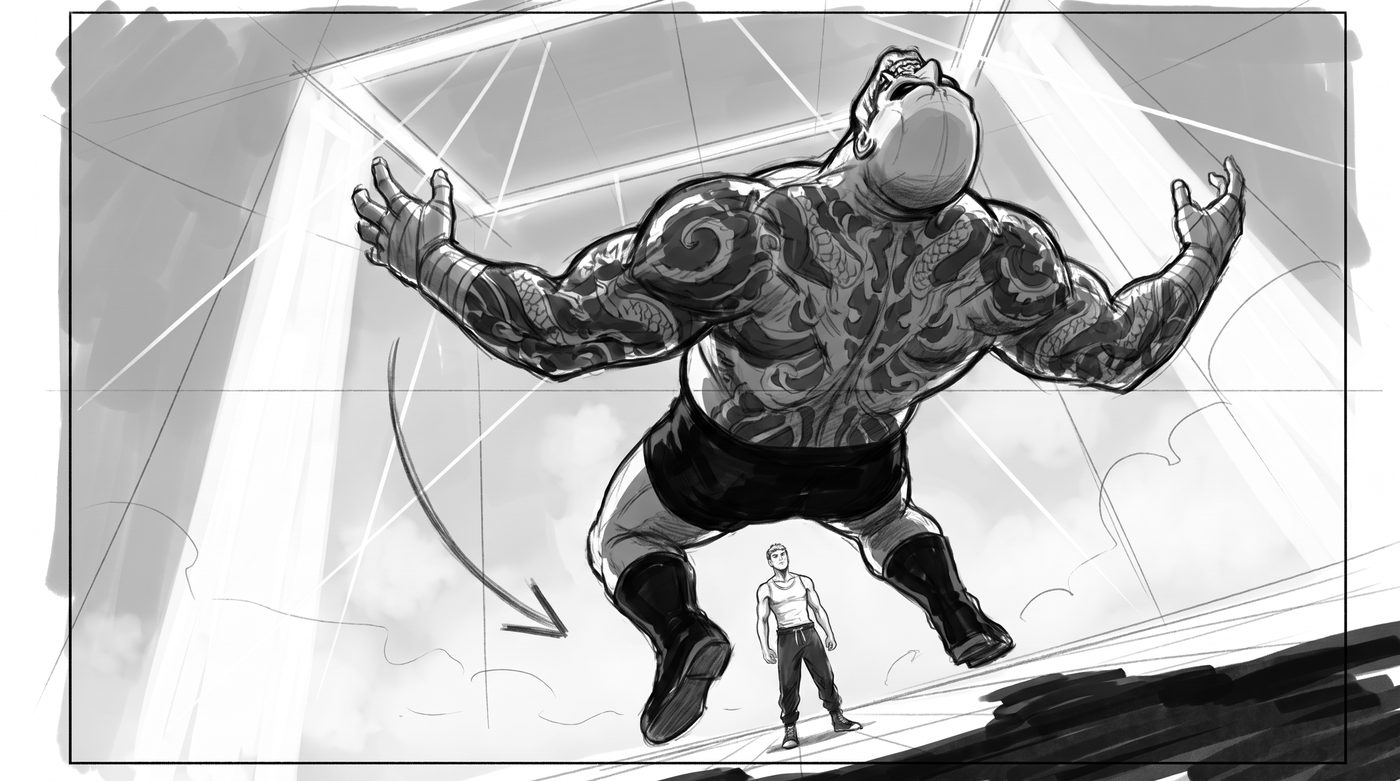
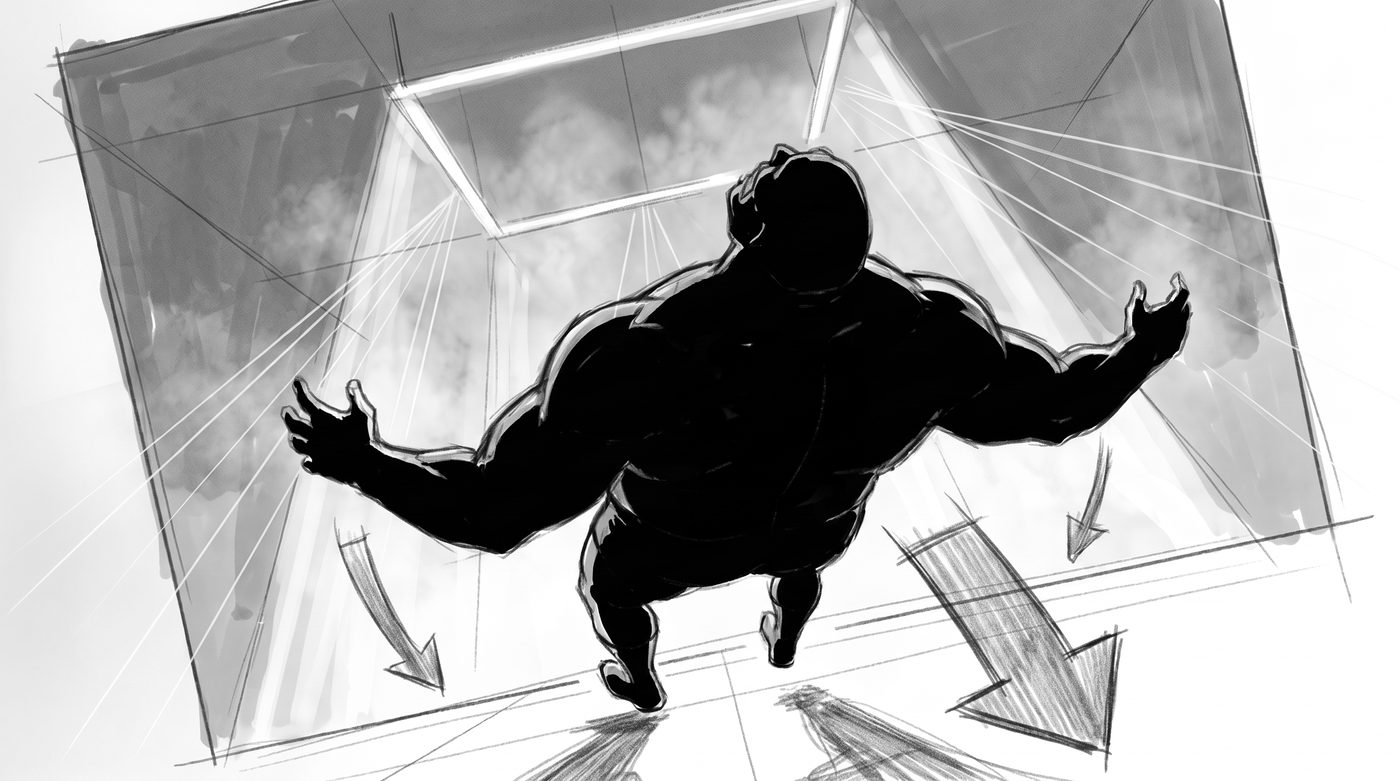
I17. The fall. From the canvas, looking up at a huge black silhouette tipping backward against blinding spotlights. Moves: tips toward the lens.
Generate these stills first, then animate from them with the plates attached. To split it up, keep the typography paragraph with each title plate, and the style paragraph and cast with each insert. Set T1 in real type if you can.
Protagonist close-ups P01–P06
DREAMERS — PROTAGONIST CLOSE-UPS (TITLE INSERTS, SHOT 1A)

Create six still plates: extreme close-ups of the protagonist in the arena, readying himself before the fight. They match an existing set of close-ups of his opponent, so attach plates I02 and I03 as style references, and the protagonist character sheet for identity. Each plate is a separate, clean, finished image: 16:9, highest available resolution. Black and white only, with no colour anywhere. No CRT, scanline, glitch or screen effects; those are added in post.

Style, for every plate: a hand-drawn 2D animation keyframe in the visual language of an adult black-and-white manga and noir graphic novel. Black ink and white paper only. Extreme close-up, the subject filling the frame edge to edge, its key shapes in the middle band of the frame. Built from big, simple shapes: large solid black shadows, bright white highlights, confident brush contours with rough dry-brush edges, very little fine detail. One hard top light from directly overhead, with bars of slatted light falling across the skin, as in the existing plates. The background is lost to pure black. No grey wash, gradients, screentone, photographic texture or 3D-render look. No text or lettering anywhere, including on the skin. No logos, borders or panel lines.

The protagonist: a tall, lean young fighter in a white tank top, with frosted slicked-back hair and a gold pendant on a chain. His stillness reads as control, not nerves.

Each plate gives the moment, then a line on how it will move when animated.

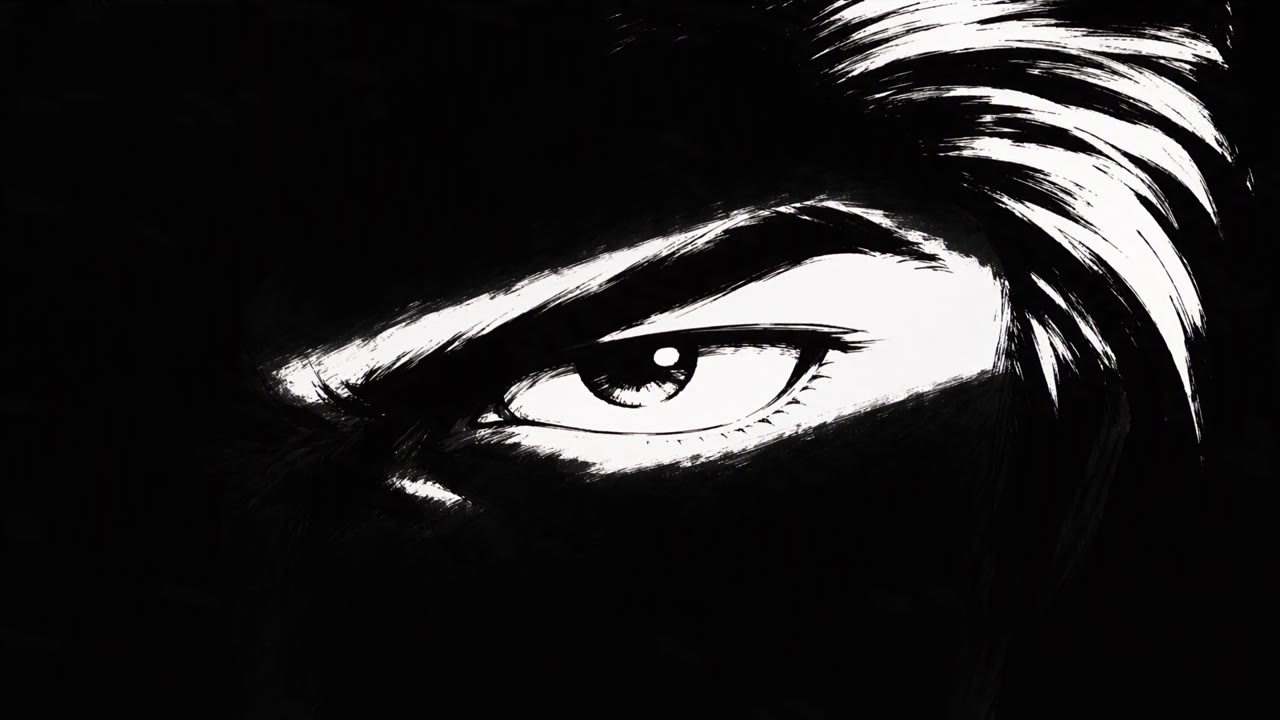
P01. The eye. One eye under frosted, slicked-back hair, narrowed and fixed on something off-frame to the right, a bar of light across it, the rest of the face in black. Moves: the eye opens slightly, finding its focus.
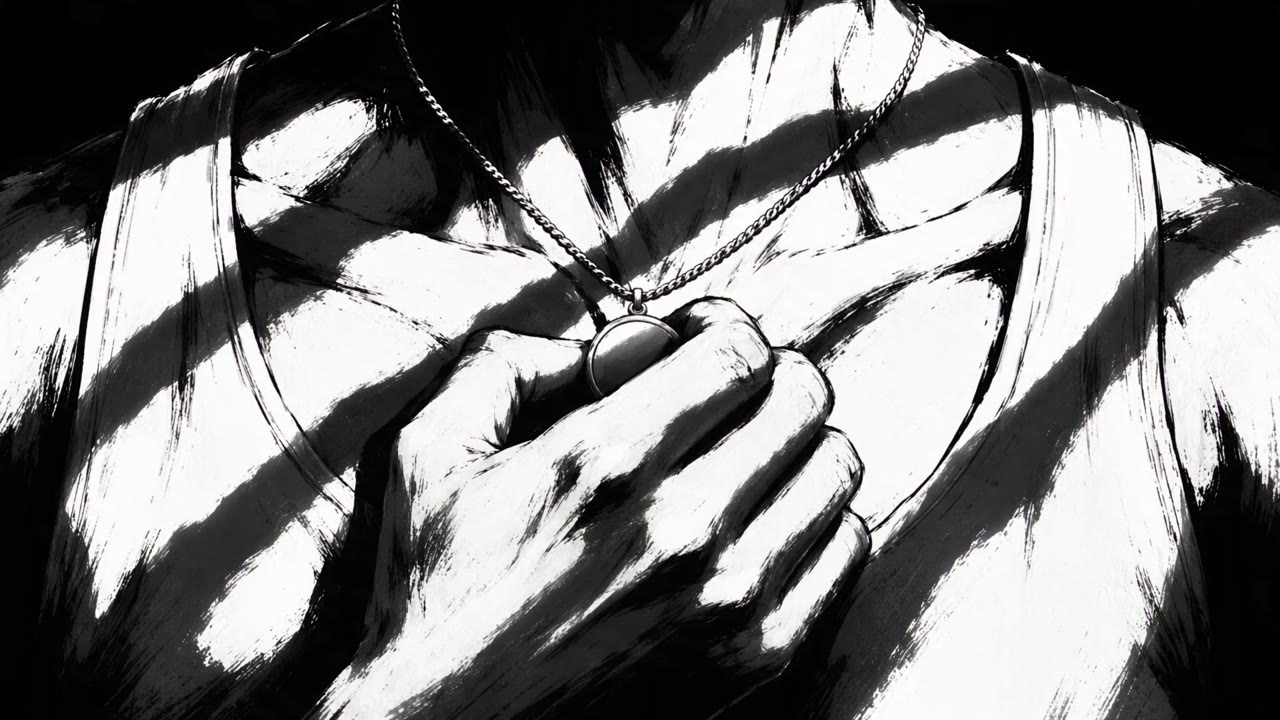
P02. The pendant. His hand closing around the pendant at his chest, the knuckles catching the light, the chain taut against his collarbone. Moves: the hand opens and lets the pendant drop.
P03. The breath. His mouth and jaw in profile, lips parted in a slow exhale, a plume of breath curling into the haze, a bead of sweat at the corner of the mouth. Moves: the breath leaves him; the jaw sets.
P04. The knuckles. His fist closing tight, the knuckles pale under the top light, tendons standing out along the back of the hand. Moves: release, gather, clench.
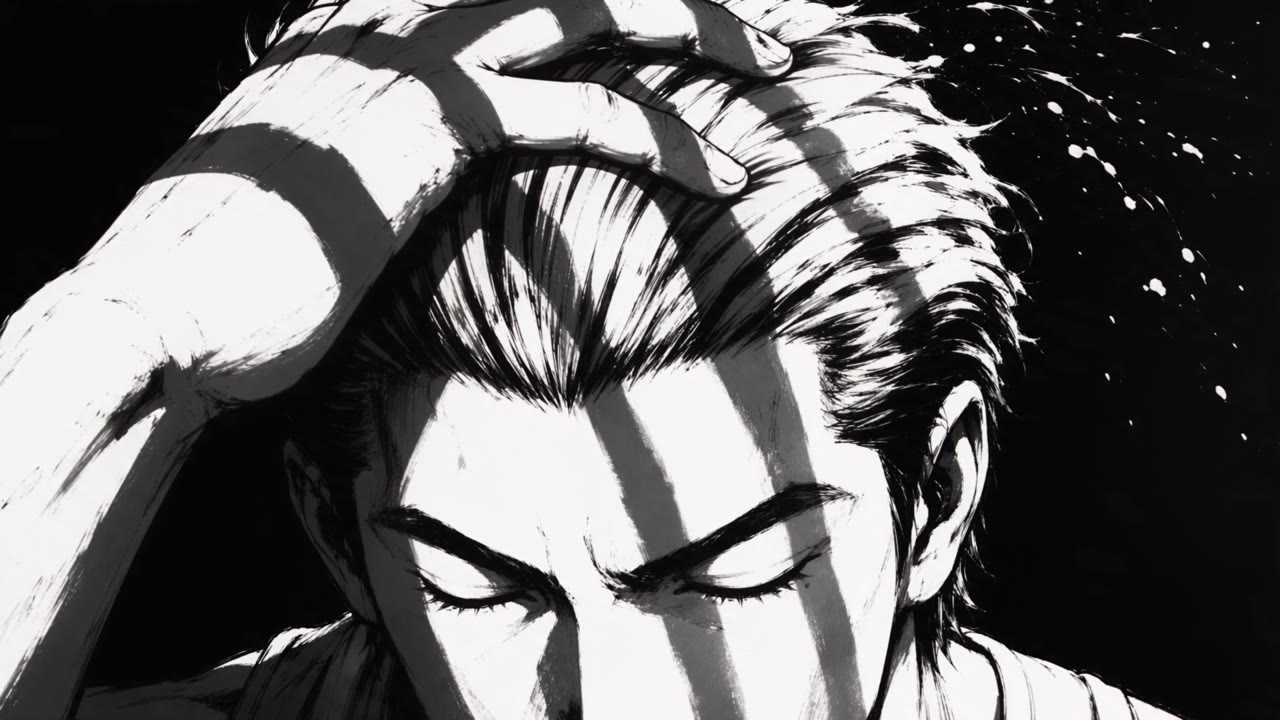
P05. The hair. His hand slicking back his frosted hair, sweat flicking off in a spray of white droplets, his eyes closed. Moves: the hand drags back through the hair; the eyes open.
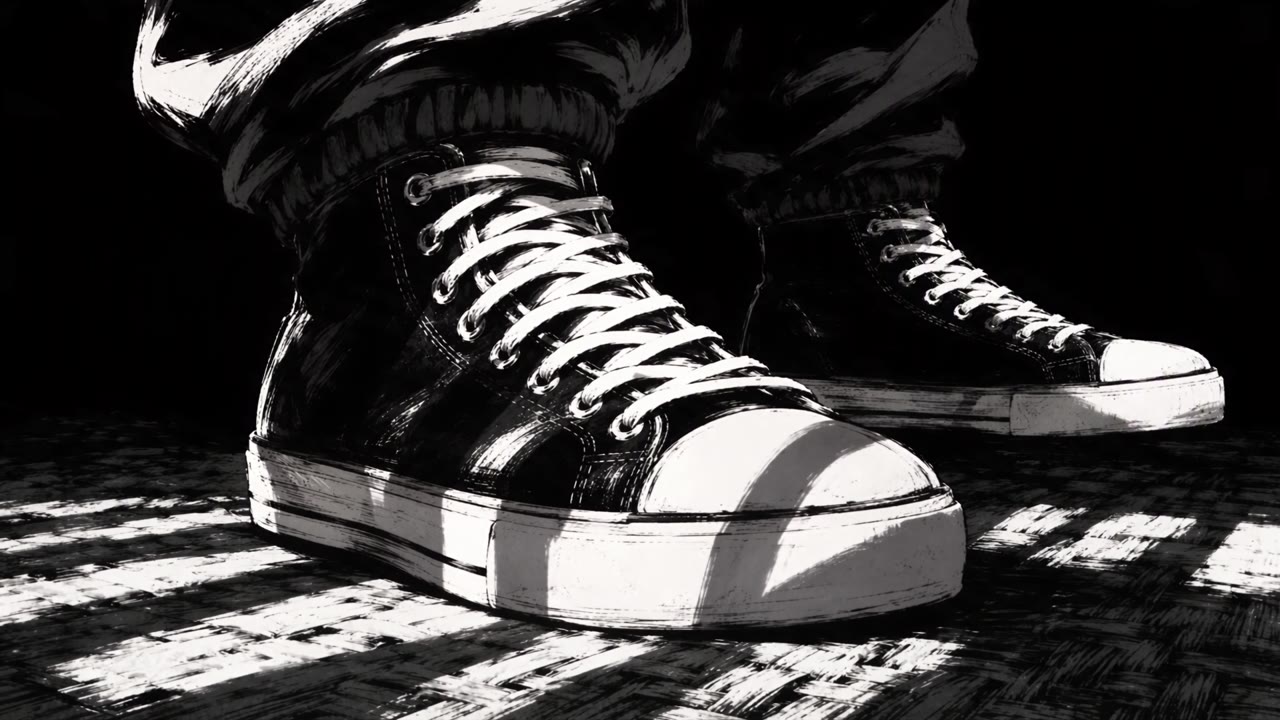
P06. The feet. High-top sneakers settling on the canvas, a bar of light across the laces, the weave of the canvas below. Moves: the lead foot slides forward into his stance.
Six close-ups of the protagonist readying himself, to match the Gurendo set. Attach I02 and I03 as style references and the protagonist sheet.
The descent D01–D06
DREAMERS — THE DESCENT (TITLE INSERTS, SHOT 1A)

Create six still plates of the descent from the night city into an underground fight arena, in the order the film travels. Each is a separate, clean, finished image: 16:9, highest available resolution. Black and white only, with no colour anywhere. No CRT, scanline, glitch or screen effects; those are added in post. Attach plates I02 and I03 as style references so that the set matches the existing close-ups.

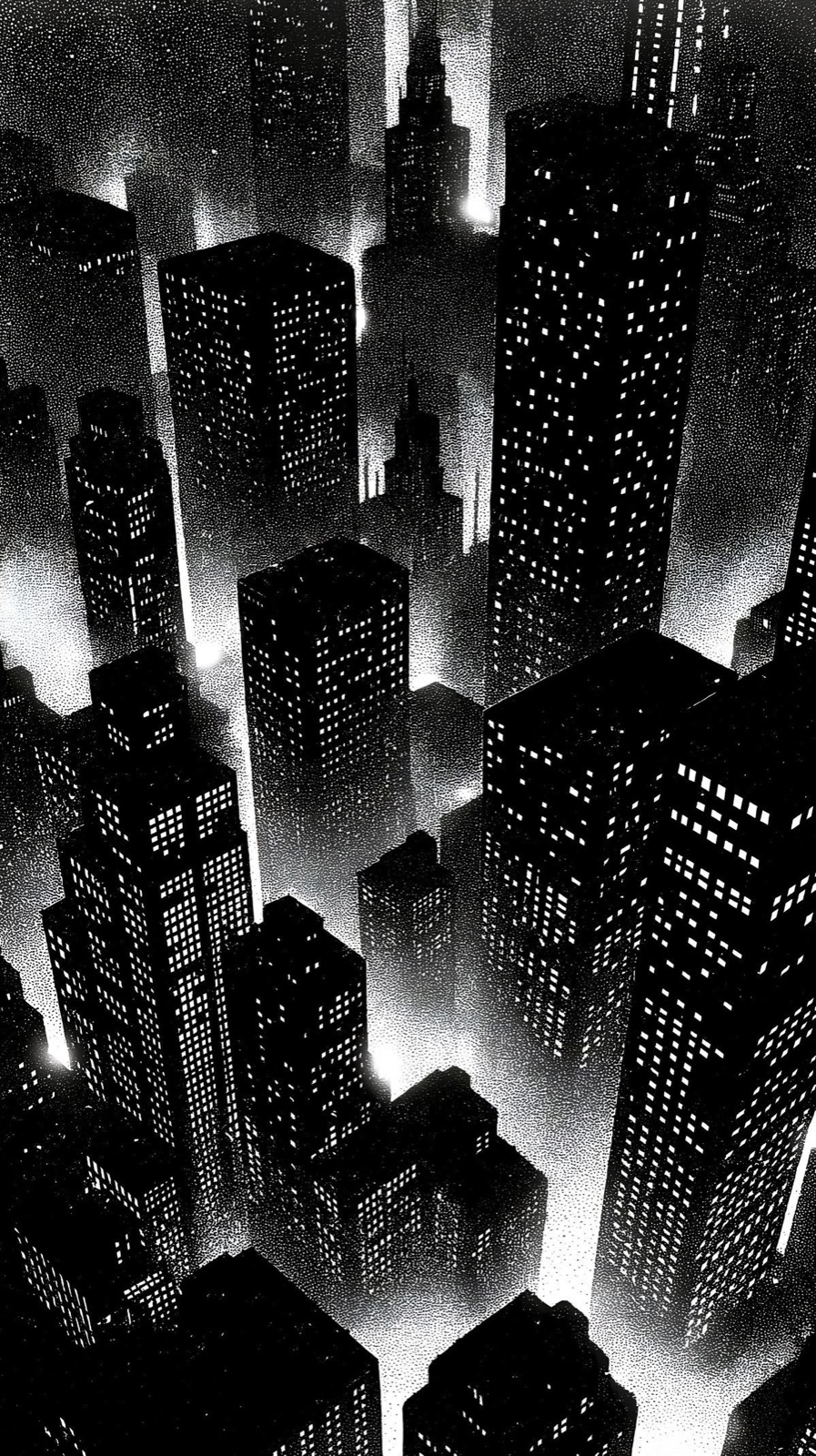
Style, for every plate: a hand-drawn 2D animation keyframe in the visual language of an adult black-and-white manga and noir graphic novel. Black ink and white paper only. Gritty, damp, high-contrast noir chiaroscuro. Built from big, simple shapes: large solid black masses, bright white light, confident brush contours with rough dry-brush edges, stippled dots for fog and haze, little fine detail. The key shapes sit in the middle band of the frame. Light comes in grids and slats throughout: lit windows, fire-escape shadows, wall panels, wire mesh. People are only ever solid black silhouettes. No grey wash, gradients, screentone, photographic texture or 3D-render look. No logos, borders or panel lines. No text except where a plate says so.

Each plate gives the place, then a line on how it will move when animated.

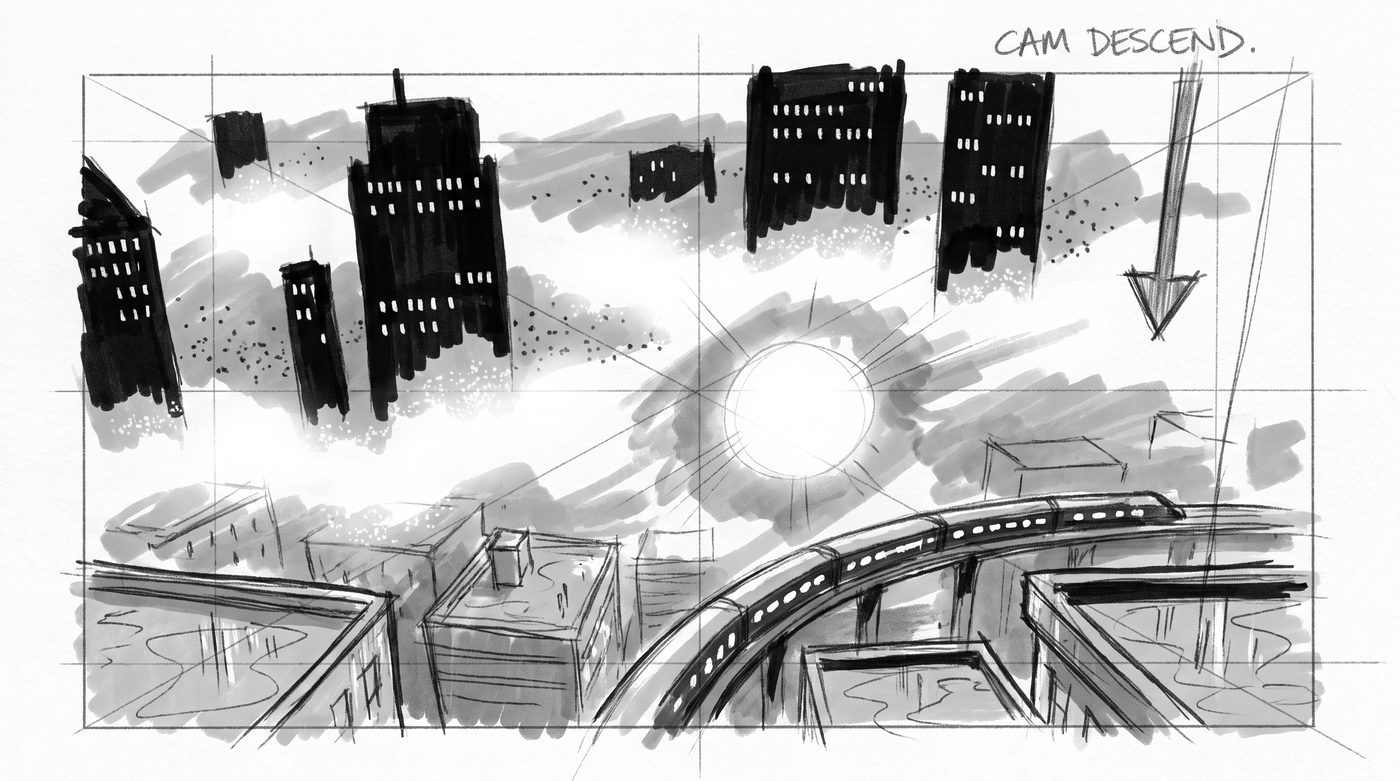
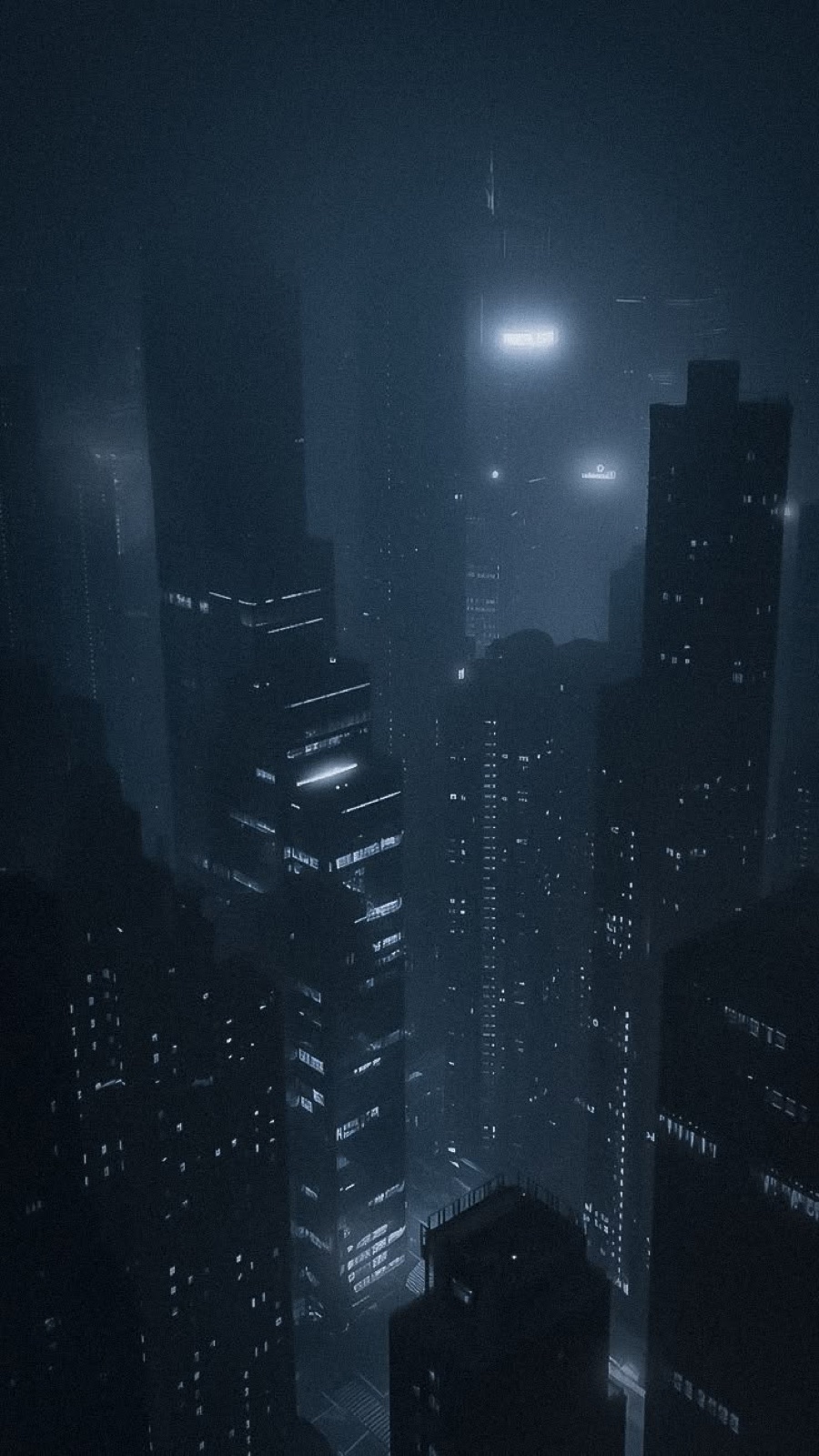
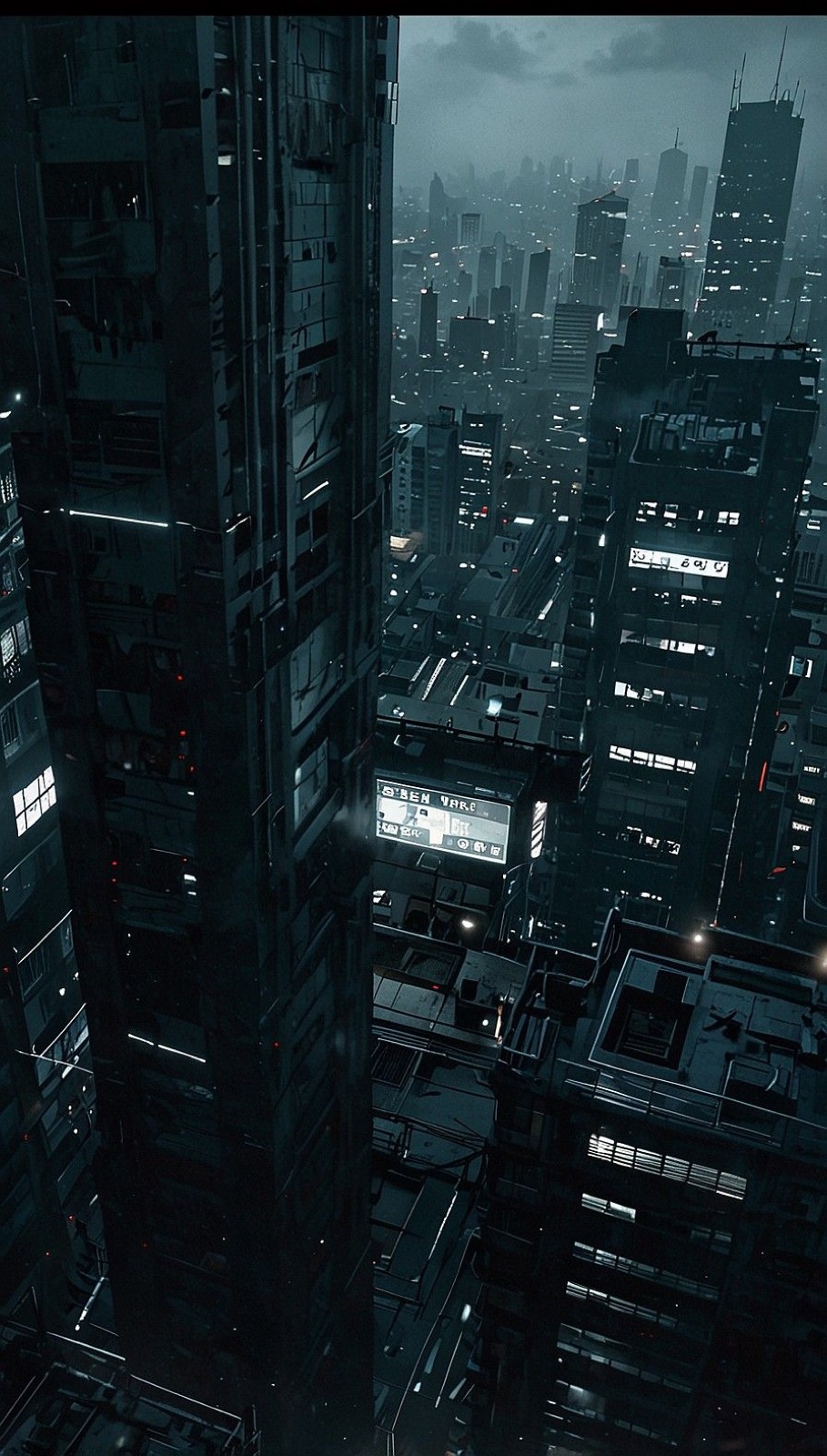
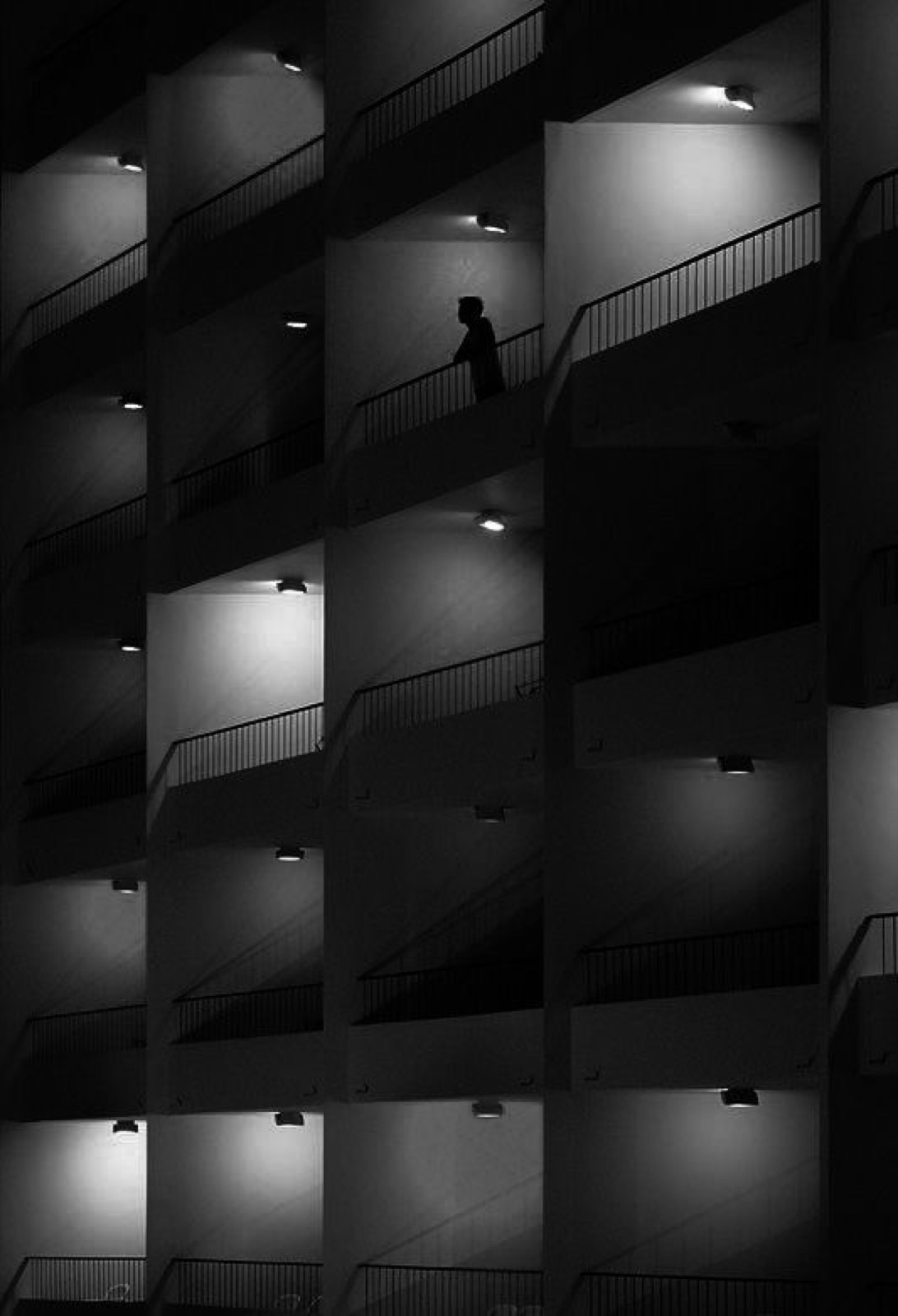
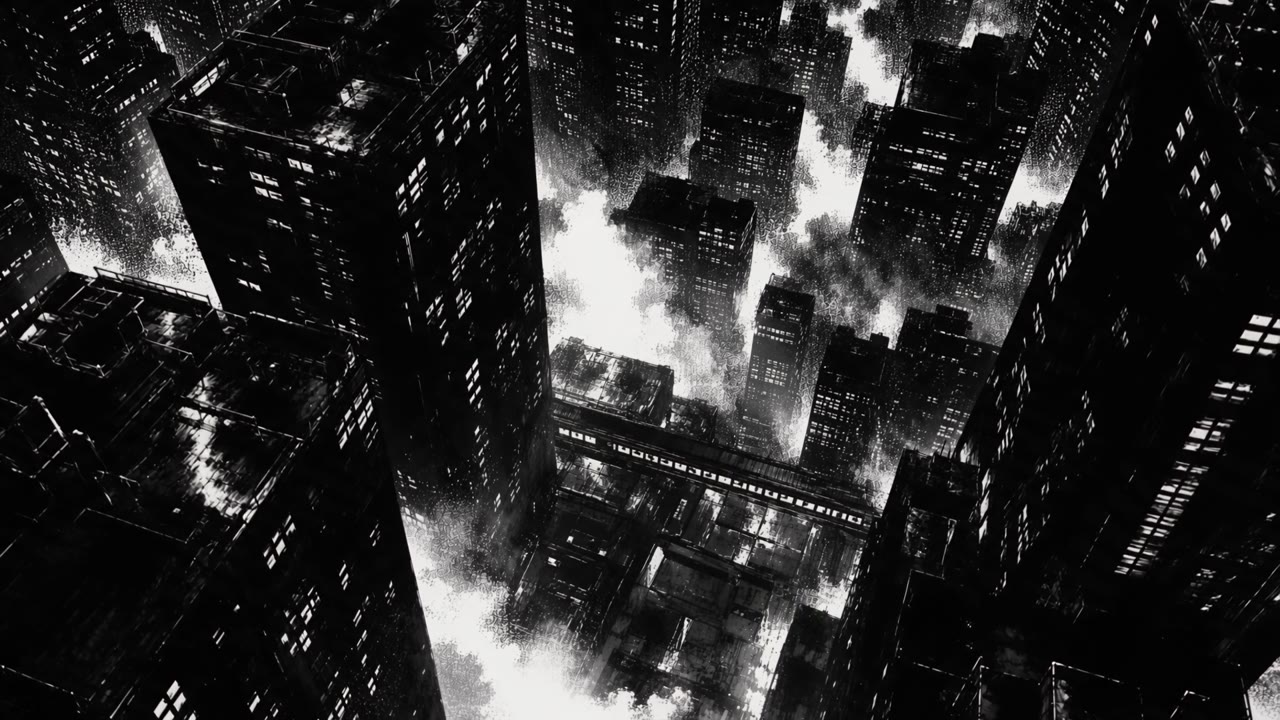
D01. The city. High above a dense city at night, looking down into fog. Towers rise out of the haze as black masses, their lit windows drawn as grids of small white dashes. Layers of fog glow white between them; one light blooms in the fog. Far below, wet rooftops and an elevated train with a band of lit windows. Moves: the camera drops through the fog.
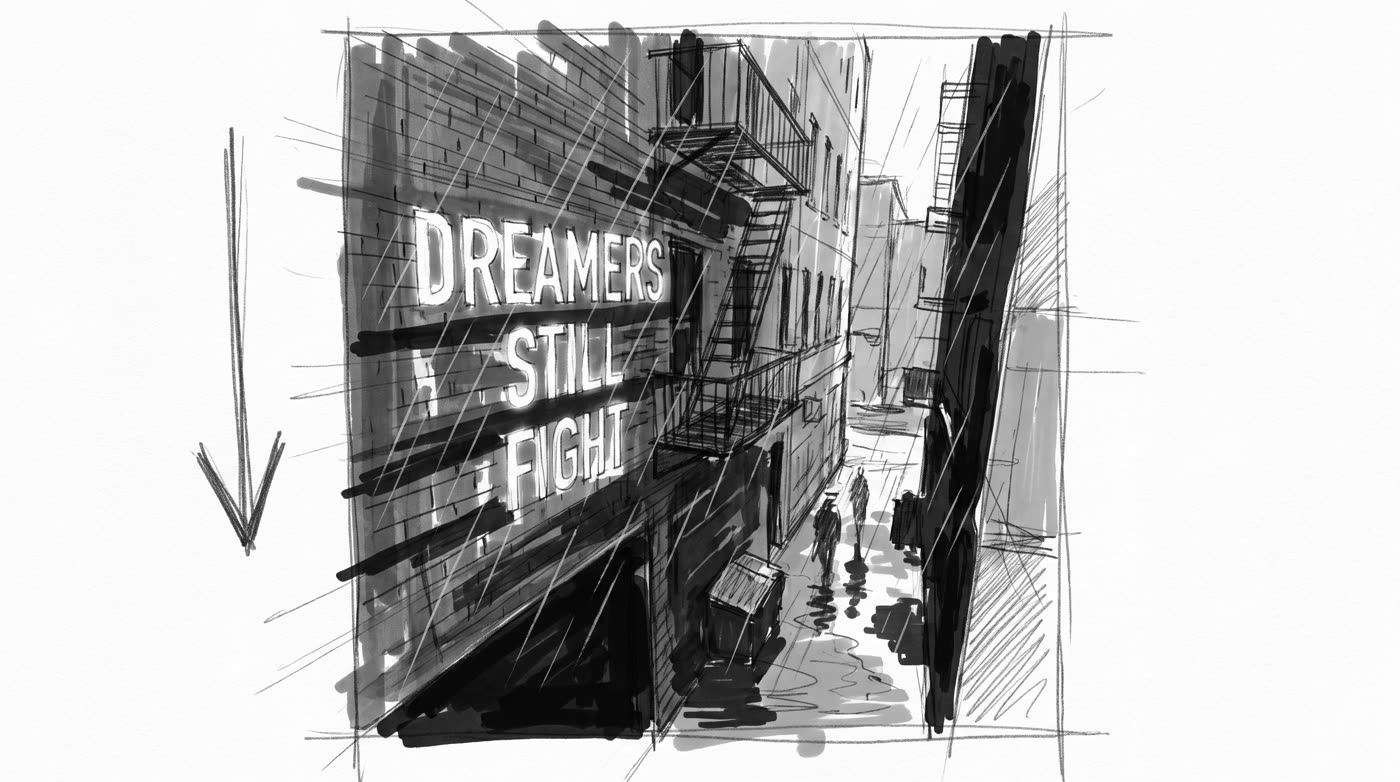
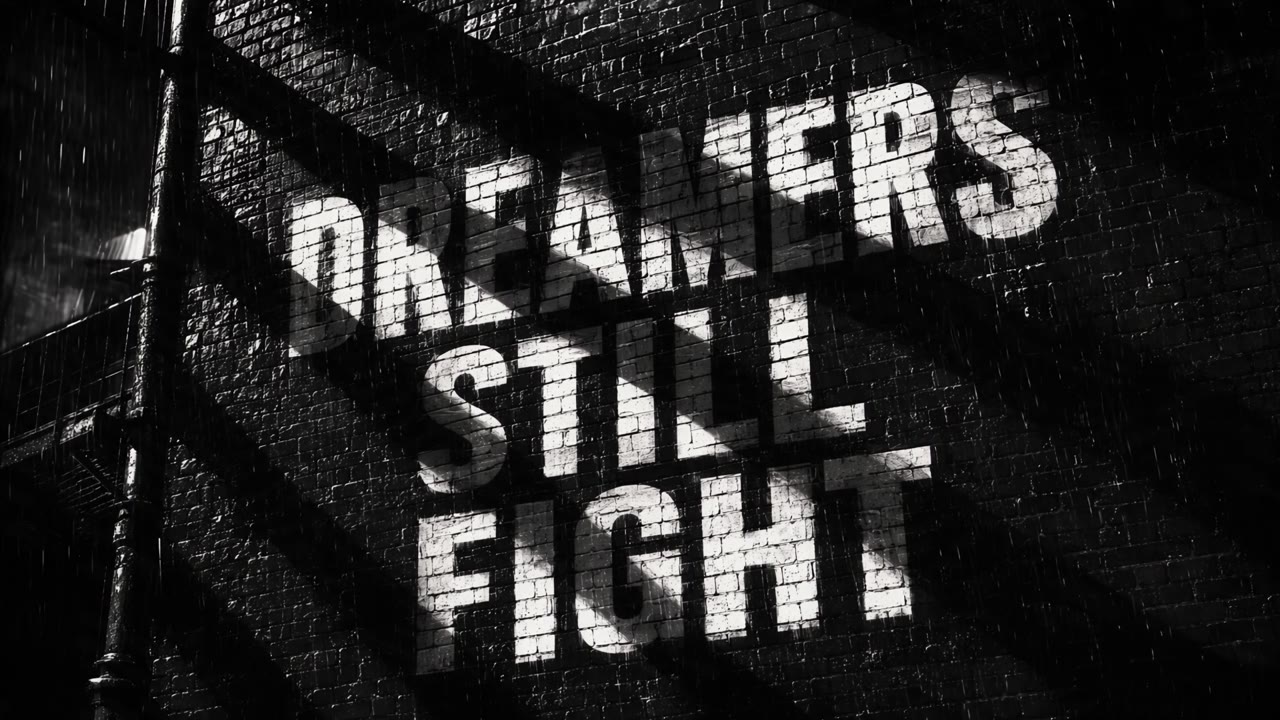
D02. The wall. Descending past a brick wall in the rain. The words DREAMERS STILL FIGHT are projected onto it in white light, in heavy modern sans-serif capitals, broken by diagonal bars of shadow and streaks of rain. Moves: the slats of shadow crawl across the letters.
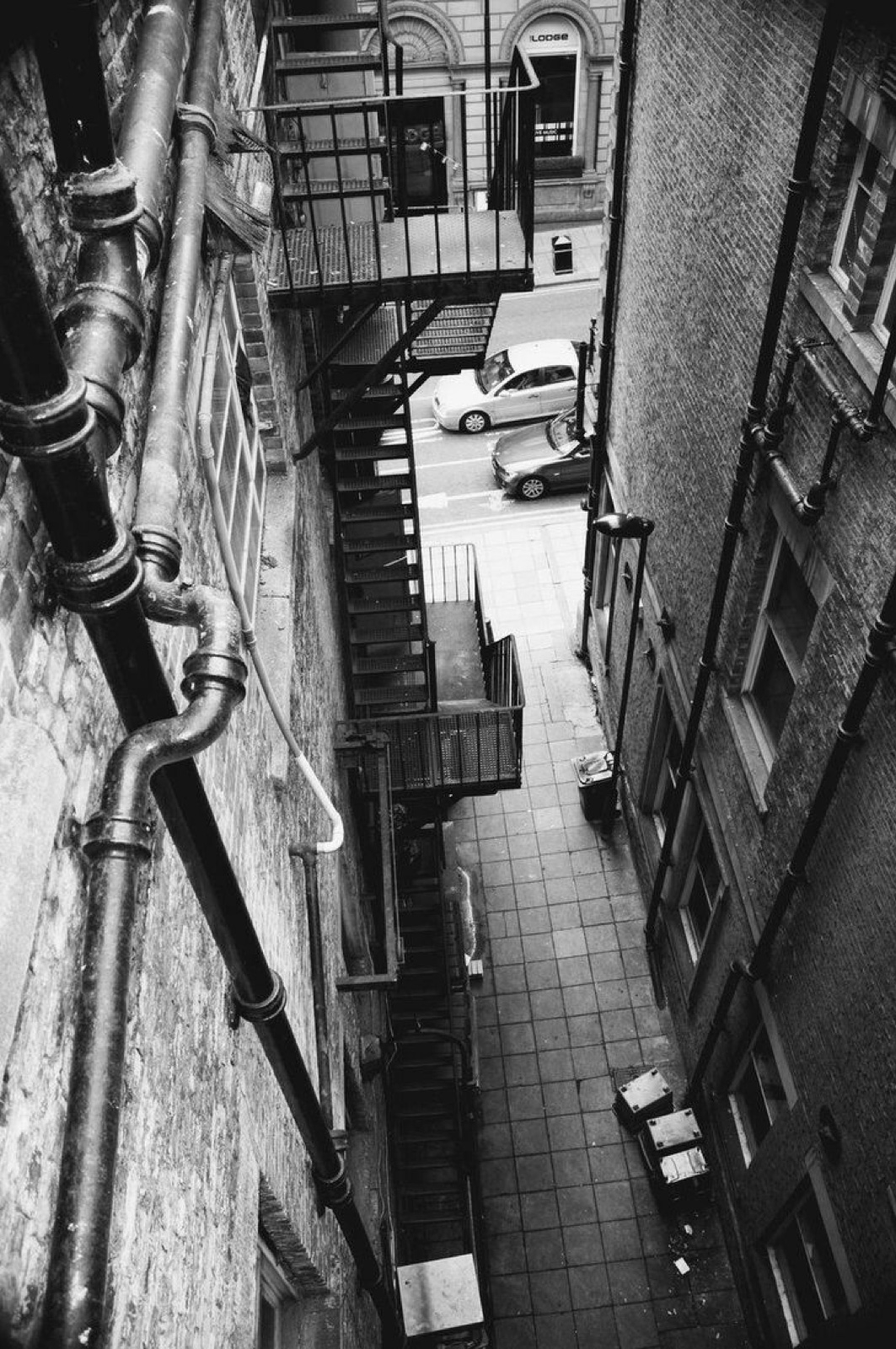
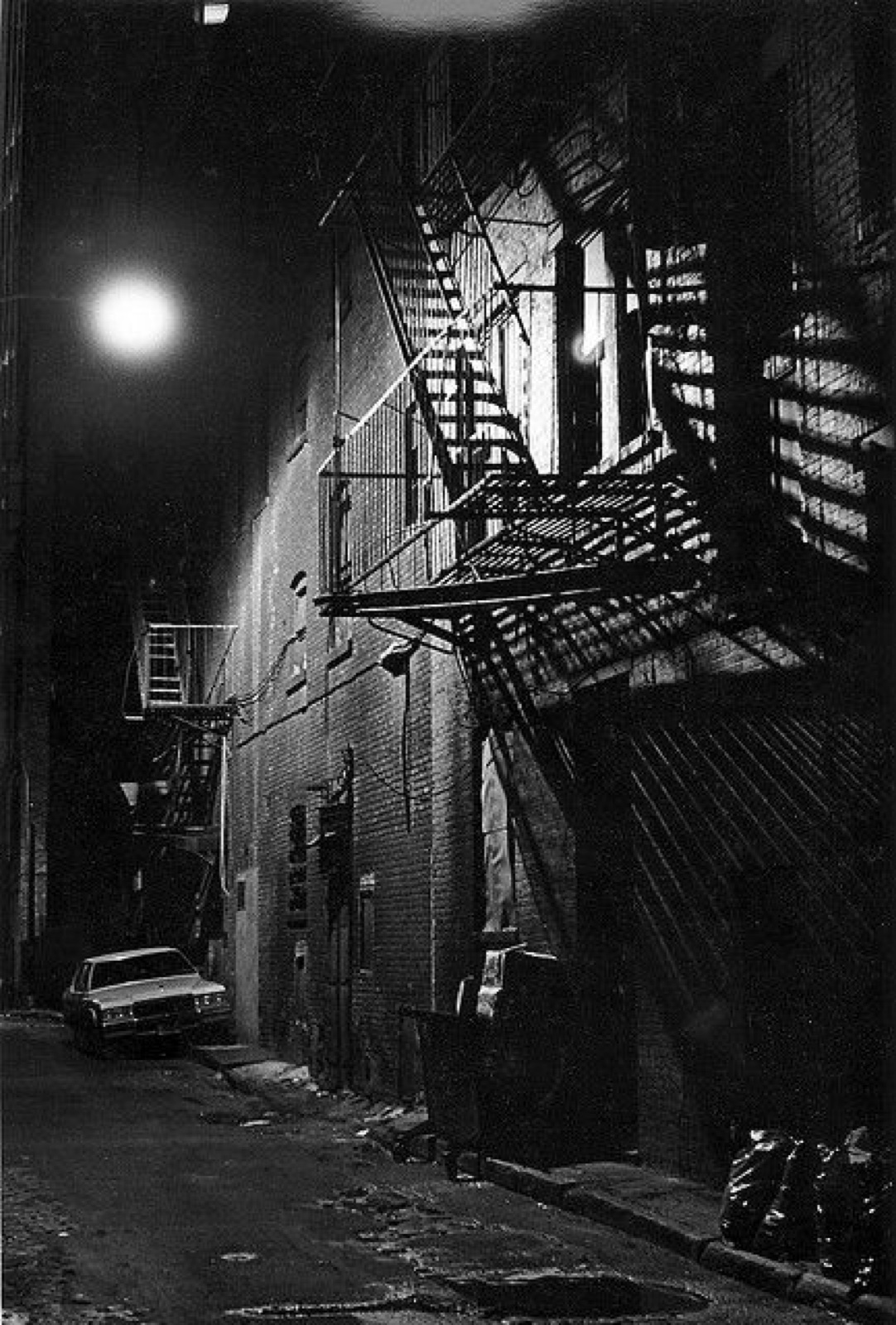
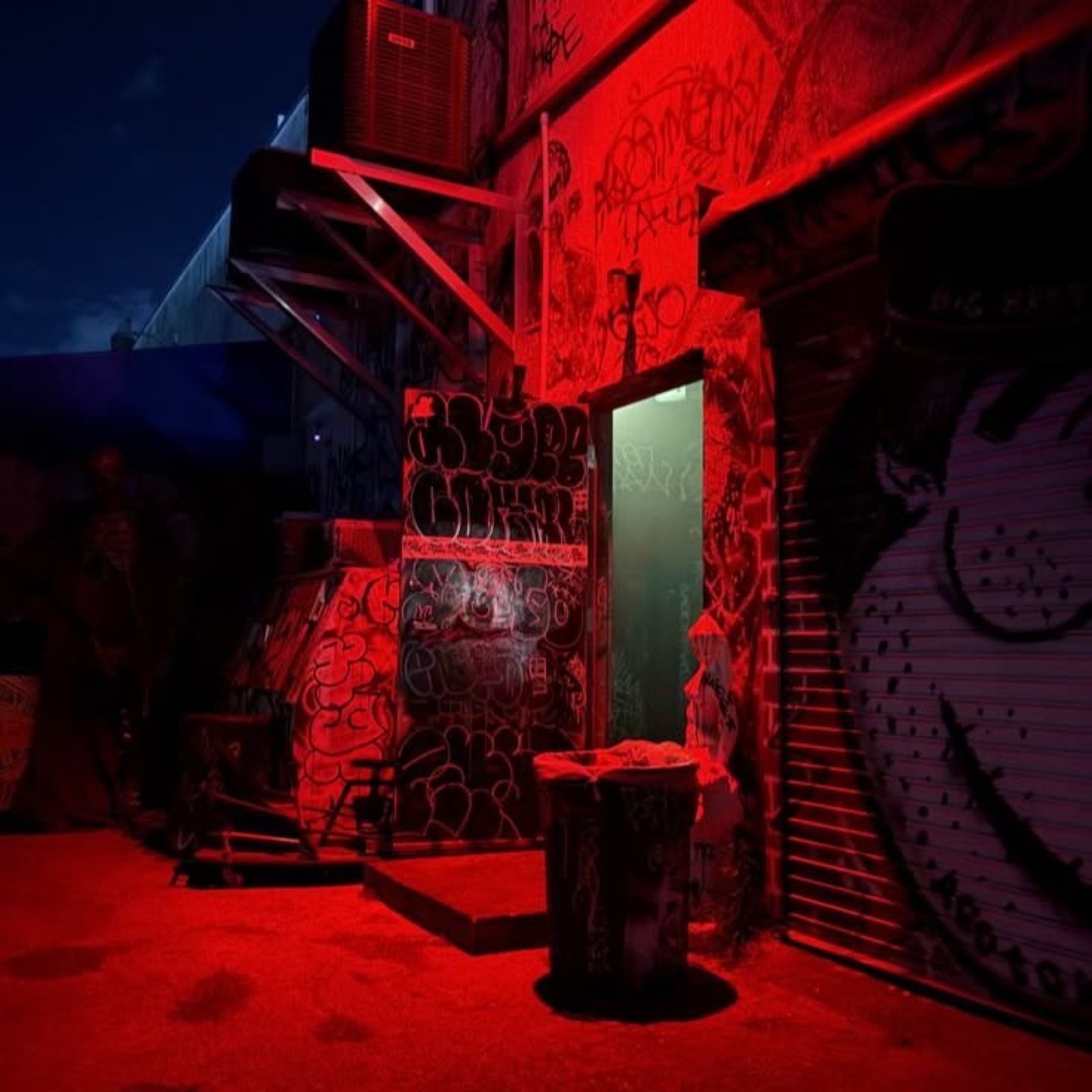
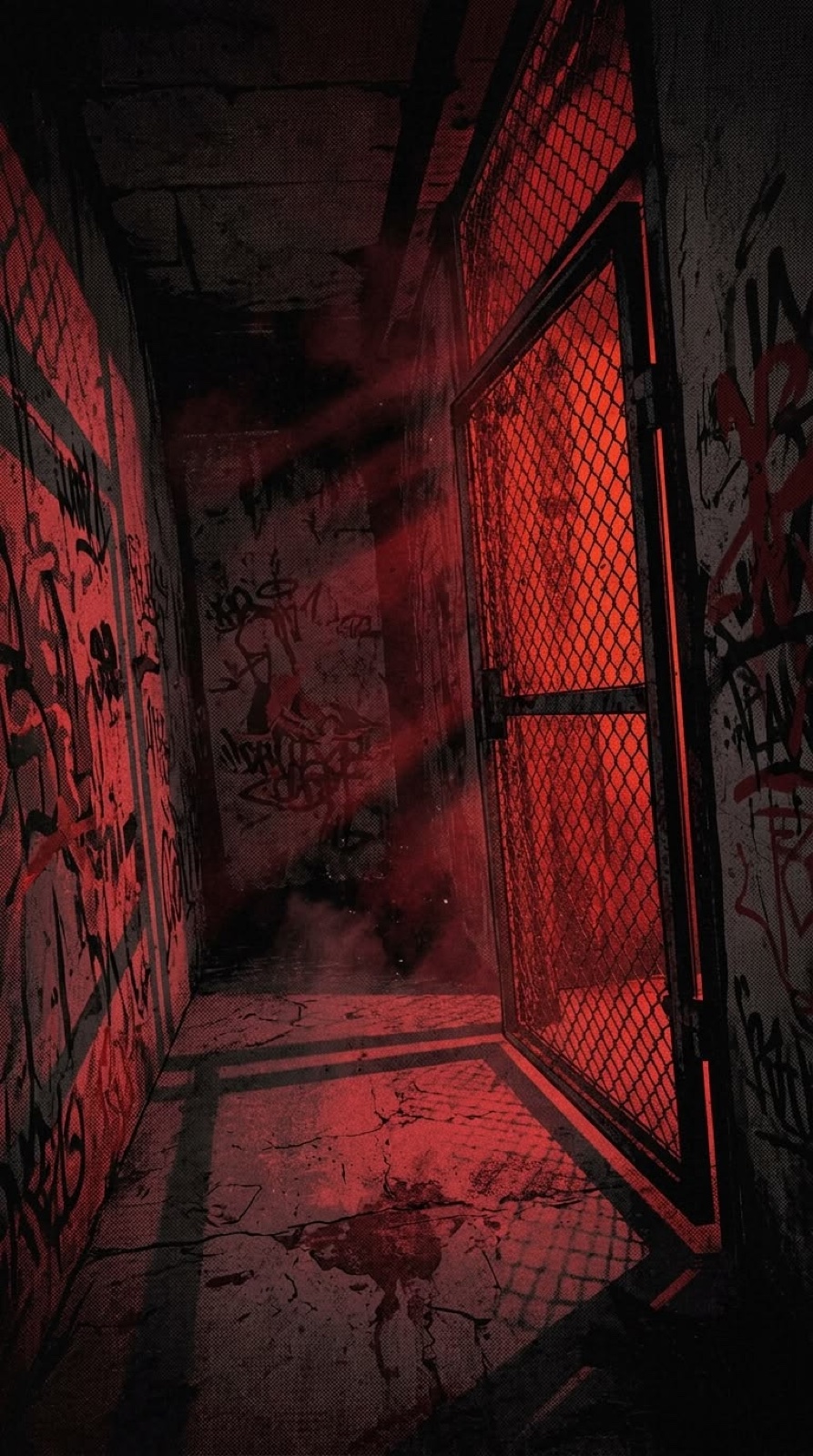
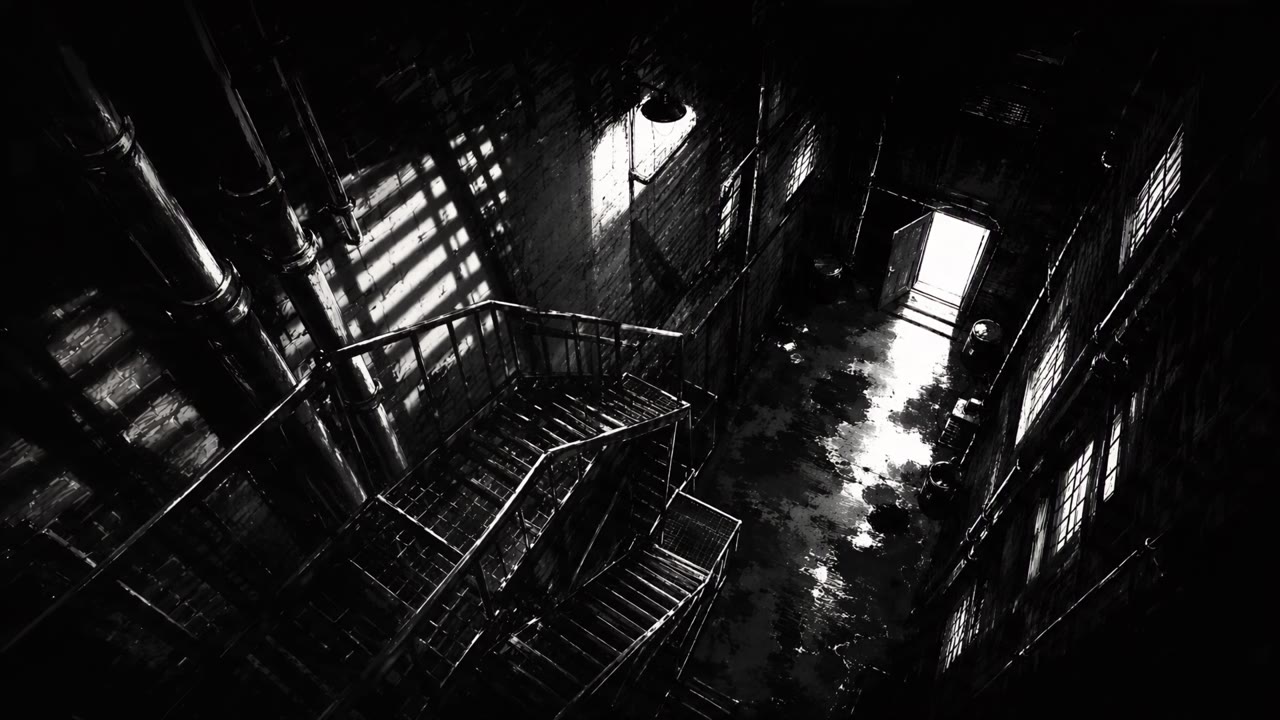
D03. The alley. Looking straight down a narrow alley from high on a wall: a fire escape zigzags down the brick, and one street lamp throws its shadow across the wall in hard slats. At the bottom, wet ground, puddles holding the light, and a back door standing open with white light spilling out. Moves: the camera drops down the fire escape toward the door.
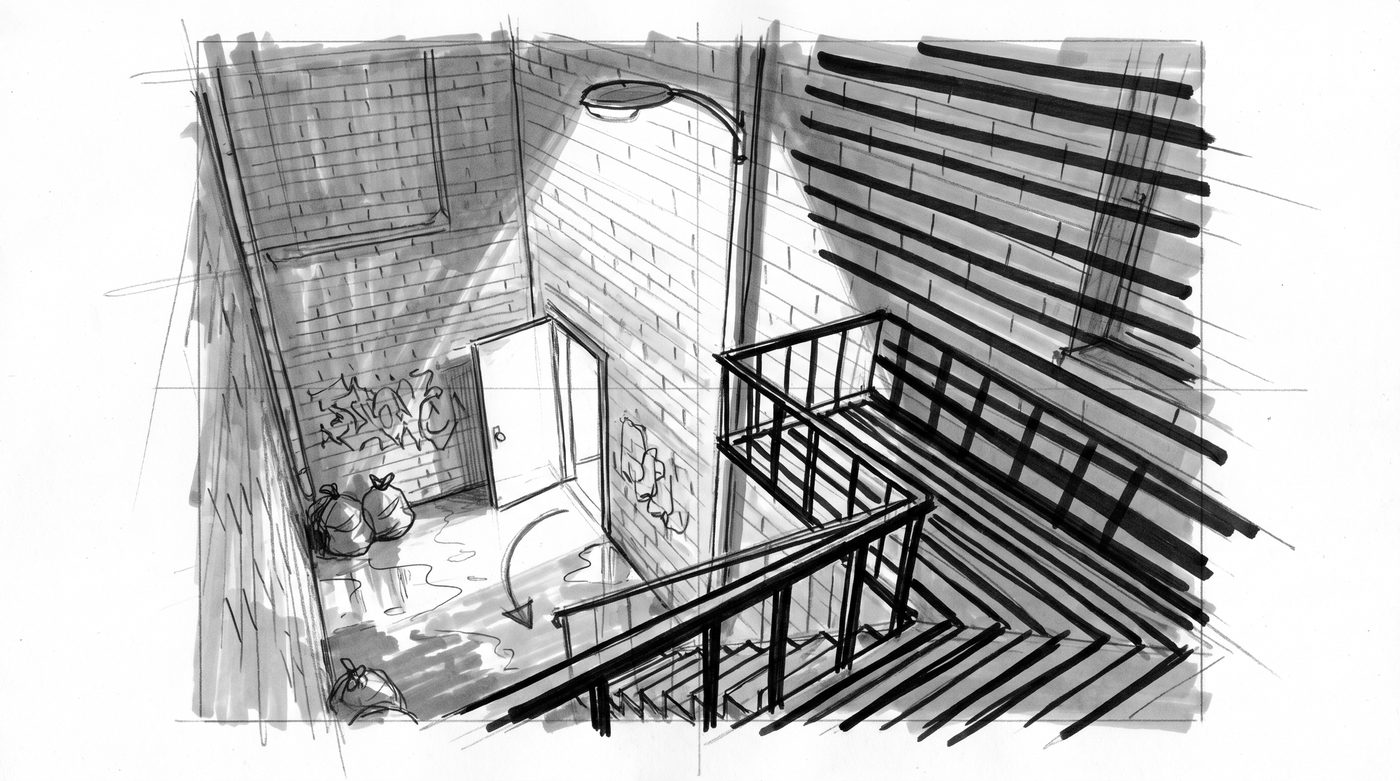
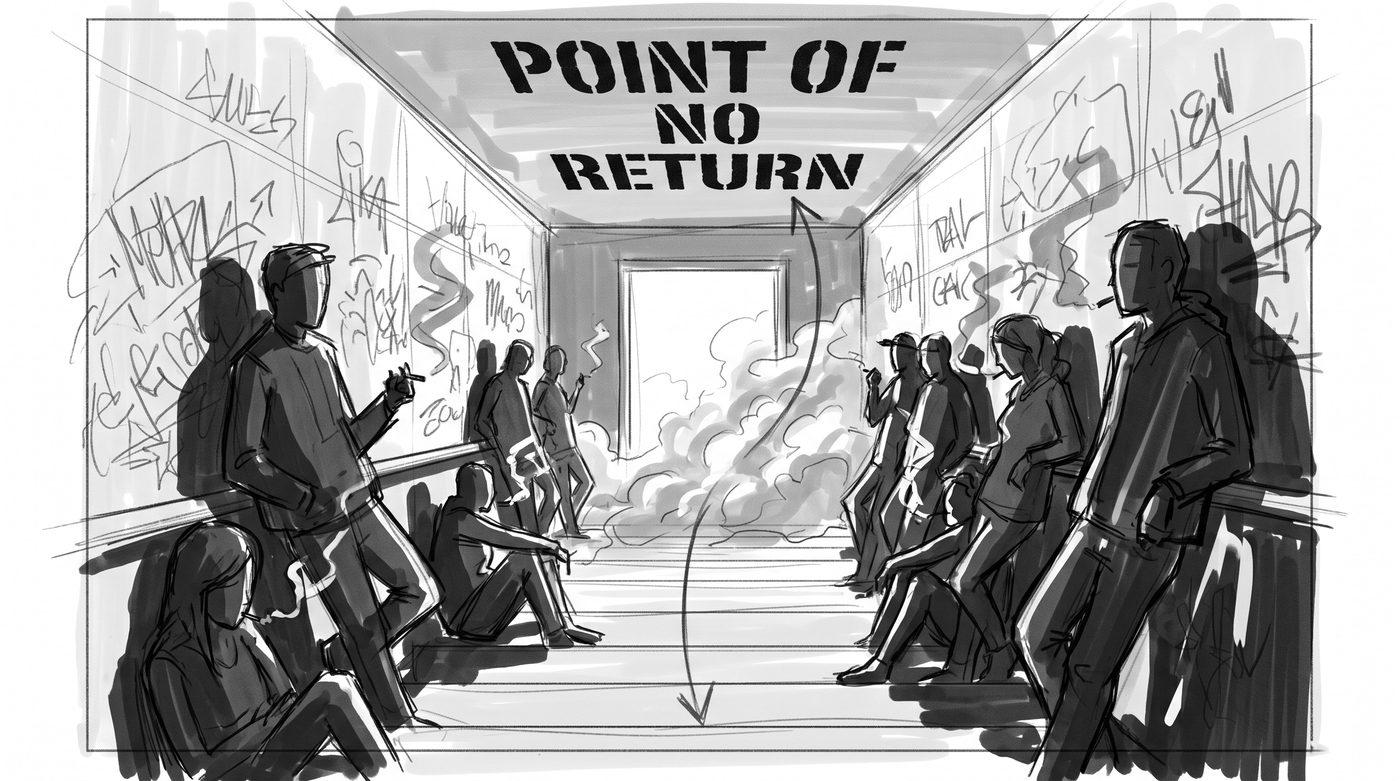
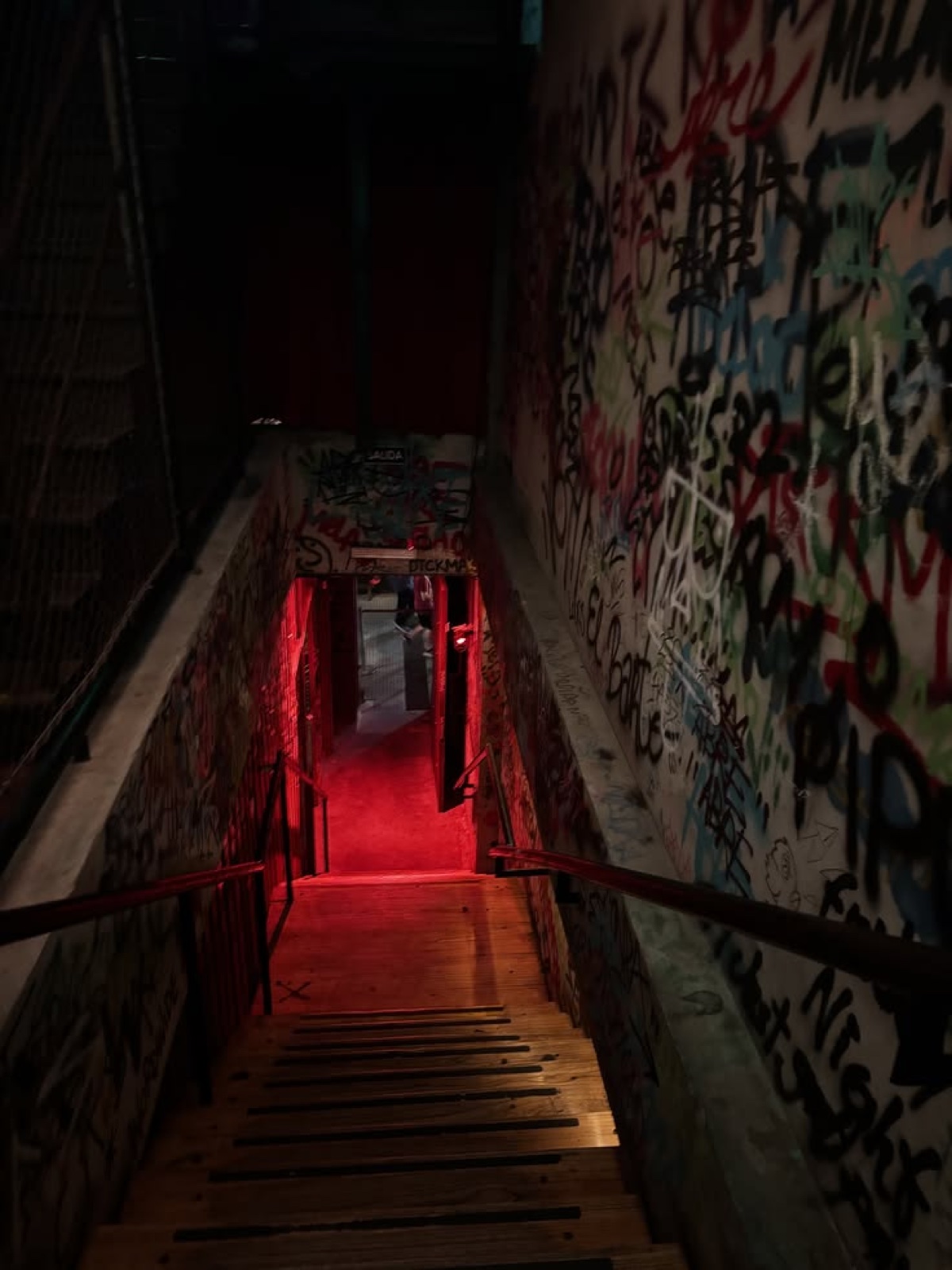
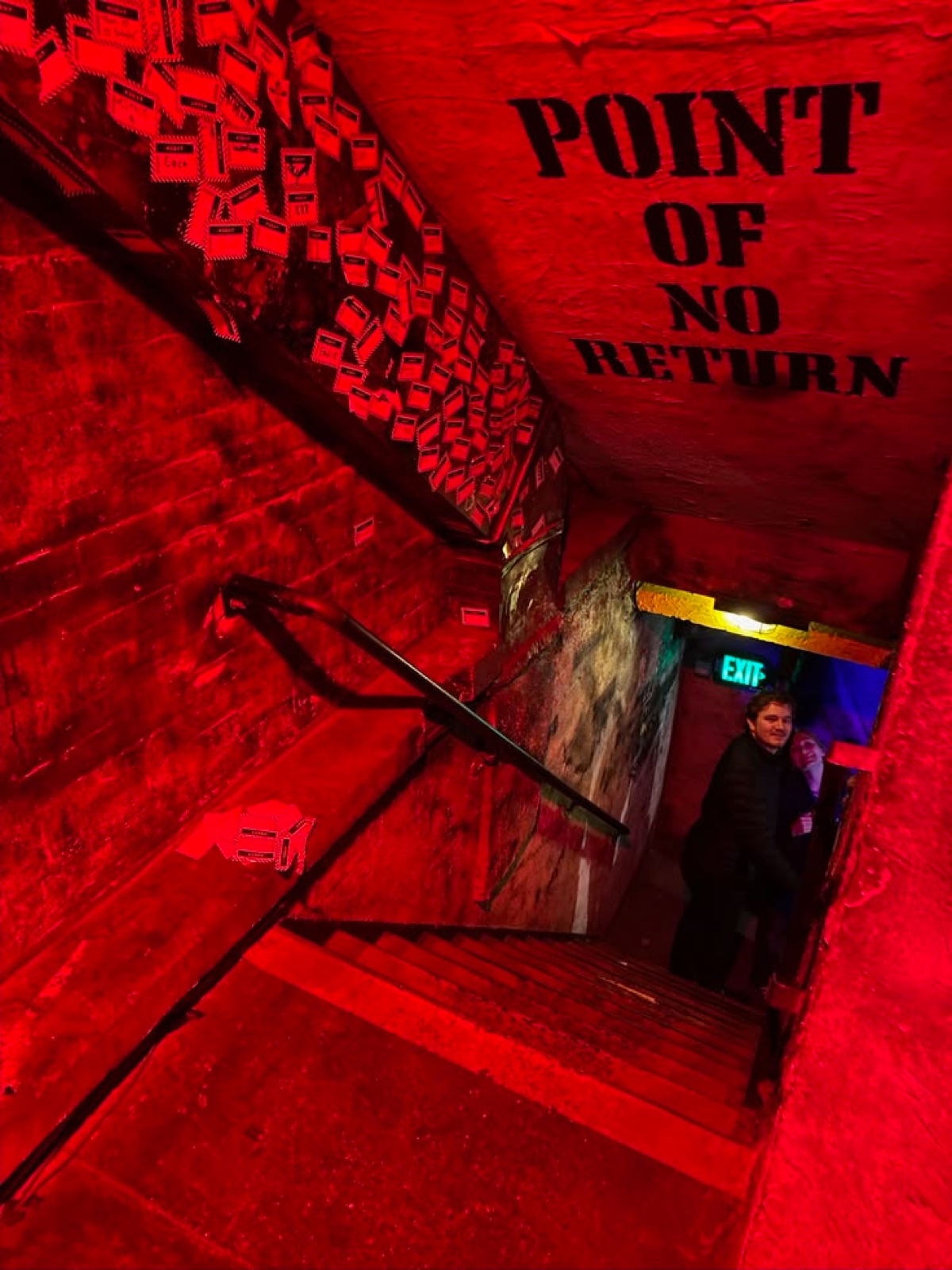
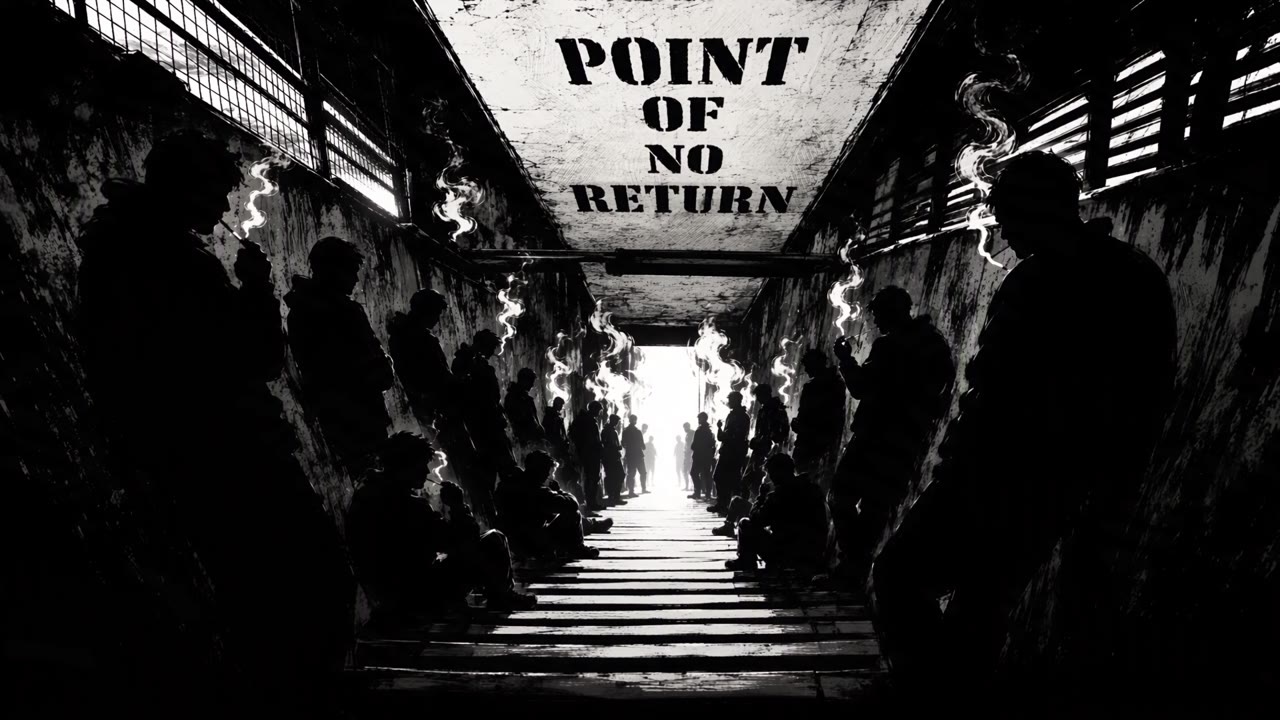
D04. The stairs. Looking down a steep stairwell crowded with people in silhouette, leaning on both walls and sitting on the steps, smoking. Smoke rolls up from a doorway glowing white at the bottom; the middle of the stairs is clear. Stencilled on the low ceiling in black block capitals: POINT OF NO RETURN. Moves: smoke curls upward; the camera descends between them.
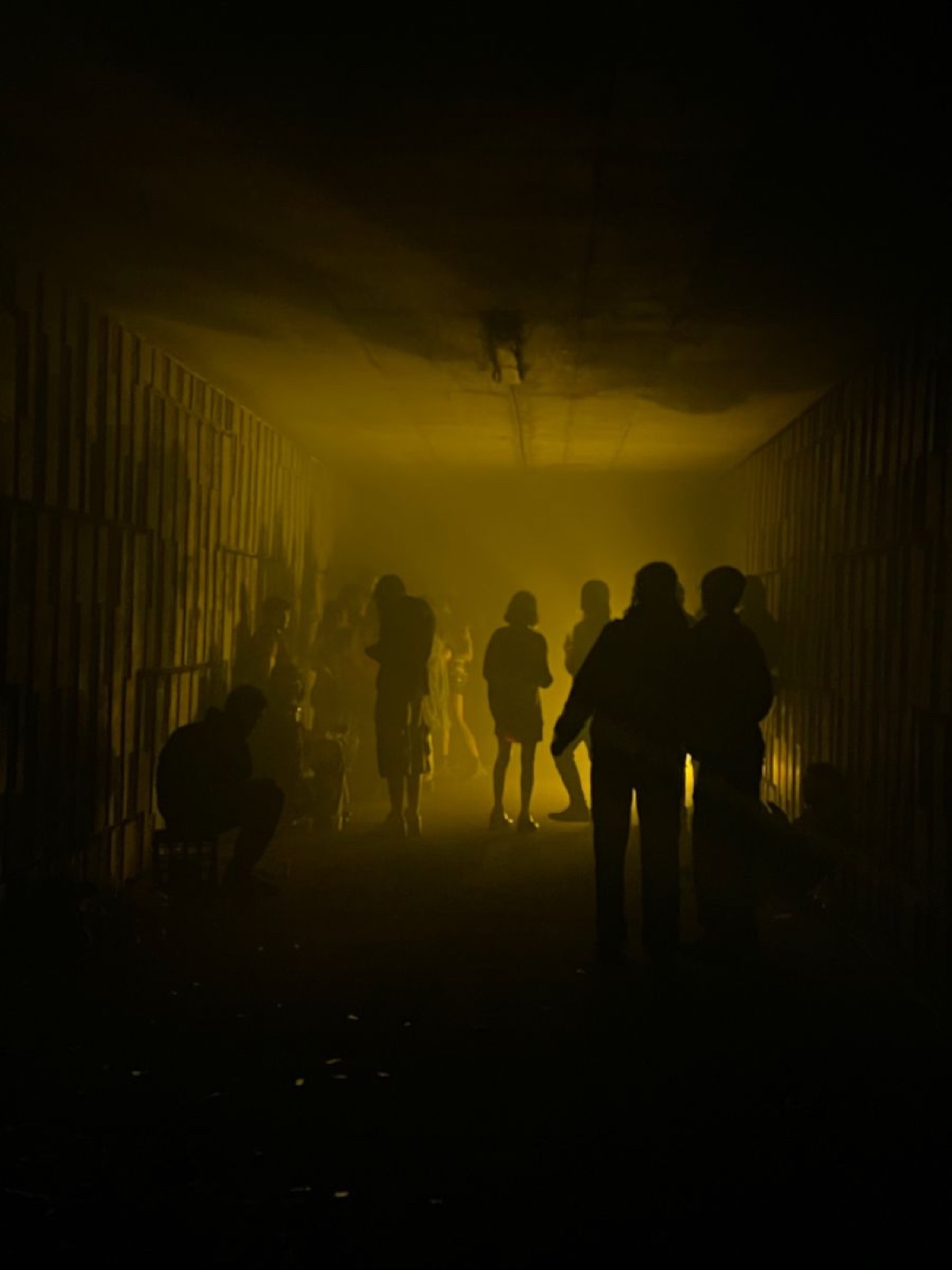
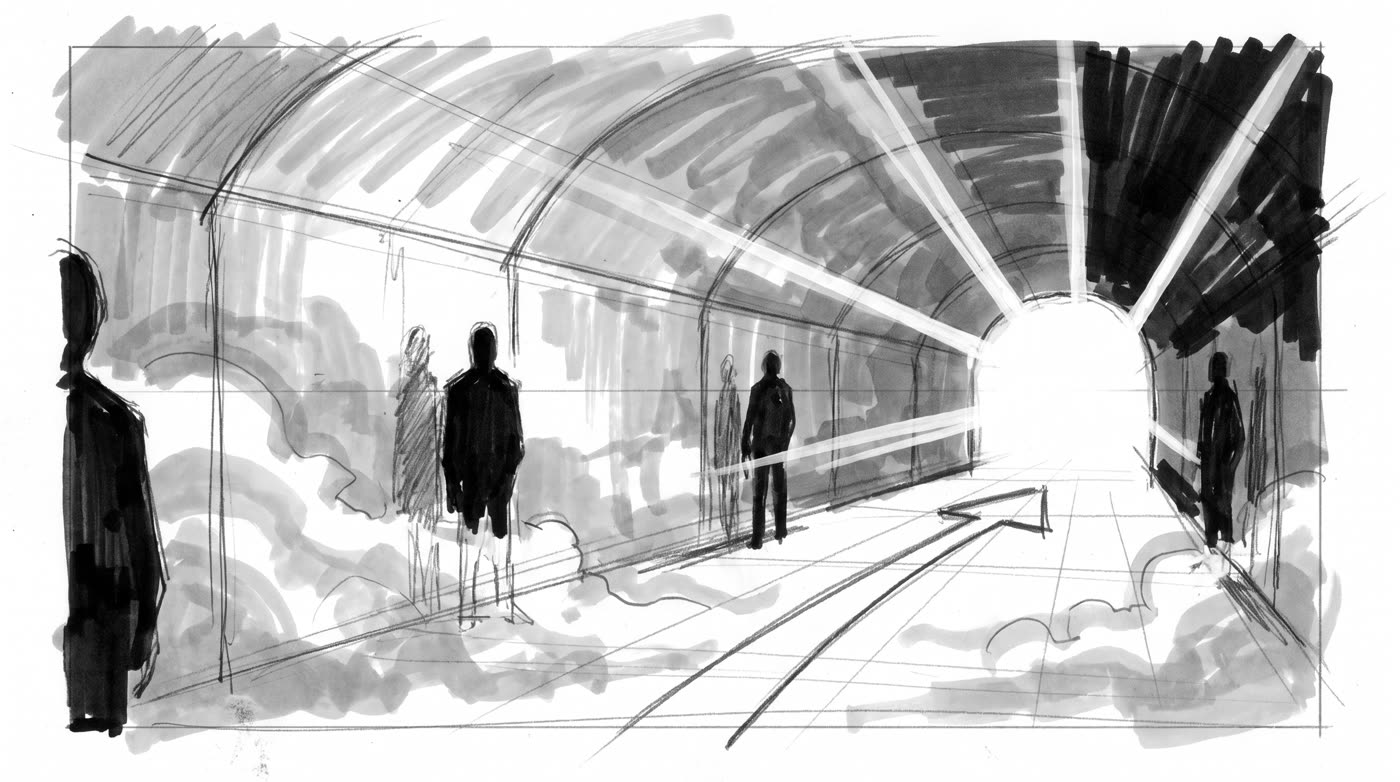
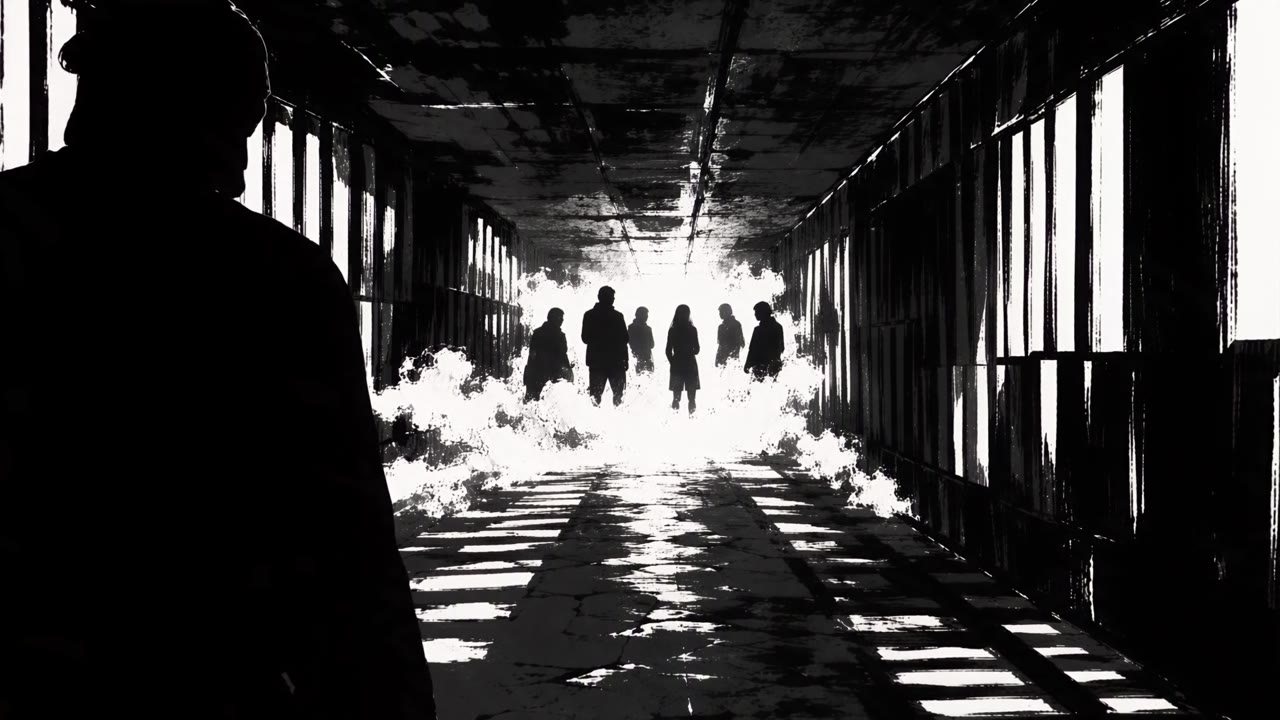
D05. The walkway. A long, low concrete walkway filled with smoke, its walls lined with slatted panels. At the far end the smoke is lit so brightly that the people standing in it are only black silhouettes; one is close to the lens at the edge of the frame. Moves: the camera creeps through them.
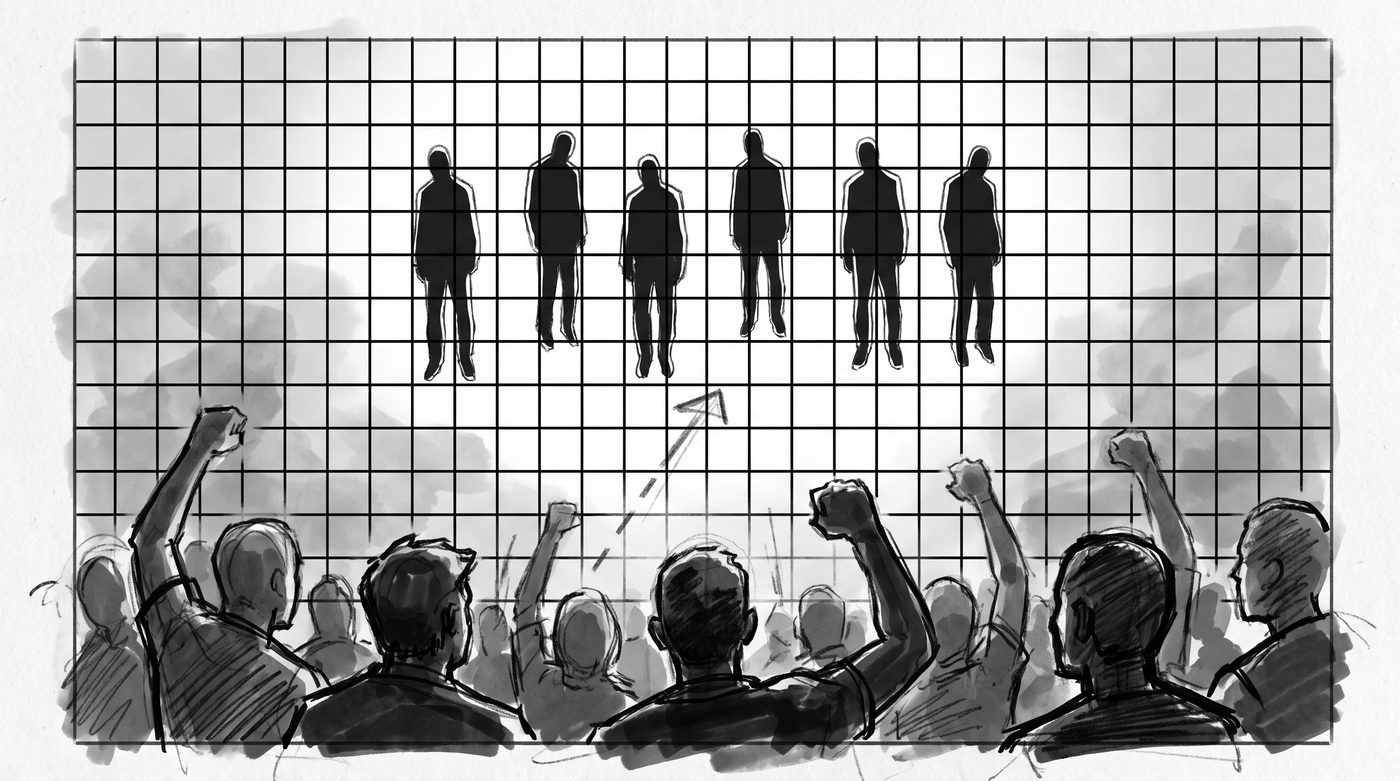
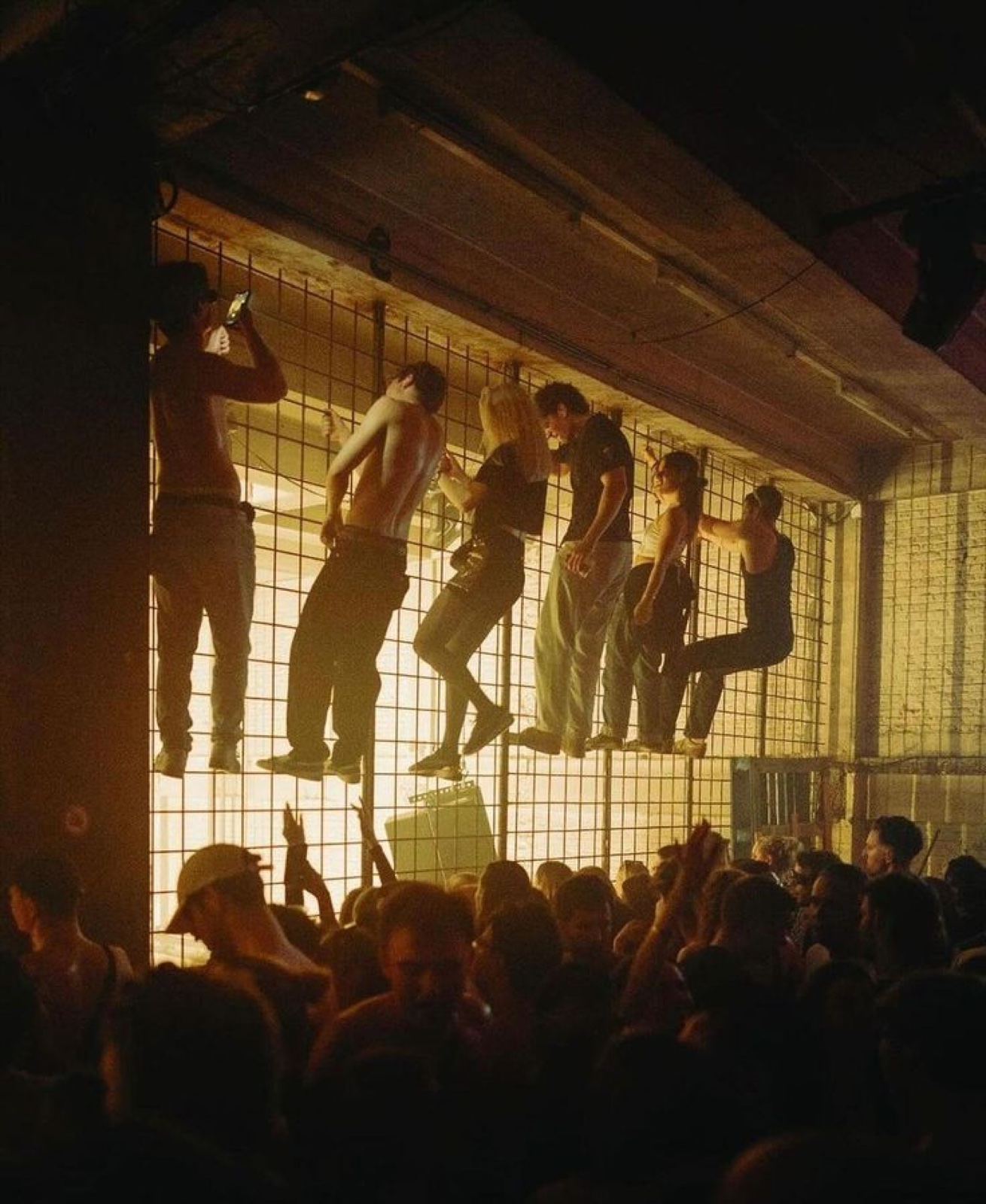
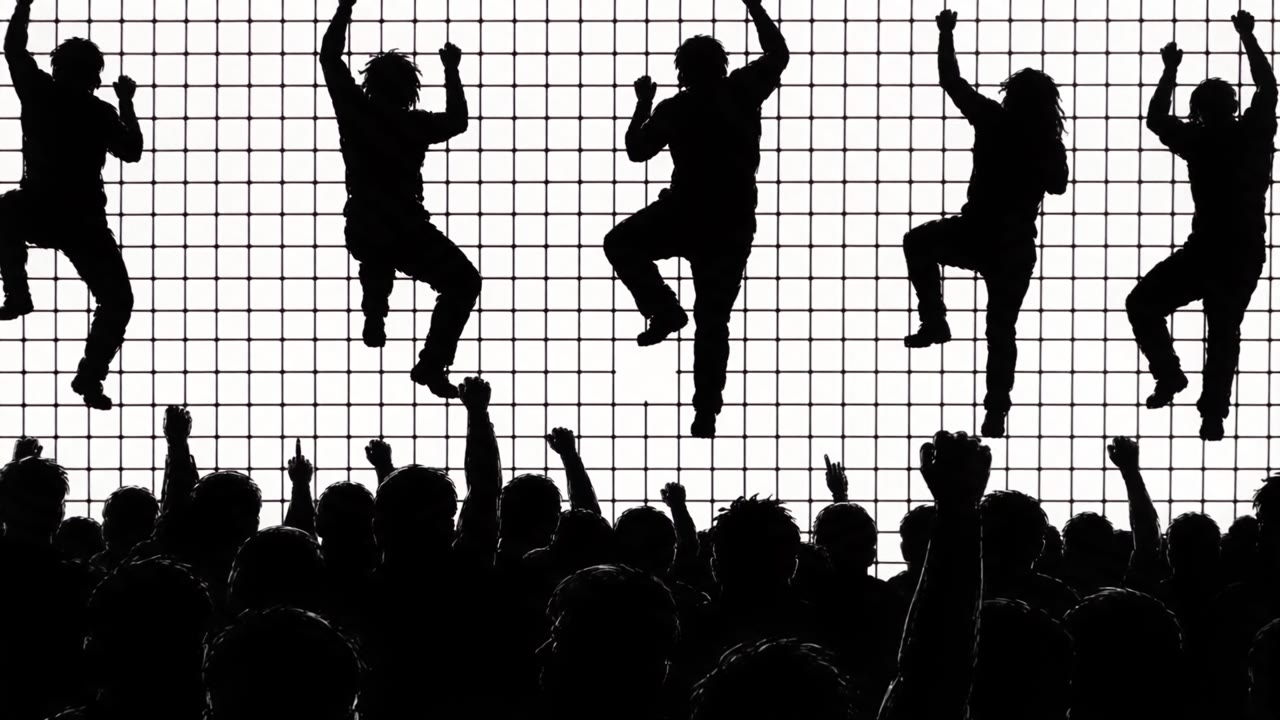
D06. The fence. From just above a packed crowd: a tall fence of square welded wire mesh, face-on and filling the frame, lit from behind so the light blows out to white and the mesh reads as a crisp black grid. A row of people hang from the fence in silhouette; below them, a dark mass of heads and raised fists. Moves: the camera travels over the crowd into one square of the mesh.
The descent from 1B to 1F as six plates for the title's quick cuts. Attach I02 and I03 as style references.
Opening title plate
DREAMERS — OPENING TITLE PLATE (SHOT 1A)

Create one still image: the opening title frame of Dreamers, a black-and-white manga noir animated short. 16:9, highest available resolution. Black and white only.

A flat, pure black plate fills the frame. Cut out of it is the word DREAMER, set in big, heavy, modern sans-serif block capitals in the spirit of the Enter the Void opening titles: a black-weight grotesque or geometric sans, in the family of Helvetica Neue Black, Akzidenz-Grotesk Super or Futura Extra Bold, with uniform stroke weight, flat terminals, sharp square corners and no serifs. Tight kerning: the letters almost touch, separated only by thin slivers of black. One line, centred, spanning about 90% of the frame width, the letters tall and heavy so that each stroke is a wide window. Perfectly clean, crisp edges; the type is not hand-painted, brushed, distressed, stencilled, outlined or decorative. The plate is flat black, with no texture, glow, bevel or shadow.

Through the letter openings, and only through them, we see the action: the attached fight plate, filling the frame behind the plate at full size, so that the letters crop it like windows. The brightest parts of the drawing glow through the letters; where the drawing is black, the letters go dark. The frame reads first as type, then as the violence inside it.

No other text, logos or borders. No CRT, glitch or screen effects; those are added in post.
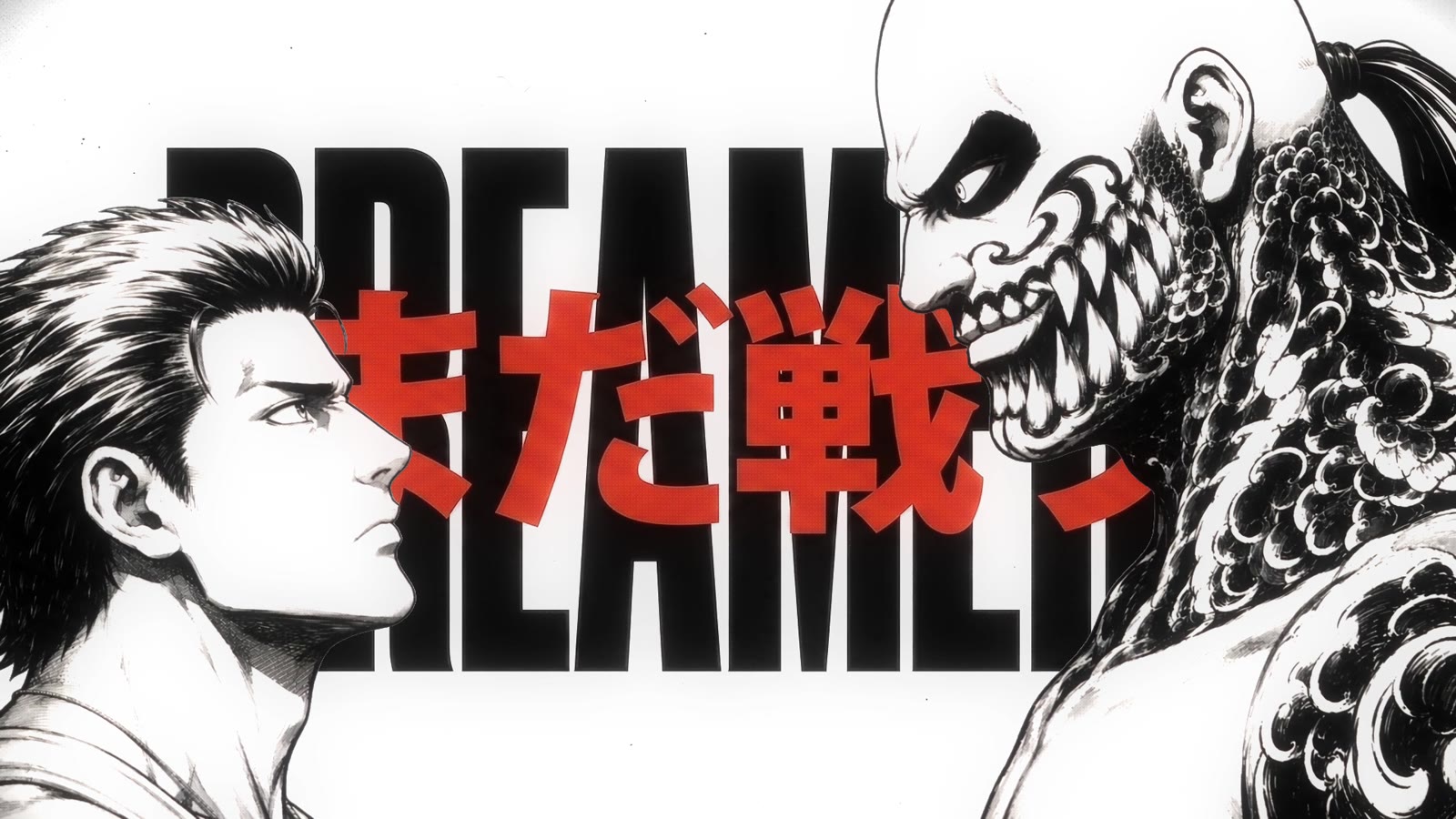
DREAMER cut out of black with a fight plate behind it: key art and a reference for the animator. Attach one fight plate (C01 or C09) and the type matte.
Title montage: 29 clips in 5 seconds
DREAMERS — TITLE MONTAGE (SHOT 1A): 29 CLIPS IN 5 SECONDS

Edit the 29 attached clips into one rapid-fire montage: exactly 5 seconds, 24 fps, 120 frames, 16:9. Black and white only. This is the opening of the film: the whole short, shown in order, too fast to follow.

RULES
- Hard cuts only. No dissolves, wipes, zooms, transitions or added effects.
- Use every clip exactly once, in the order below, for exactly the number of frames given.
- From each clip, take its most active moment: the instant of impact, the snap of a head, the drop of the camera, the eye opening. Play it at its own speed; do not slow it down or speed it up.
- The cuts accelerate: the descent reads, the arena quickens, the fight becomes a strobe.
- Keep every clip in black and white as delivered. No colour, no grain, no CRT or glitch effects; those are added in post.
- Remove all audio from the clips. The soundtrack is laid in separately.

CUT LIST (frames at 24 fps)

The descent: 8 frames each
1. D01 The city, falling through fog: 8
2. D02 The wall, DREAMERS STILL FIGHT: 8
3. D03 The alley, down the fire escape: 8

The way in and the arena: 6 frames each
4. D04 The stairs, POINT OF NO RETURN: 6
5. D05 The smoke-filled walkway: 6
6. D06 The fence: 6
7. P06 His feet settling into his stance: 6
8. P05 His hand slicking back his hair: 6
9. P02 His hand closing on the pendant: 6

The blow: 4 frames each
10. P01 His eye: 4
11. I04 Gurendo loads: 4
12. I02 Gurendo's fist driving at the lens: 4
13. C01 The fist lands on his cheek: 4
14. C02 Over the shoulder: 4
15. C03 Knuckles on bone: 4
16. C04 The follow-through: 4
17. C05 His back hits the canvas: 4

The turn and the strikes: 2 frames each
18. I03 Gurendo's laugh: 2
19. P04 His fist clenching: 2
20. P03 His breath: 2
21. I01 Gurendo's eye, afraid: 2
22. C06 The kick lands: 2
23. C07 Gurendo's face at the kick: 2
24. C08 The fold: 2
25. C09 The cross lands: 2
26. C10 The striker: 2
27. C11 The cheek: 2
28. C12 The aftermath: 2

The fall
29. C13 The landing: 4
30. Pure white: 2

Total: 120 frames, 5.0 seconds. The montage ends on 2 frames of pure white, which is the cut into the next shot.

IF THE TITLE IS COMPOSITED IN THE SAME PASS
Lay the montage behind the attached DREAMER matte, so that it is seen only through the letters, which never change shape. Hold the title still for the first 2 seconds, then push in on the A, accelerating, so that its thick left stroke fills the frame by frame 118, just as the white arrives.
The edit: all 29 animated plates in film order, 120 frames, cuts accelerating from 8 frames to 2, ending on the fall and white. Frame-exact if cut in an editor or with ffmpeg.
Contact inserts C01–C13: the four collisions
DREAMERS — CONTACT INSERTS (SHOT 1A, AND REFERENCE FOR THE FIGHT)

Create a set of still plates of the fight's moments of contact: extreme close-ups where two bodies collide. Each is a separate, clean, finished image: 16:9, highest available resolution. Black and white only, with no colour anywhere. No CRT, scanline, glitch or screen effects; those are added in post. Attach plates I02 and I03 as style references, and the protagonist and Gurendo character sheets for identity.

Style, for every contact insert: the same treatment as the existing inserts. A hand-drawn 2D animation keyframe in the visual language of an adult black-and-white manga and noir graphic novel: black ink and white paper only, large solid black shadows, bright white highlights, confident brush contours with rough dry-brush edges. Bars of slatted light fall across the bodies, as in the existing plates. Each frame is frozen at the exact instant of contact, cropped tight so that both bodies are in frame and the point of contact sits near the centre, in the middle band of the frame. Force reads through the drawing: flesh and skin deforming around the blow; sweat, spit and blood thrown as white and black ink spatters in the direction of force; radial white rays or speed lines bursting from the point of contact, in the manner of a manga impact panel. The background is lost to pure black. No grey wash, gradients, screentone, photographic texture or 3D-render look. No text, logos, borders or panel lines.

Screen direction, for every contact insert: the protagonist attacks from screen-left, Gurendo from screen-right. Spray and debris travel away from the striker.

Cast. Attach both character sheets for every contact insert.
- Gurendo: a heavyweight with a tattooed face and body, black tattooed patches around the eyes, a ponytail and wrapped wrists.
- The protagonist: tall and lean, white tank top, frosted slicked-back hair, a gold pendant on a chain.

Each insert gives the moment, then a line on how it will move when animated.

The blow: Gurendo hits the protagonist (shot 3B)
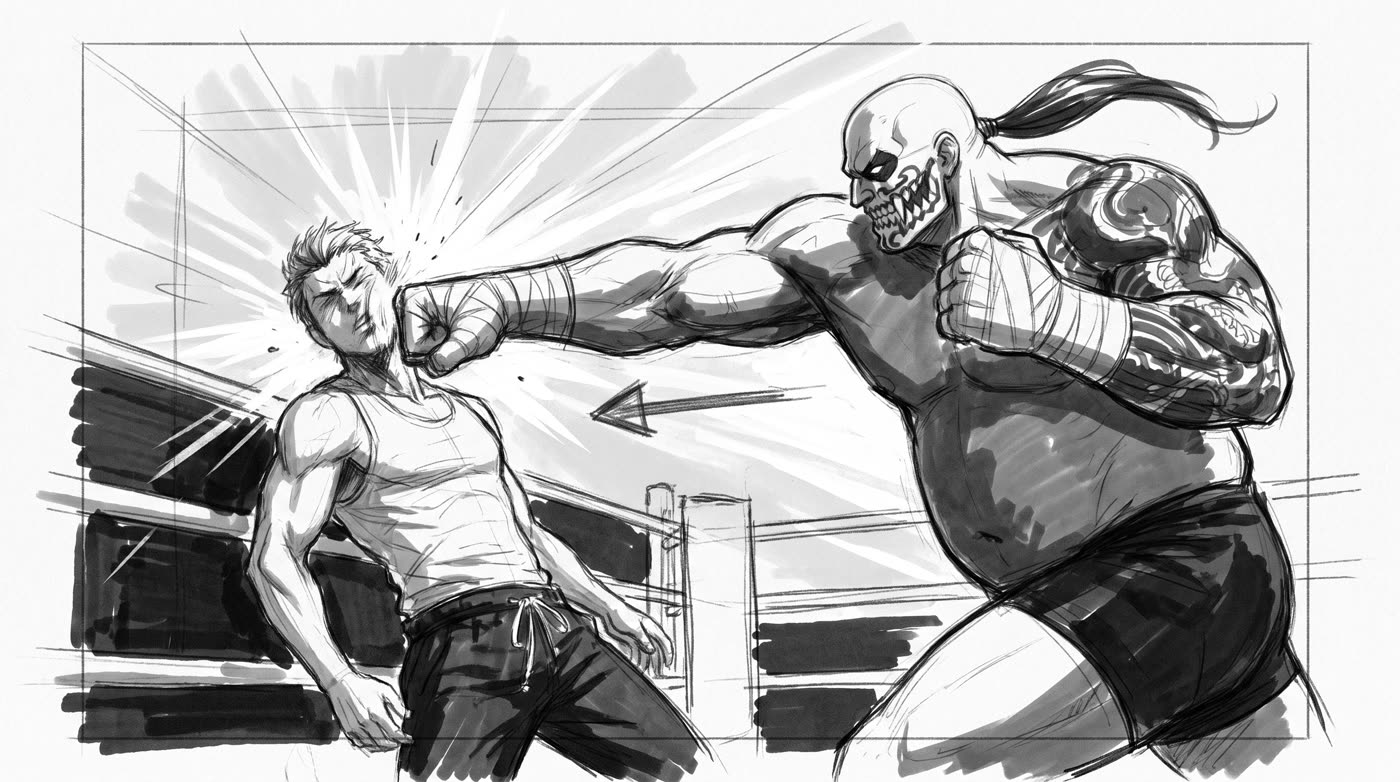
C01. Contact. In profile, Gurendo's huge wrapped fist, coming from screen-right, buried in the protagonist's cheek. His face distorts around the knuckles, his head starting to turn, sweat and spit spraying out to screen-left. Moves: hit stop on contact, then the head whips away.
C02. Over the shoulder. From just behind the protagonist's head: his frosted hair and ear in the foreground, Gurendo's fist arriving into the side of his jaw, Gurendo's tattooed forearm and shoulder filling the right of the frame. Moves: the hair snaps sideways with the impact.
C03. Knuckles on bone. A macro close-up of the contact itself: split, wrapped knuckles pressing into the jaw, the skin rippling outward in a ring. Moves: the ripple travels across the face.
C04. Follow-through. The protagonist's head snapped round, eyes rolling, the gold pendant flying off his chest on its chain, blood droplets hanging in the air, Gurendo's fist carrying on through where his face was. Moves: everything flies to screen-left.

The knockdown (shot 3C)
C05. The canvas. The protagonist's back slamming onto the canvas, sweat and dust bursting up around him, the pendant chain whipping across his throat. Moves: the bounce, then stillness.

The kick: the protagonist hits Gurendo (shot 6A)
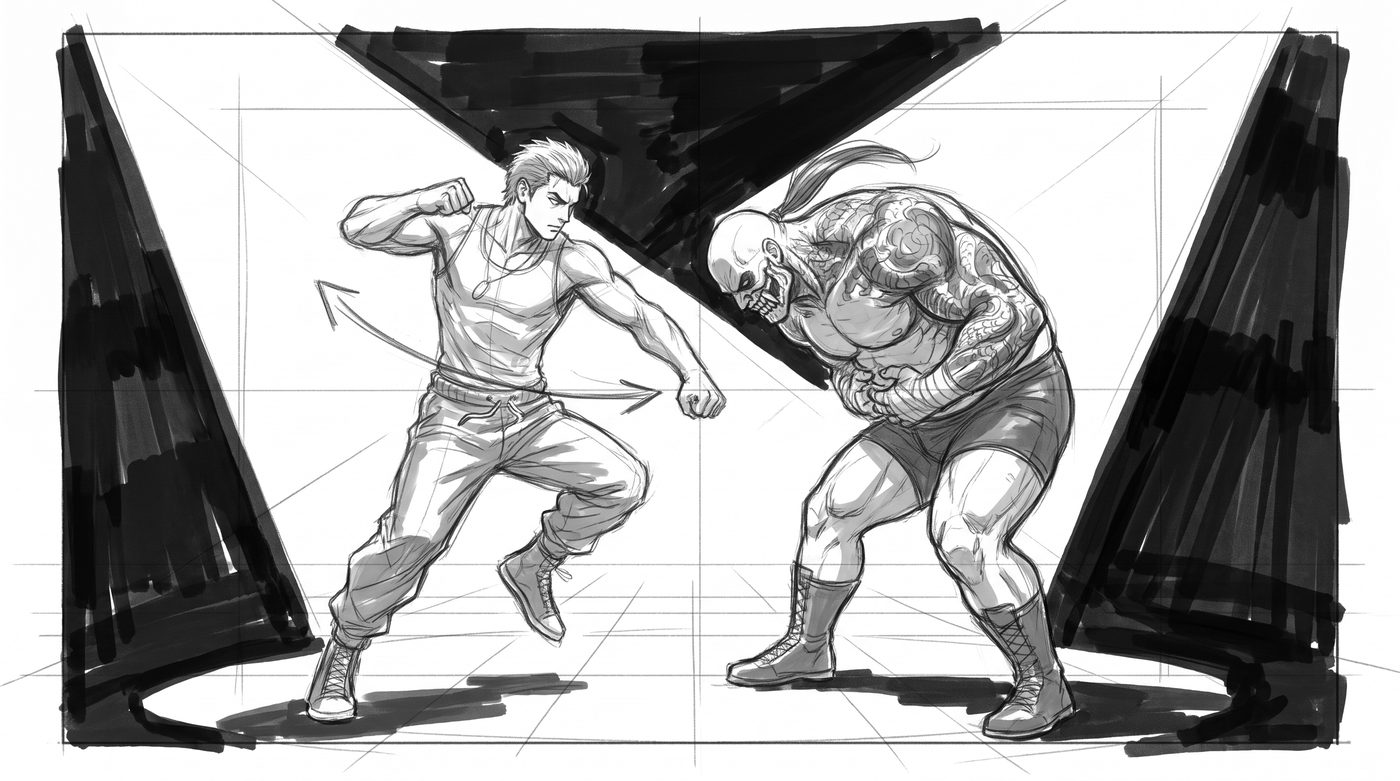
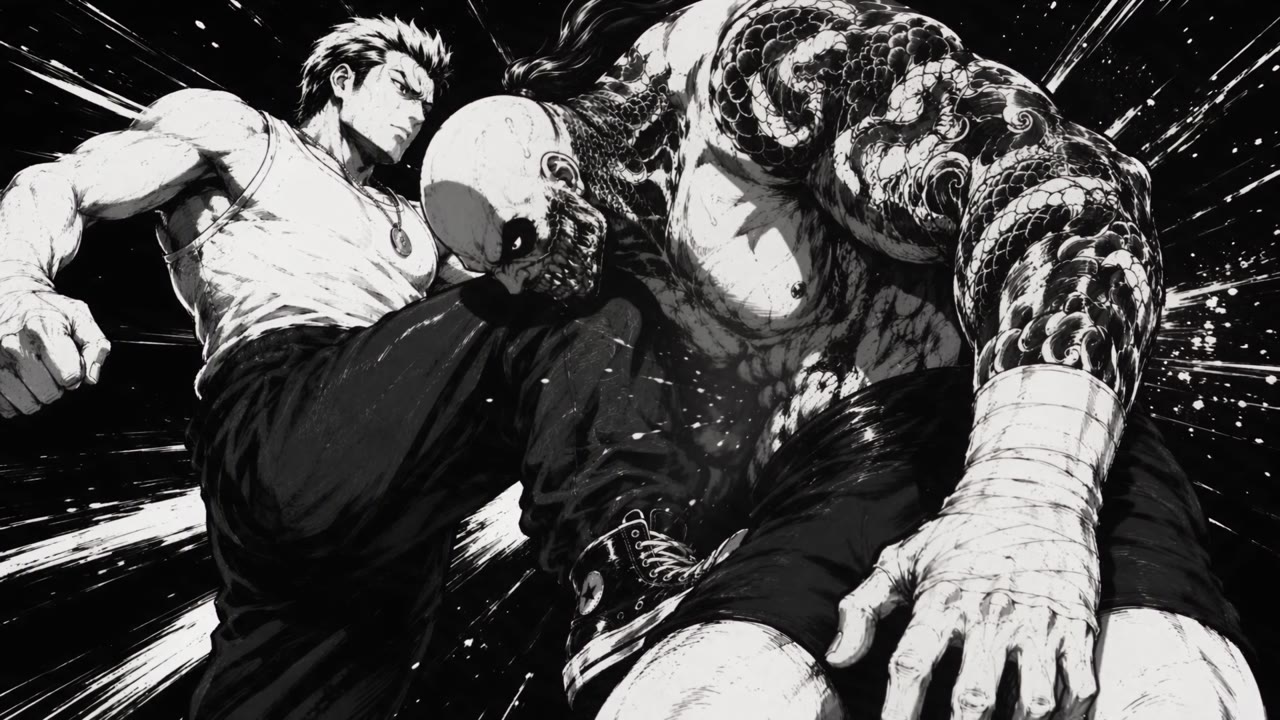
C06. Contact. The protagonist's shin and foot, from screen-left, driven into Gurendo's solar plexus. The tattooed stomach caves around the foot, the tattoo patterns stretching, sweat spraying out to screen-right. Moves: holds at contact while the rays pulse.
C07. The face of it. Gurendo's face at the instant of the kick: eyes bulging, cheeks blown out, spit leaving his mouth, the ponytail lifting. Moves: the air leaves him; his head drops.
C08. The fold. Low angle: the protagonist airborne at the left, knee and foot sunk into Gurendo's gut, the giant folding forward over the leg, his head coming down toward the protagonist's shoulder. Moves: the fold, on 3s.

The cross: the protagonist finishes it (shot 6C)
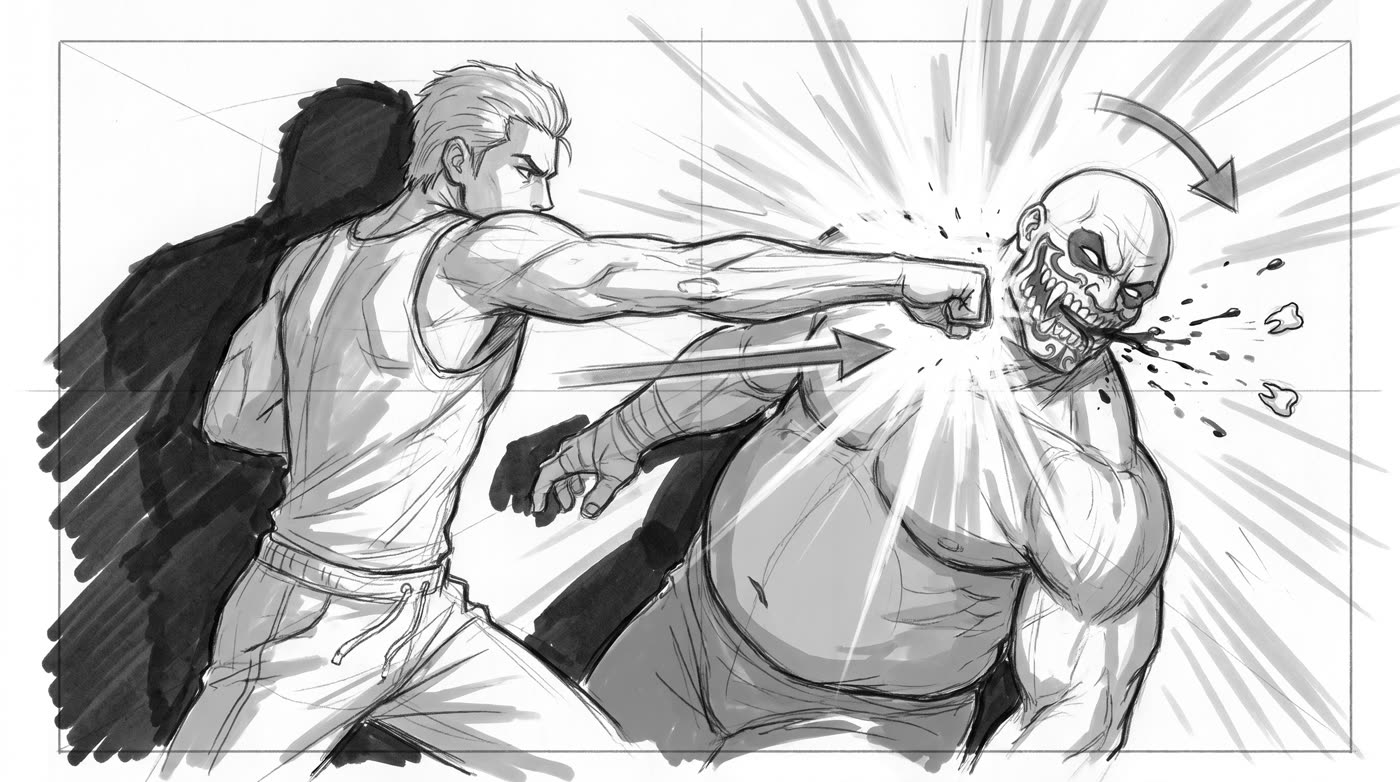
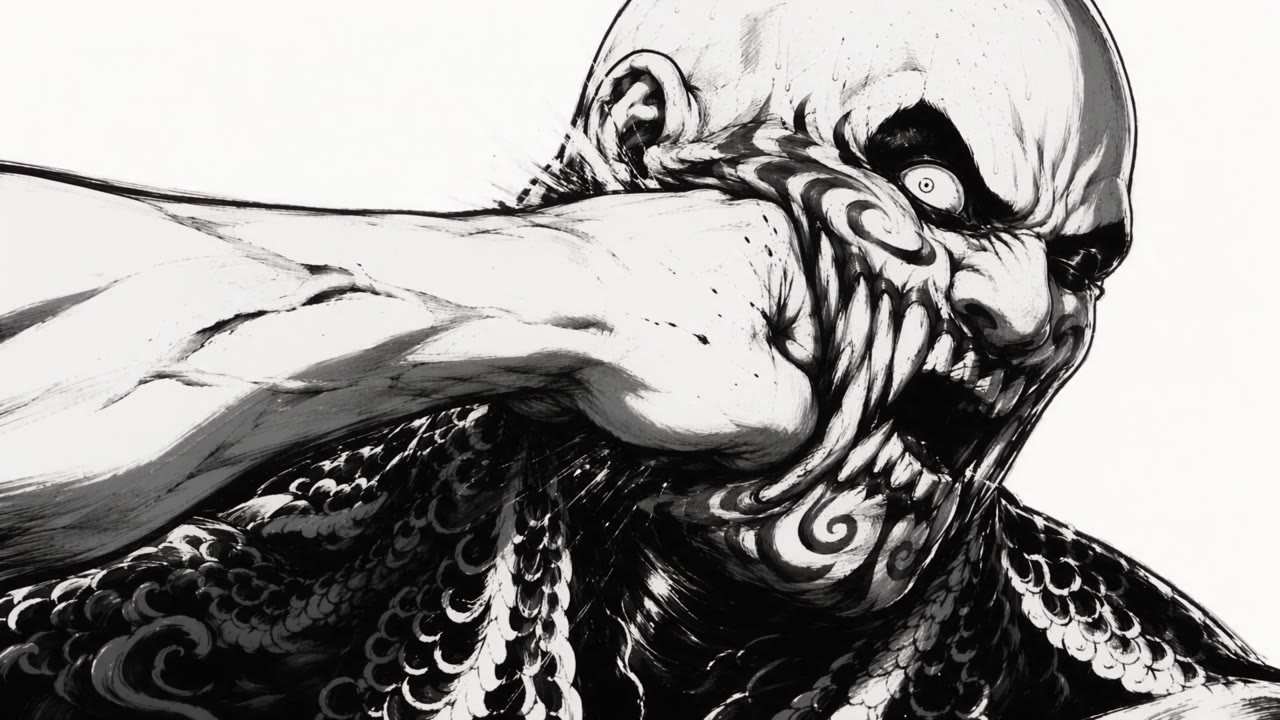
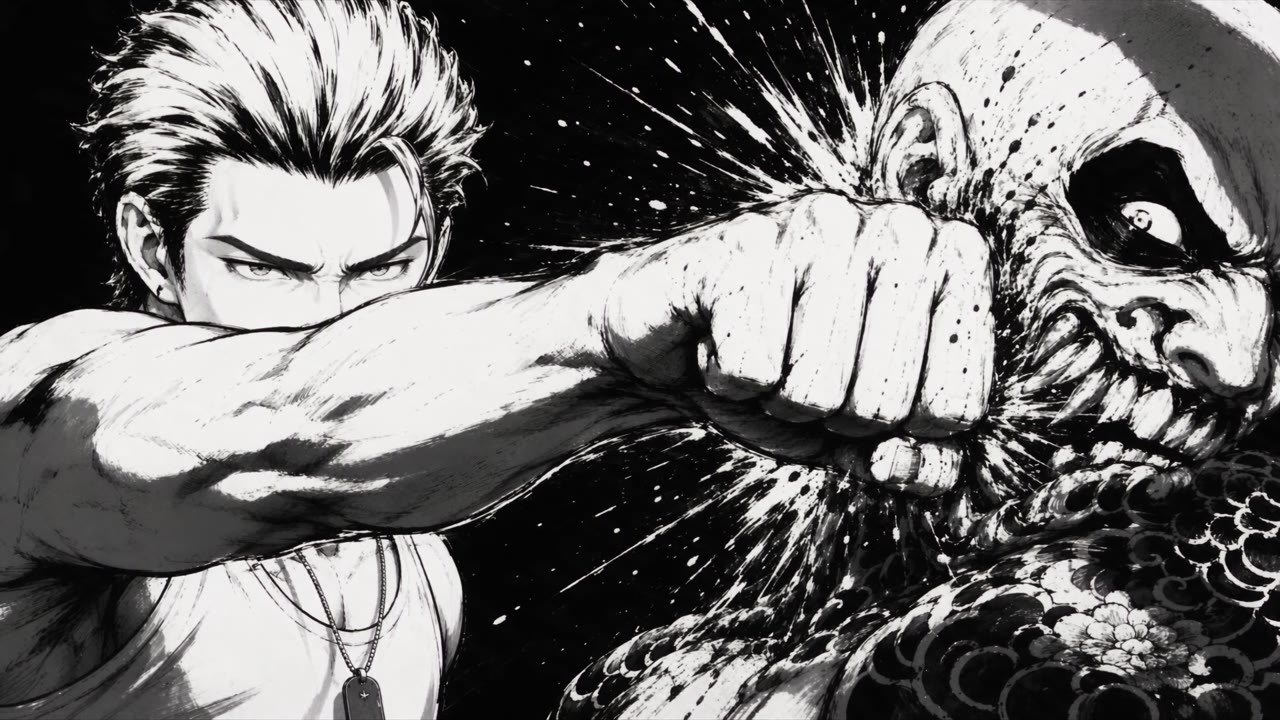
C09. Contact. The protagonist's left fist, from screen-left, sinking into Gurendo's cheek. The face deforms around it; teeth and blood are thrown out to screen-right. Moves: the deformation, in slow motion.
C10. The striker. The protagonist's face behind his own fist at the instant of contact: calm, eyes fixed, one strand of frosted hair falling across his brow, Gurendo's cheek collapsing at the edge of the frame. Moves: nothing moves but the hair.
C11. The cheek. A macro close-up: Gurendo's tattooed cheek rippling around the knuckles, one tooth leaving his mouth. Moves: the ripple, then the tooth.
C12. Aftermath. Droplets, sweat and two teeth hanging in the air against radial white rays, Gurendo's head turned away at the right, the fist still extended at the left. Moves: everything hangs, then snaps back to speed.

The fall (shot 7A)
C13. The landing. Gurendo's huge body hitting the canvas flat, the floor bouncing, sweat spraying, the ropes jumping behind him. Moves: the impact, the bounce, then stillness.
Two bodies colliding, from several angles. Attach plates I02 and I03 as style references along with both character sheets. C06–C12 flash forward to the knockout.
One-shot motion prompt
A 6-second, 16:9, 24 fps opening title shot for a black-and-white manga noir animation called Dreamers. Black ink and white only: no colour, no grey wash.

THE PLATE: A flat, pure black plate fills the whole frame. Cut out of it, centred and spanning about 90% of the frame width, is the word DREAMER in big, heavy, modern sans-serif block capitals, in the spirit of the Enter the Void opening titles: a black-weight grotesque or geometric sans, uniform stroke weight, flat terminals, sharp square corners, tight kerning so the letters almost touch. Perfectly clean, crisp vector edges; not hand-painted, brushed, distressed or stencilled. The plate is completely static: the seven letterforms keep exactly the same shape, edges and spacing for the entire shot. They never wobble, morph, flicker or redraw. The only things that move are what shows through the letters, and the camera.

BEHIND THE LETTERS: Seen only through the letter cut-outs is a rapid-fire edit of extreme close-ups from a brutal underground fight. Hard cuts, no transitions, each close-up cropped tight and filling the frame behind the plate. In order:
1. One wide eye of a tattooed heavyweight, ringed by a black tattooed patch.
2. His huge wrapped fist driving straight at the lens, knuckles split and wet with black blood.
3. His open mouth mid-laugh, bloodied teeth bared.
4. A showman's glasses with DREAMER glowing white across both lenses, a microphone grille below.
5. A young fighter's narrowed eye in deep shadow under frosted, slicked-back hair.
6. A single drop of black blood falling from a split lip.
7. Men screaming against a chain-link fence, fingers hooked through the wire.
8. Looking straight up into a rig of industrial spotlights flaring through haze.
Then the same close-ups again, reshuffled and faster. Each one is a hand-drawn ink drawing: big simple shapes, solid black shadows, bright white highlights, rough dry-brush edges, extreme chiaroscuro, the background lost to black. Each has a little motion of its own on 2s: the fist surging, the drop falling, light raking across the teeth. The close-ups are bright, so the light spilling through the letters pulses with every cut.

TIMING AND CAMERA:
- 0:00–0:02: camera locked so the title reads. Behind the letters, a cut every 6 to 8 frames.
- 0:02–0:05: the camera pushes in, centred on the A, easing in and then accelerating. The letters grow and the outer letters slide off the edges of the frame. The cuts behind them quicken to every 3 or 4 frames.
- 0:05–0:05.5: the push becomes three or four hard jump-cuts in scale, each one closer to the A. Cuts behind it every 2 frames.
- 0:05.5–0:06: the A's thick left stroke fills the frame, so the close-up behind it fills the frame and blows out to white, and the shot ends on a full white frame.
There is only one full-frame white flash, at the very end. Before that, all of the flashing is the light coming through the letters.

SOUND: night-city ambience only, unchanged across the whole shot: rain, a train passing on an elevated line, a distant siren, dogs barking with an echo. No fight sounds, no music, no voices. The fight is seen but not heard.

STYLE: the title is clean modern type; the close-ups behind it are grounded, gritty, adult black-and-white manga and noir graphic novel drawings, hand-drawn 2D animation in rough brush ink. No colour. No glitch, scanline or screen effects; those are added in post. No text other than the DREAMER title and the word on the glasses. No logos, no border.
Tried 13 Oct: premise right, aesthetics off (brushed lettering). Updated with the block-type spec. Use it after the plate pack, with the plates attached as references.
Flash rate
Keep large-area flashes under about three per second if the film is shown publicly, or open with a photosensitivity warning card. Enter the Void goes well past that limit; we borrow its energy, not its strobe rate. Storyboard question 8.