cinepaiHajime

The Black House · Ballroom

Hajime

Dragon & Tiger Clash

The call

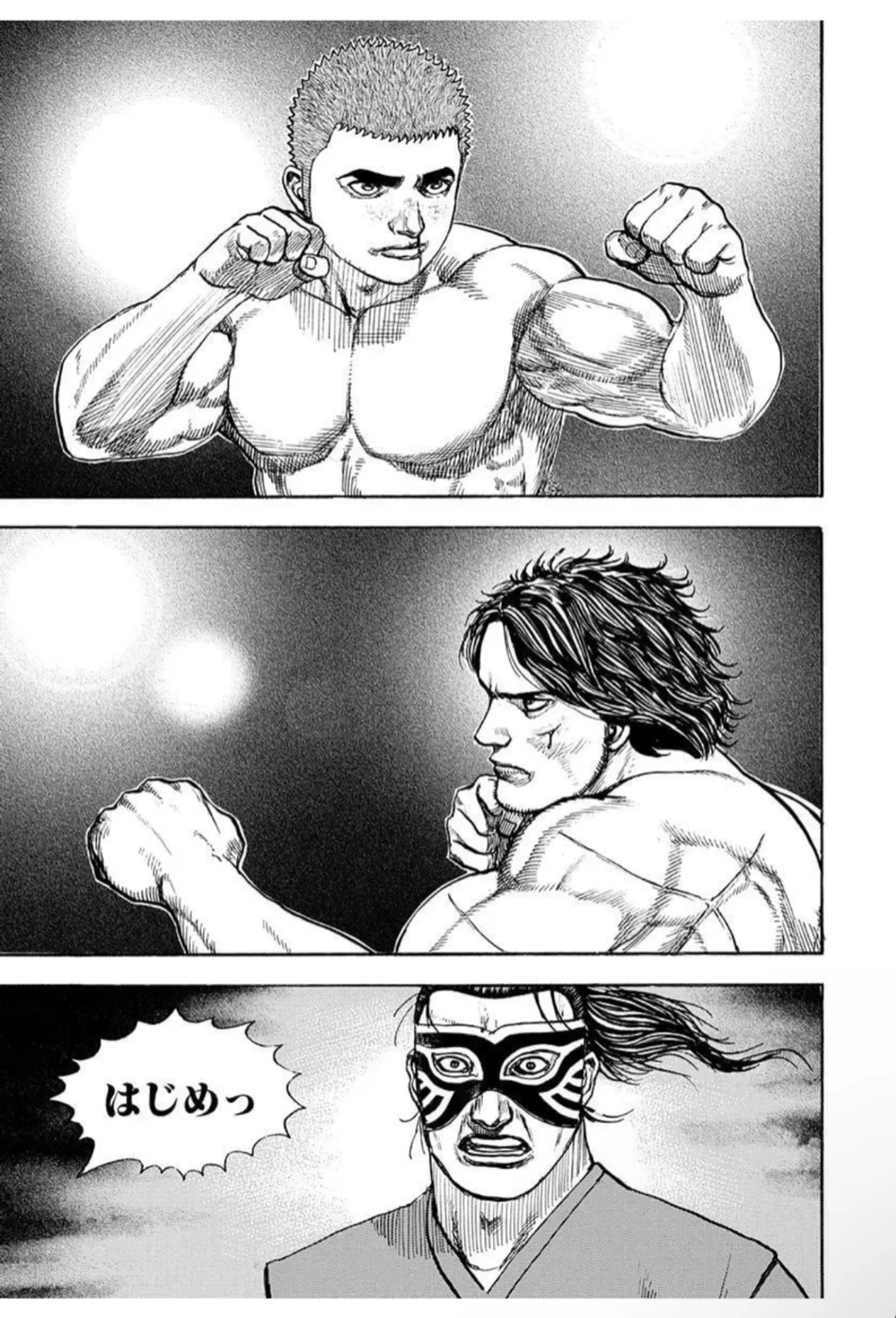
The source's first manga page: the two fighters face each other, and the masked referee calls the restart in a speech balloon.
The source, page 1. The masked referee restarts the fight: はじめっ

S08 CU, the Battle King's mask, 1.2 s

“Hajime!”

The dragon’s son meets the tiger’s son.

Jet is the jujutsu world champion, and Kiichi beats him at his own game: he takes him down, mounts him, and then uses Jet’s own escape to lock a triangle he won’t let go of, even when they both go over the ropes.

The scene

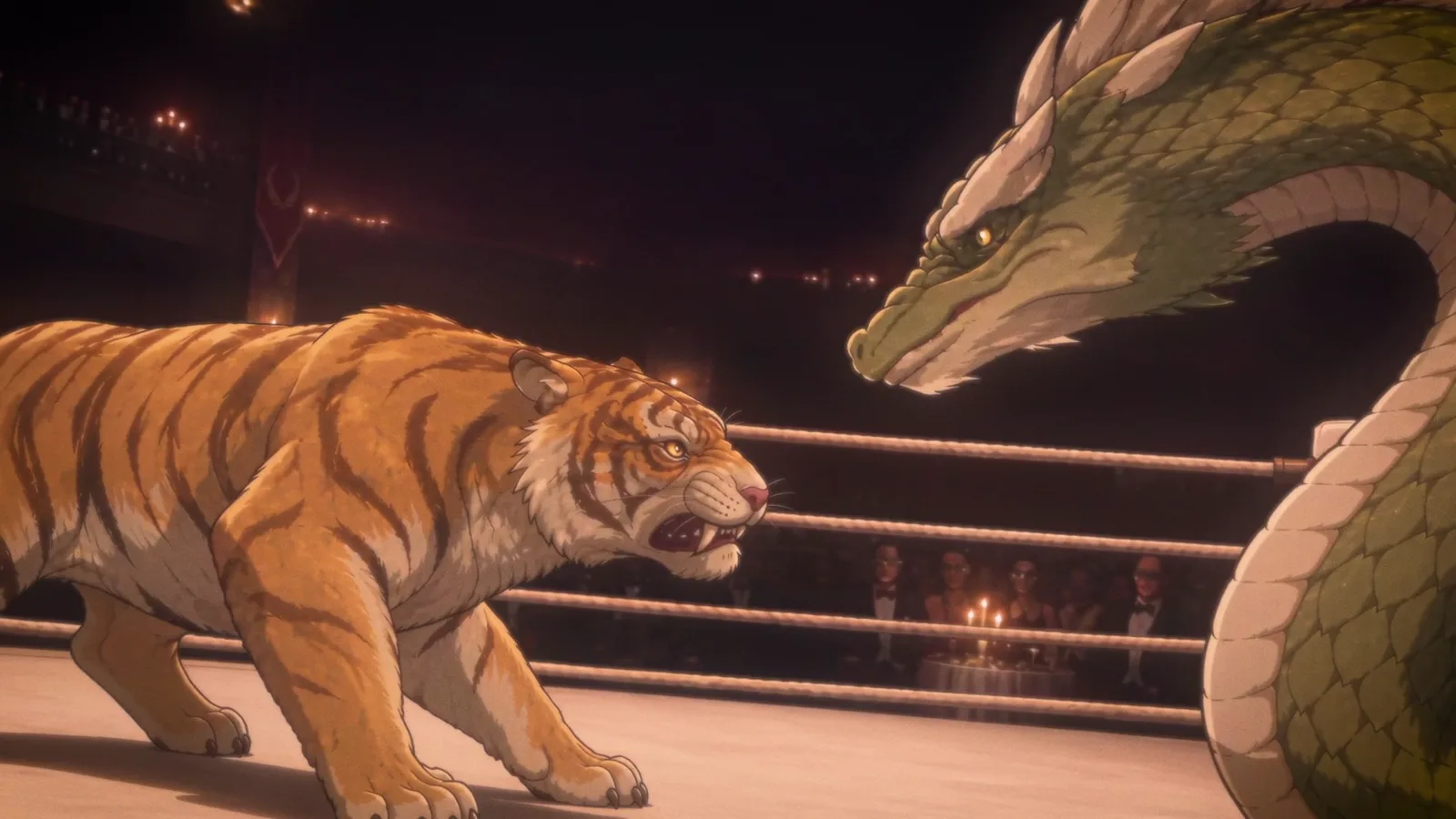
A tiger prowls the ring’s canvas toward a green dragon coiled over the ropes, the masked guests watching from their tables.
Length
2 minutes 47 seconds, from a plan of 75
Shots
41 planned, each with a permanent ID, S01 to S41
Look
2D anime throughout, some 2.5D allowed
Voices
English, with no narrator
Place
One location: the Black House, outside and in
Cast
Kiichi, Jet, the Battle King, the masked guests
Jet
“Jet never speaks; he is deaf and doesn’t speak.”

Characters

Jet, the dragon. Kiichi, the tiger. The Battle King between them, and the masked house around them.

The fighters

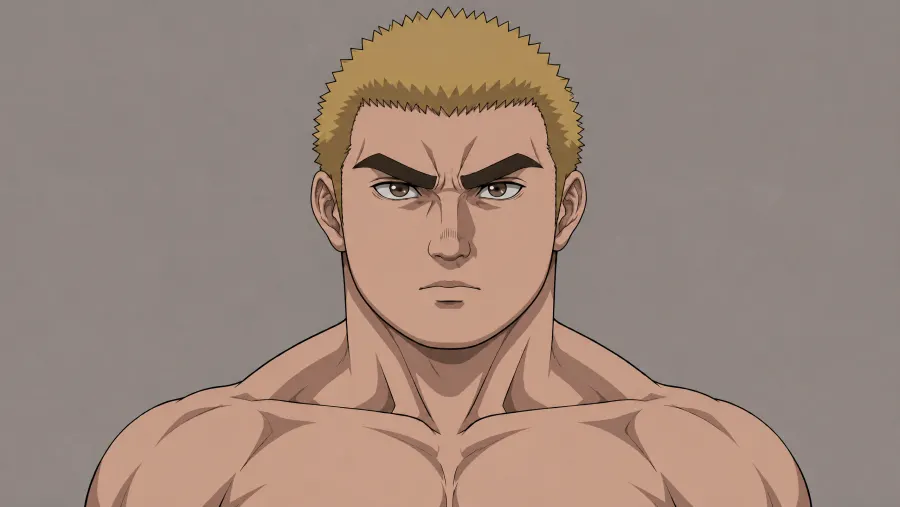
Kiichi, from his character sheet.
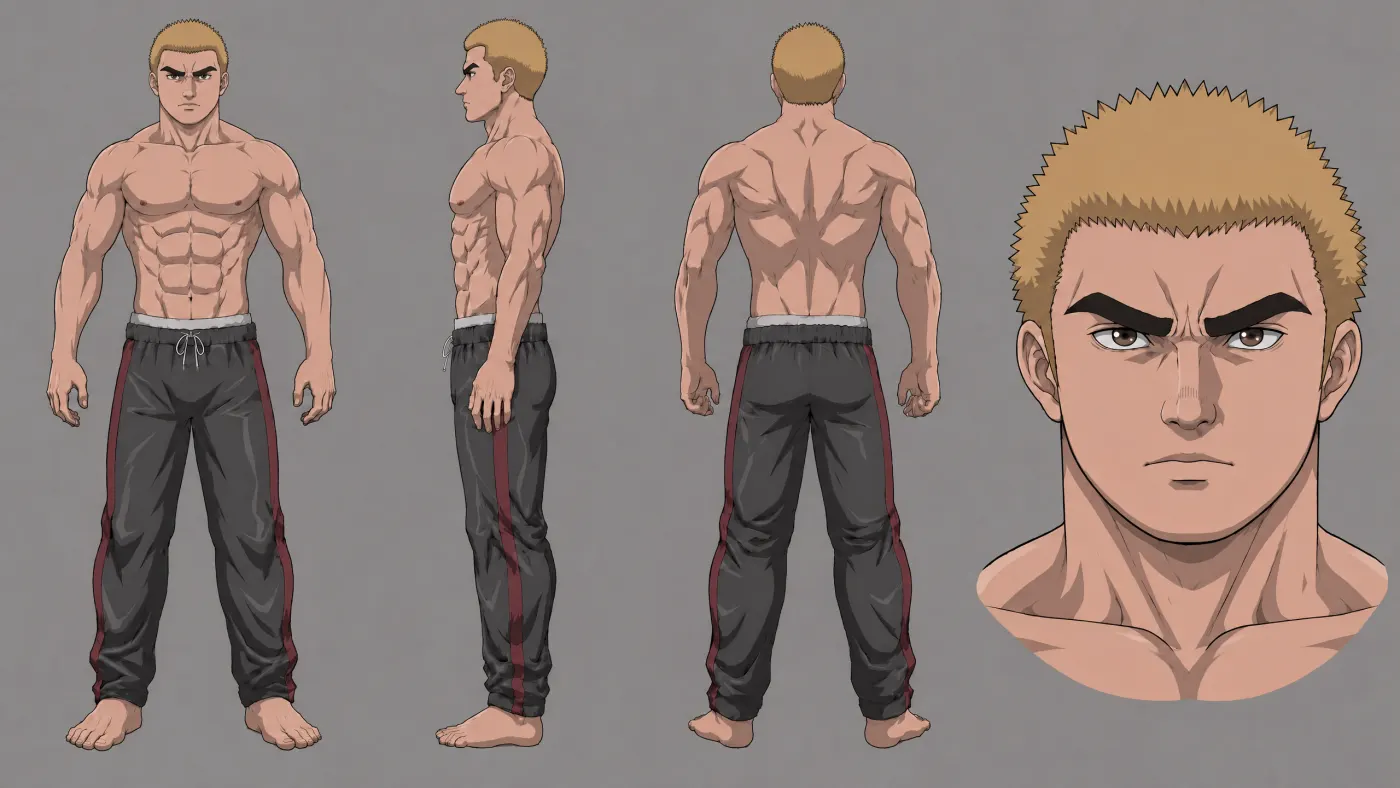
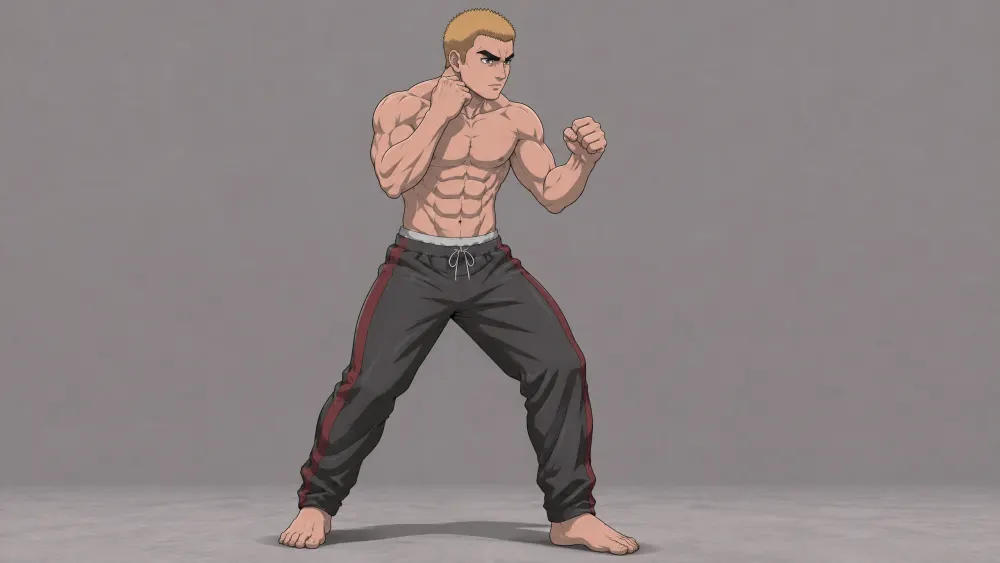
KiichiShort blond buzzed hair, dark trousers with burgundy side stripes, barefoot, a compact muscular build.
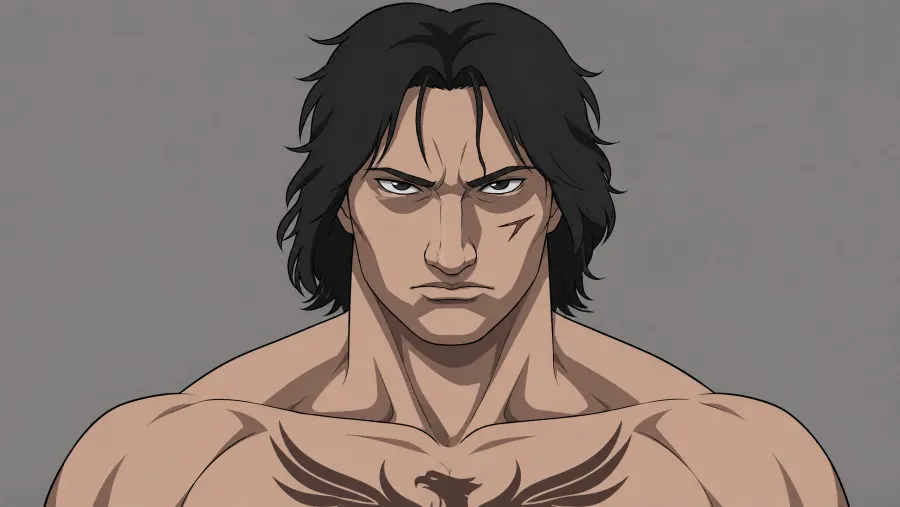
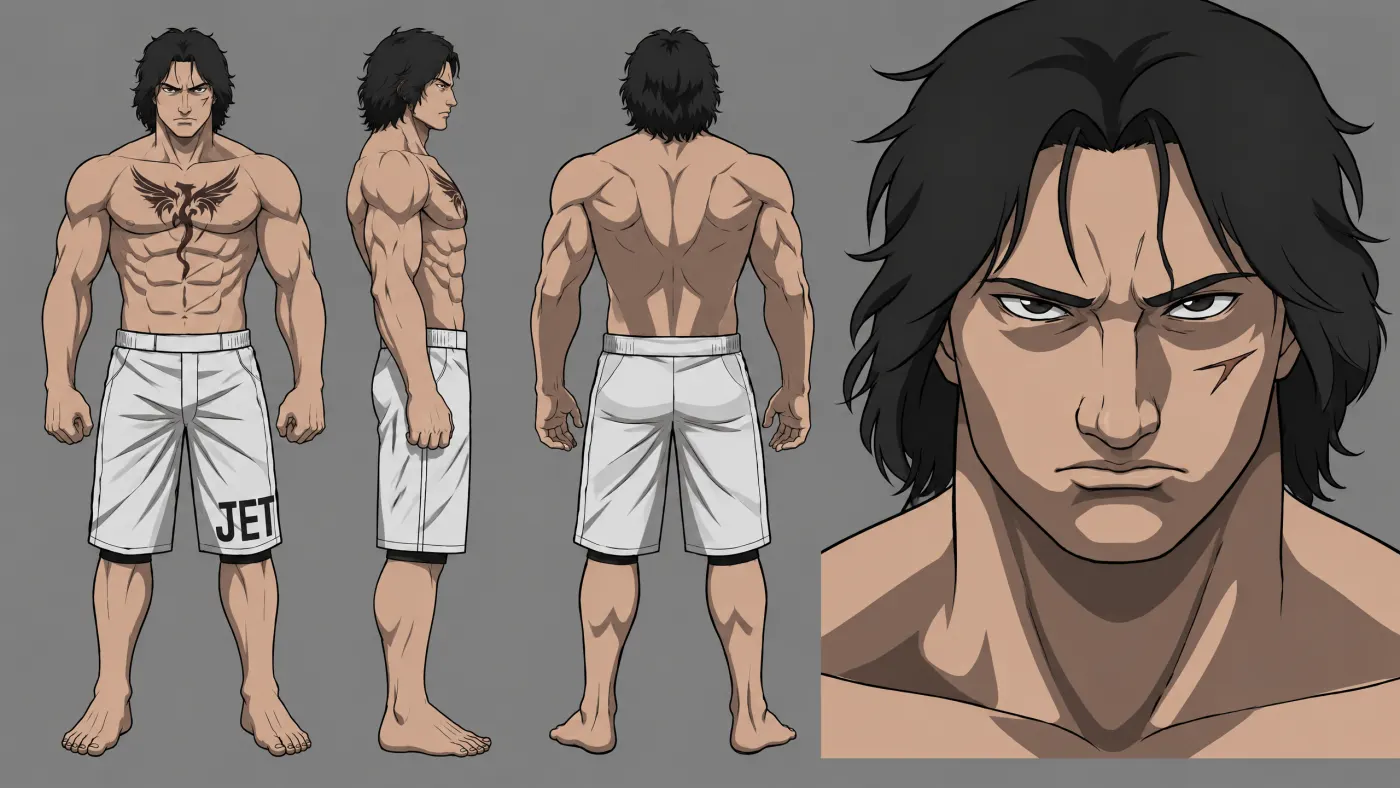
Jet, from his character sheet.
JetTousled dark hair, the cheek scar, a centred wing-like chest tattoo, white shorts lettered JET, barefoot. Silent throughout.
Kiichi's turnaround sheet: front, side and back, and a portrait.Jet's turnaround sheet: front, side and back, and a portrait.

From PAI’s handoff: “Never mirror the scar, tattoo, shorts seams, or lettering when changing camera angle or screen direction.”

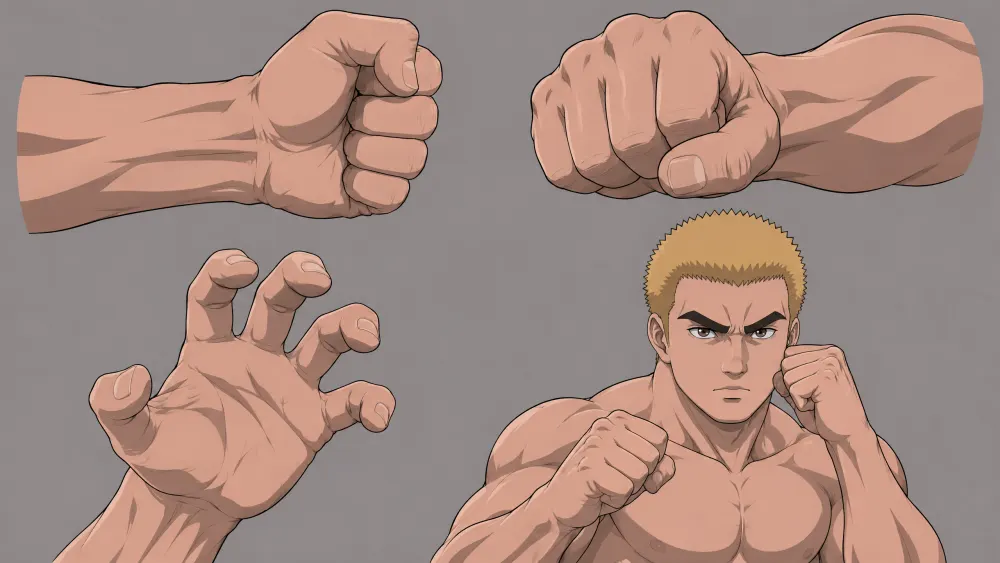
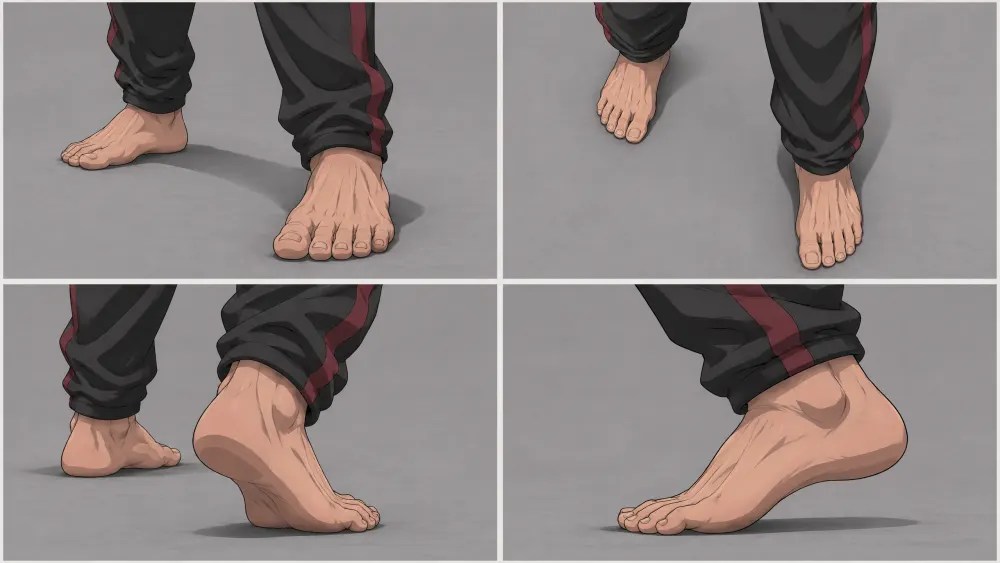
Hands, feet and guard

Kiichi's hands reference sheet.
Kiichi Hands
Kiichi's feet reference sheet.
Kiichi Feet
Kiichi's guard reference sheet.
Kiichi Guard
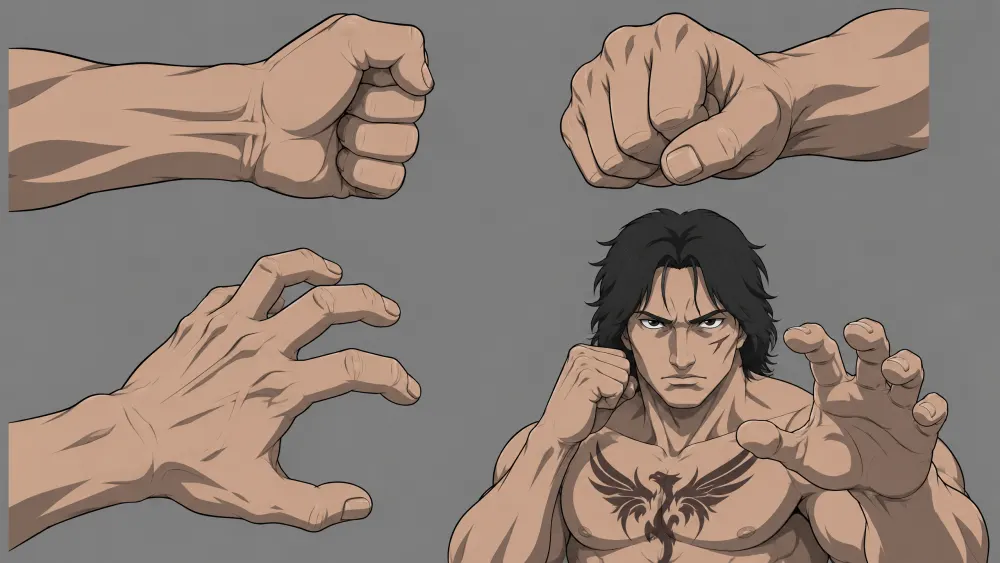
Jet's hands reference sheet.
Jet Hands
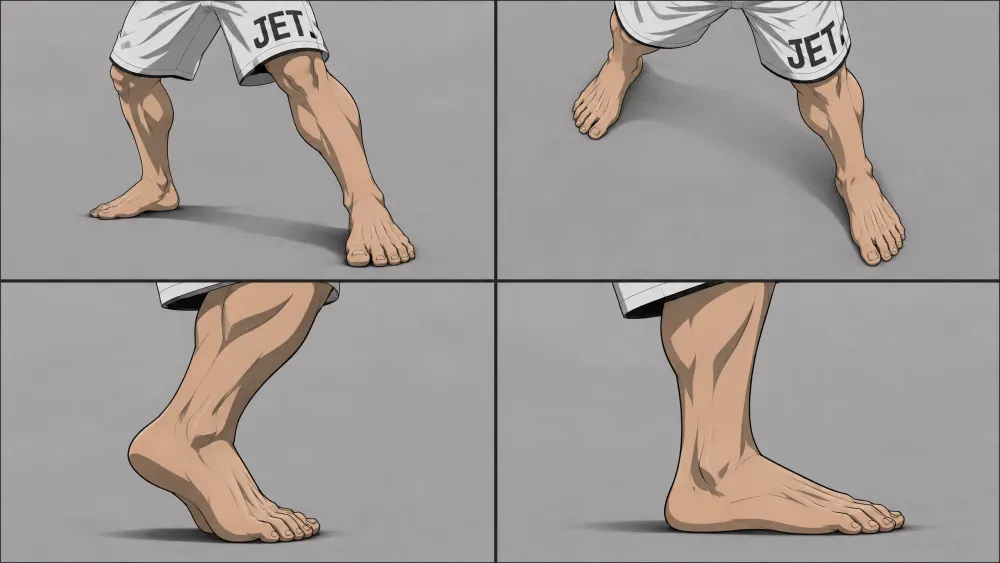
Jet's feet reference sheet.
Jet Feet
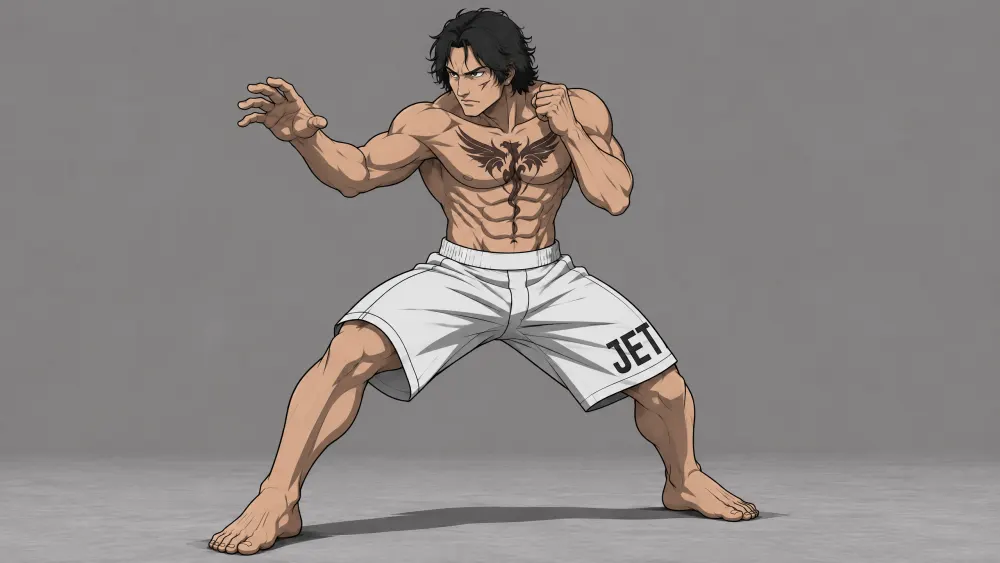
Jet's guard reference sheet.
Jet Guard

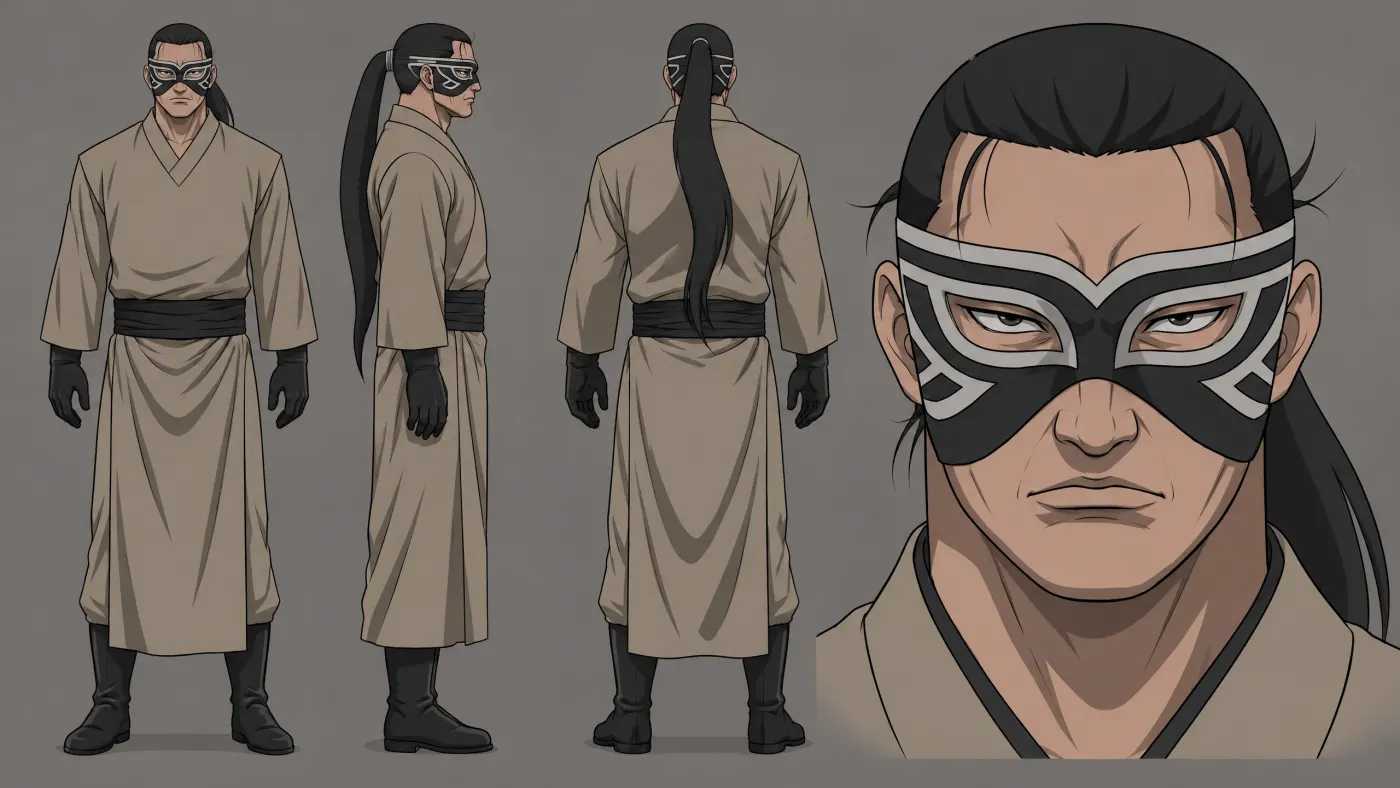
The Battle King

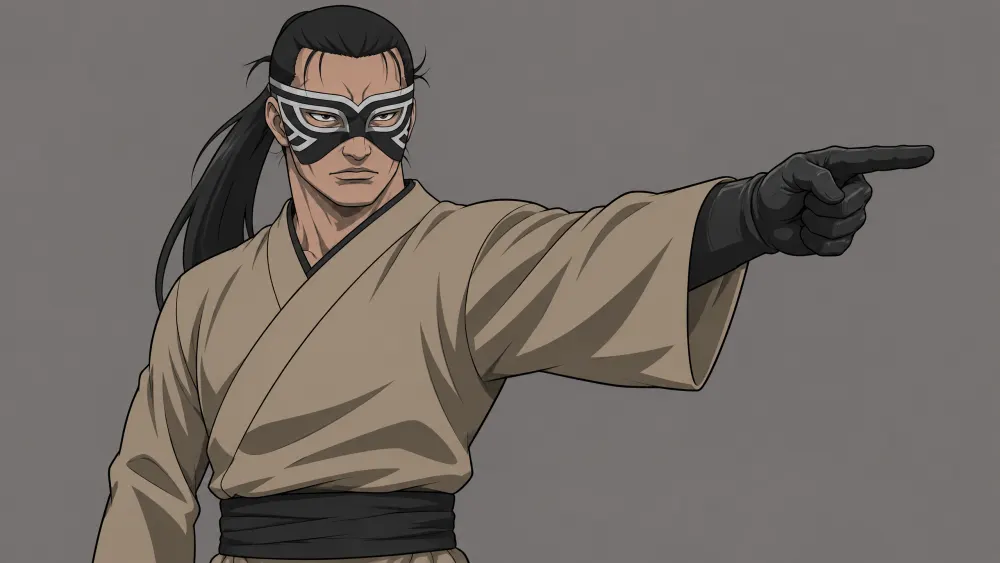
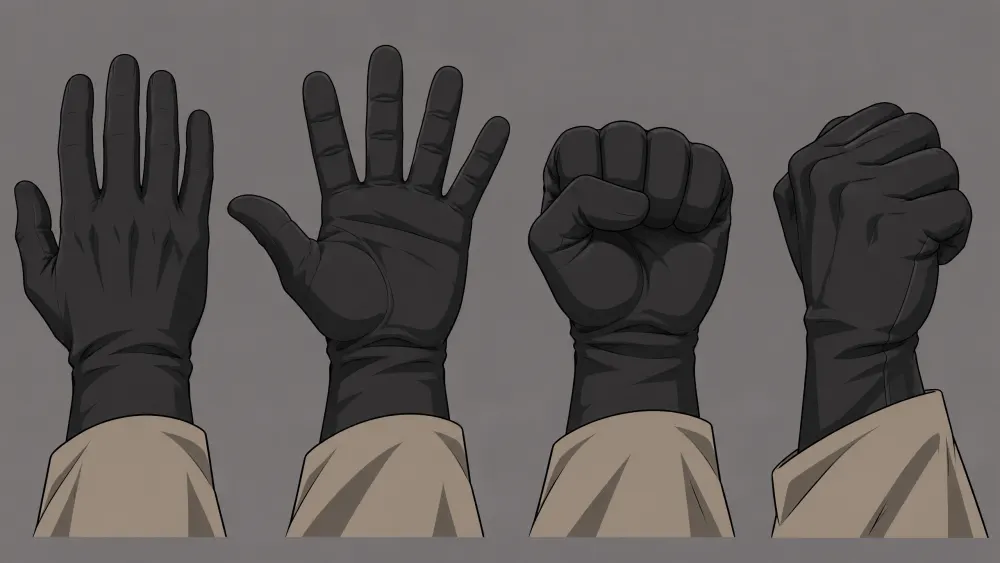
The Battle King's turnaround: angular black mask with light edging, a long dark ponytail, a beige wrap garment, black sash, gloves and boots.The Battle King pointing, his gloved arm straight out: the shoot sign.The Battle King's black gloves from four sides.

In the script: “the Battle King’s gloved finger points (the shoot sign).” S29

The crowd

“We want to know what the crowd’s going to look like … we want to make sure we have good diversity of characters there.” Matt, to PAI

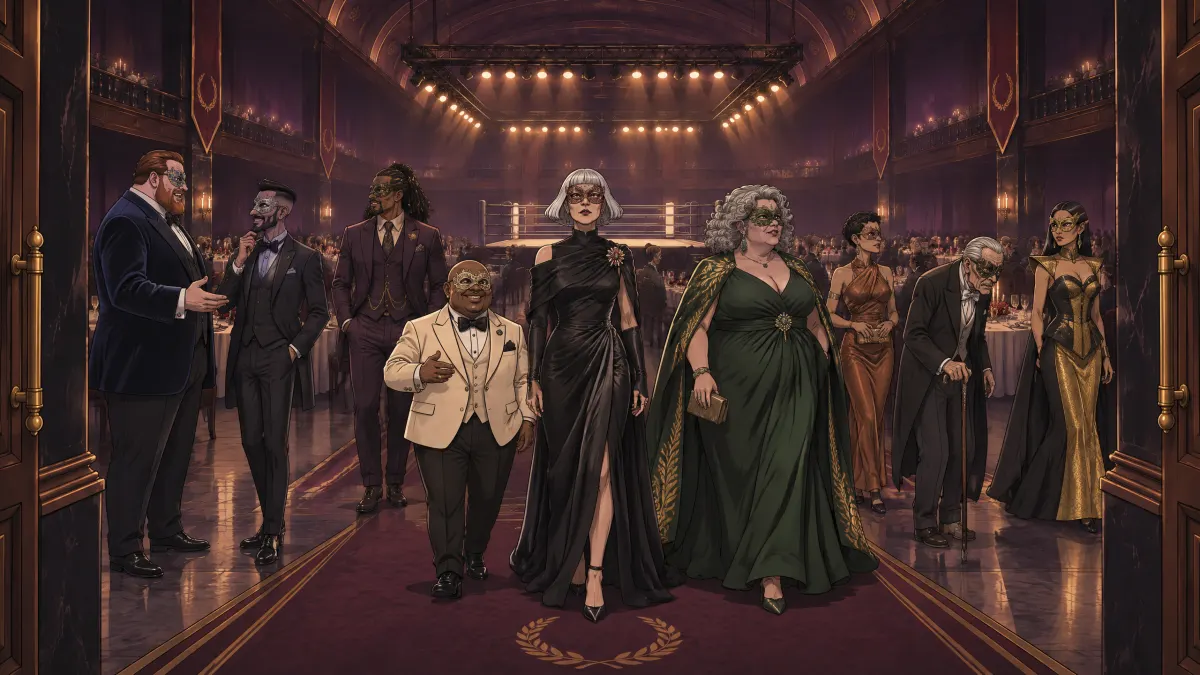
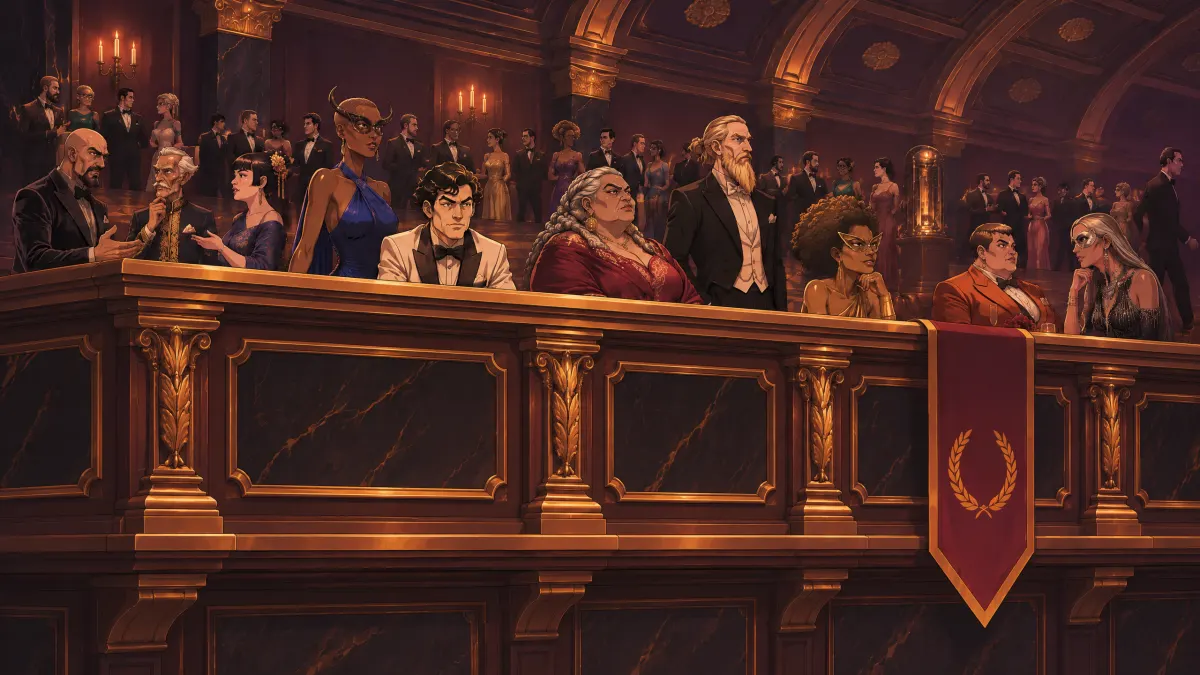
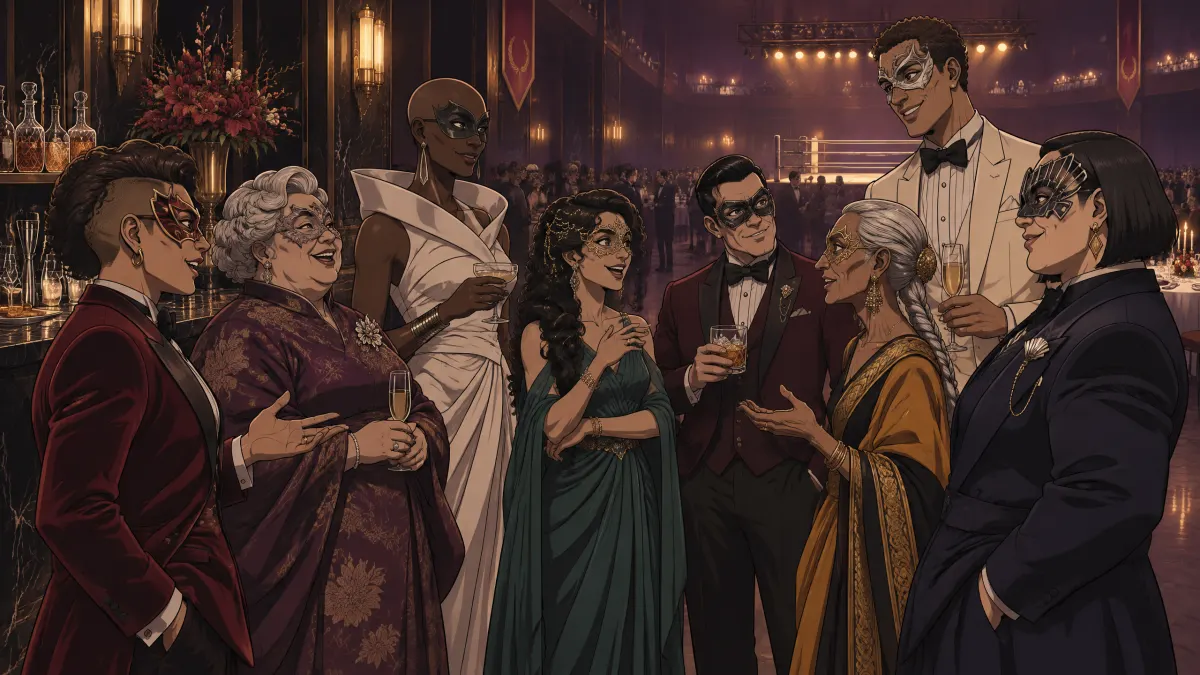
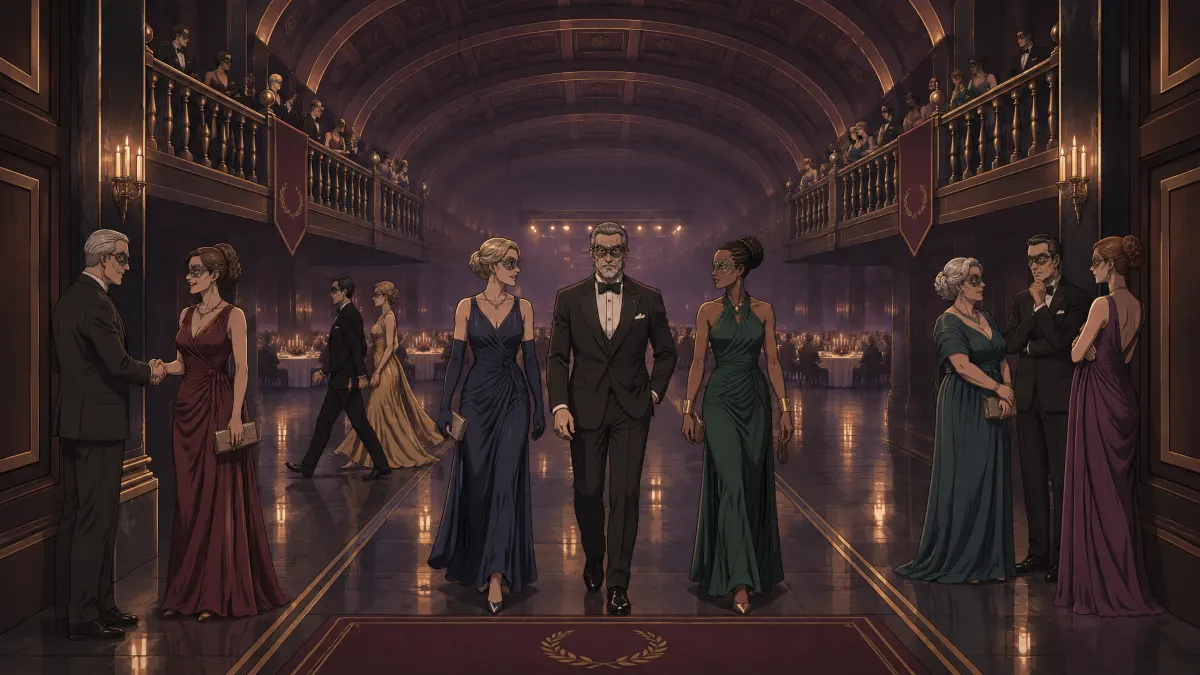
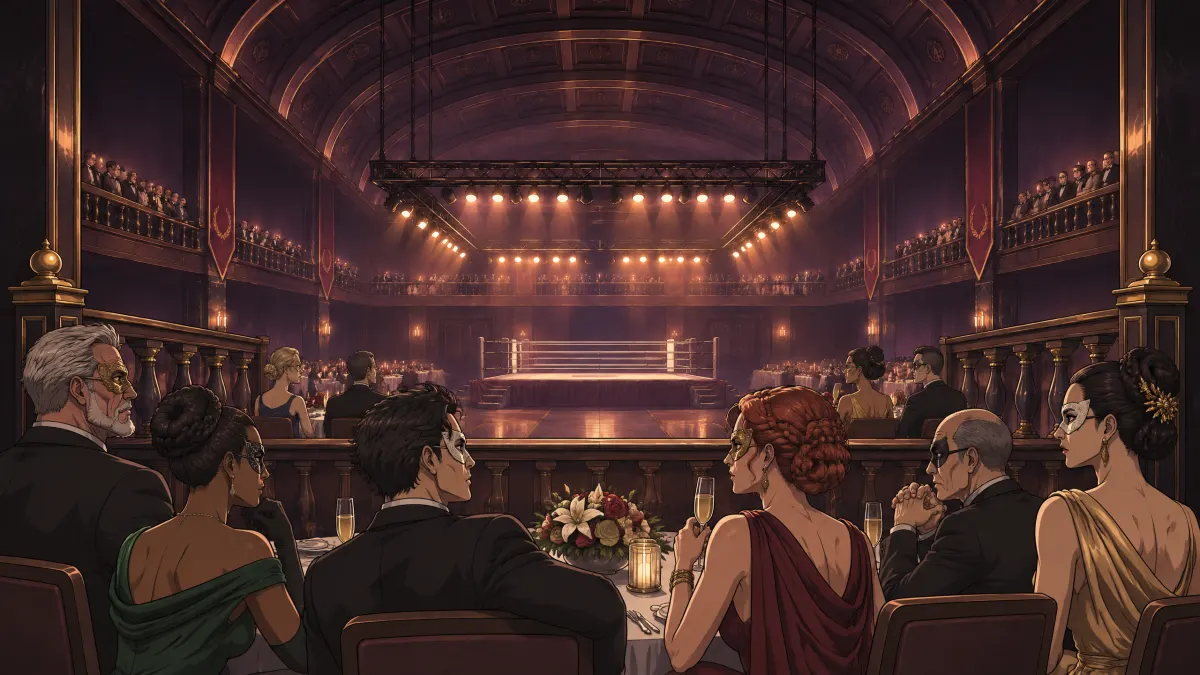
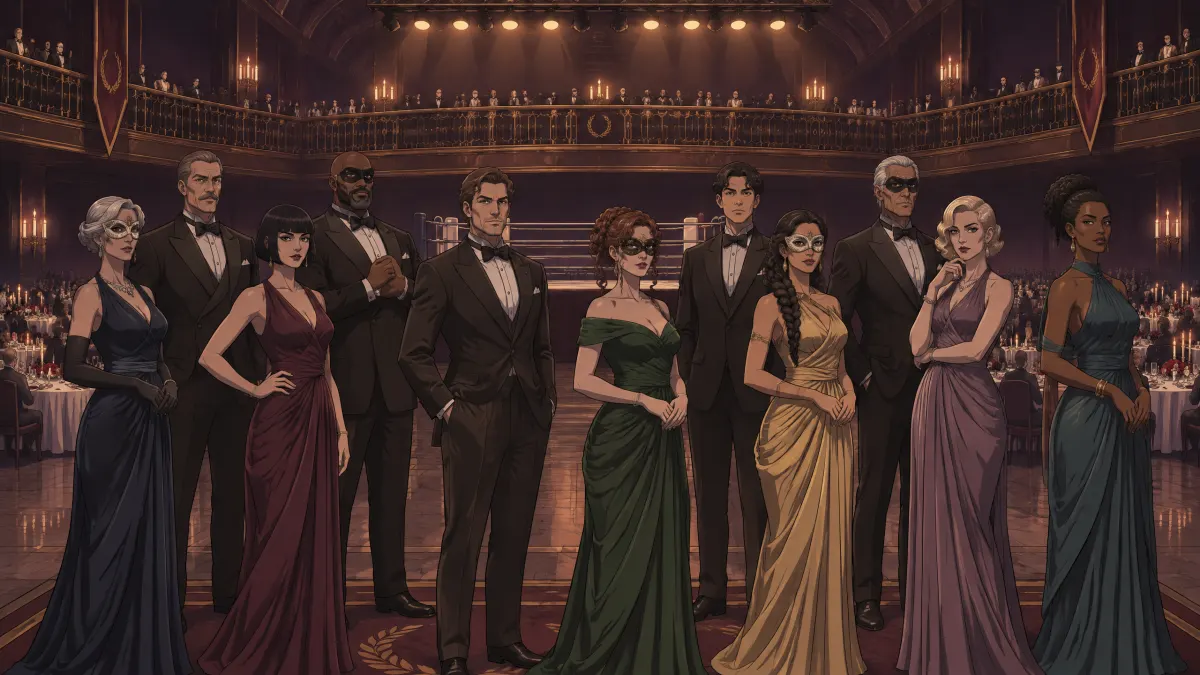
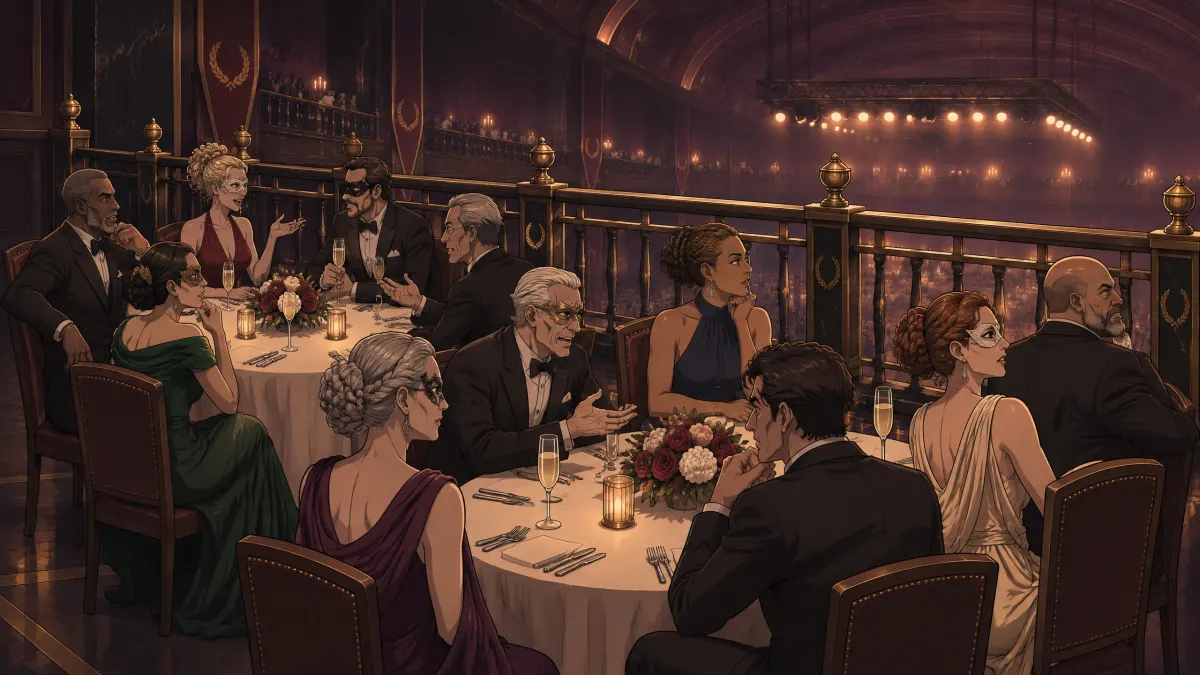
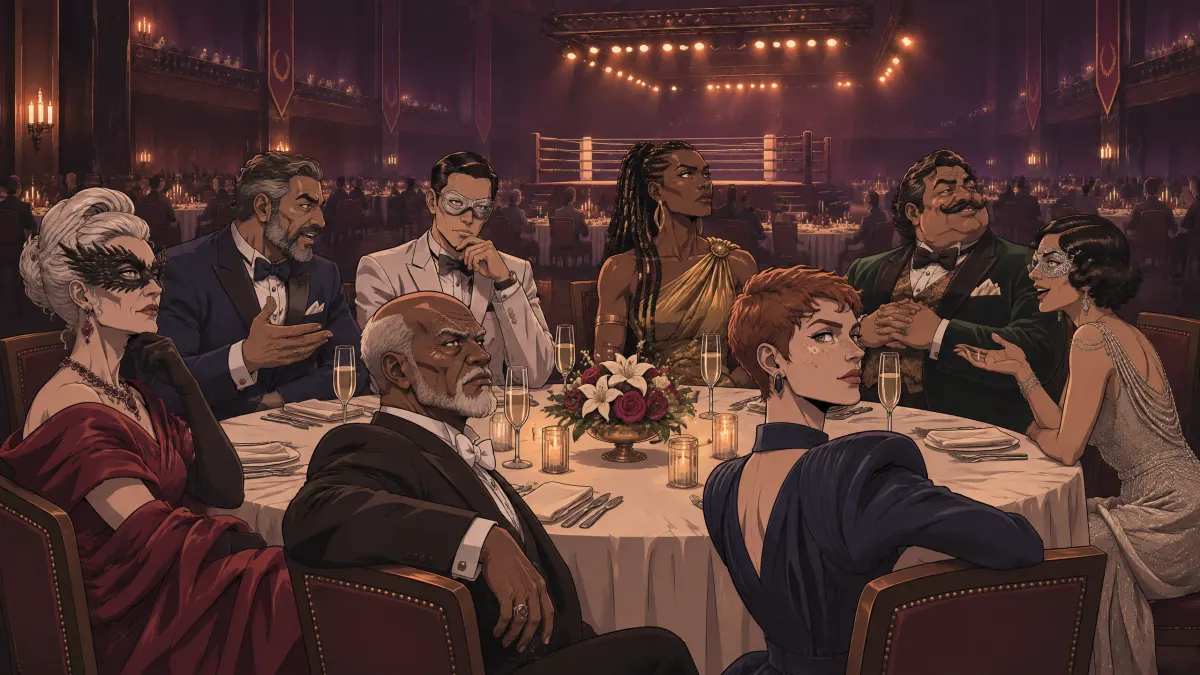
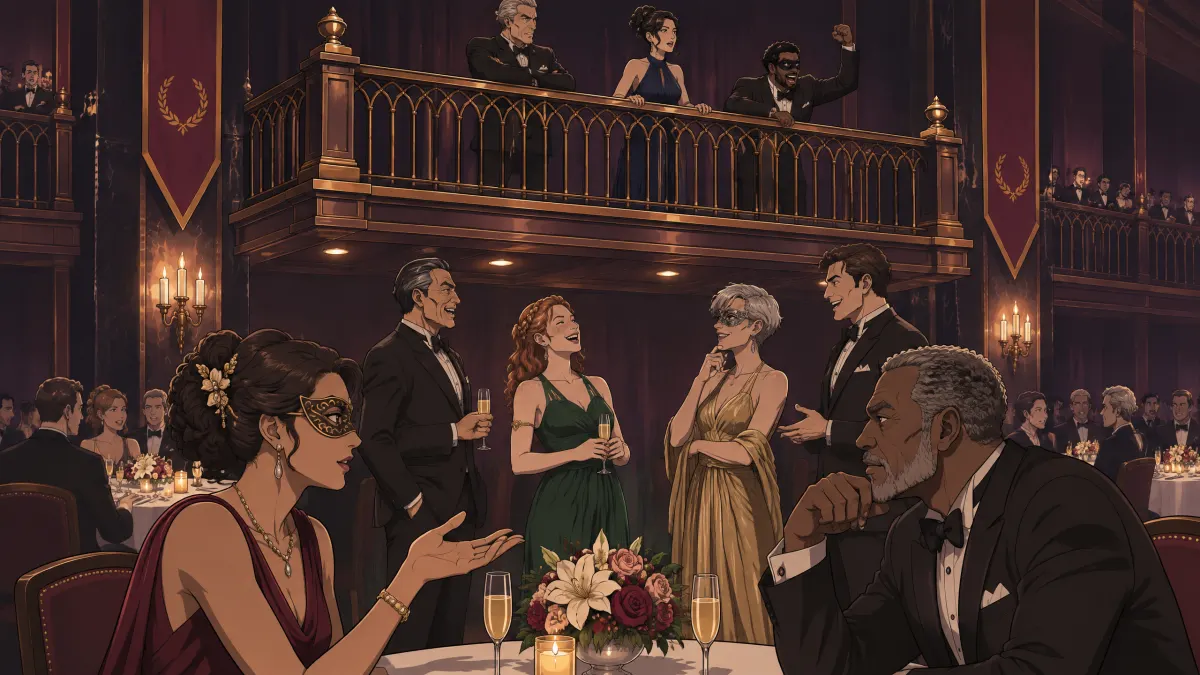
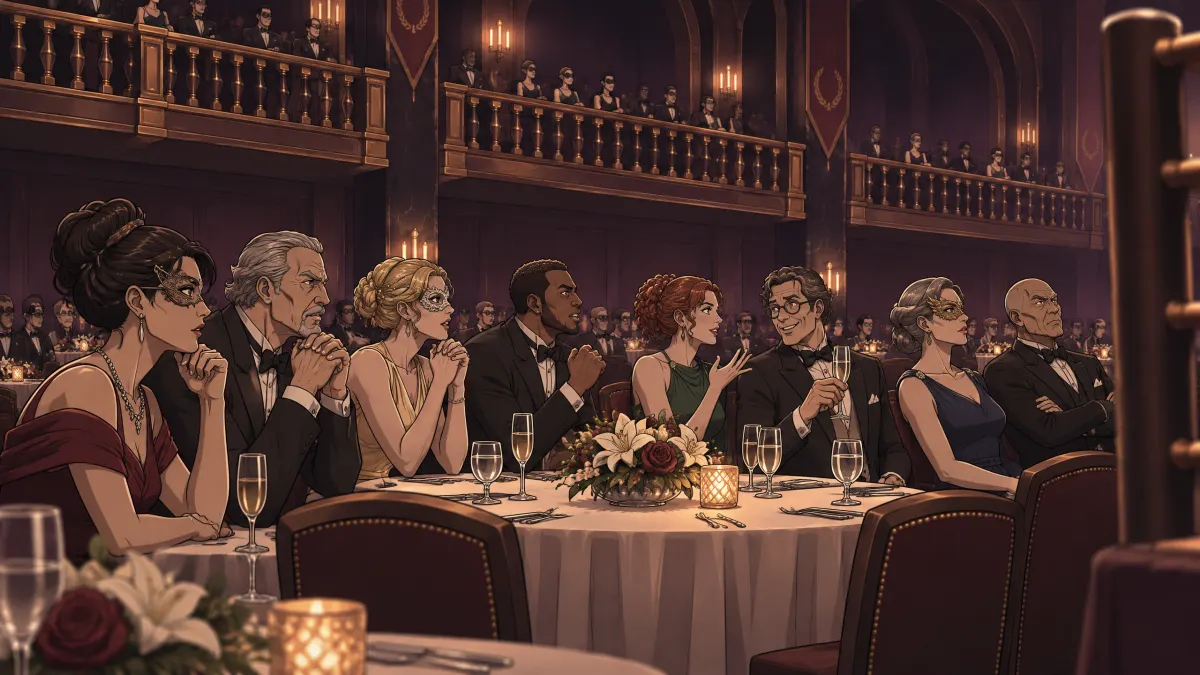
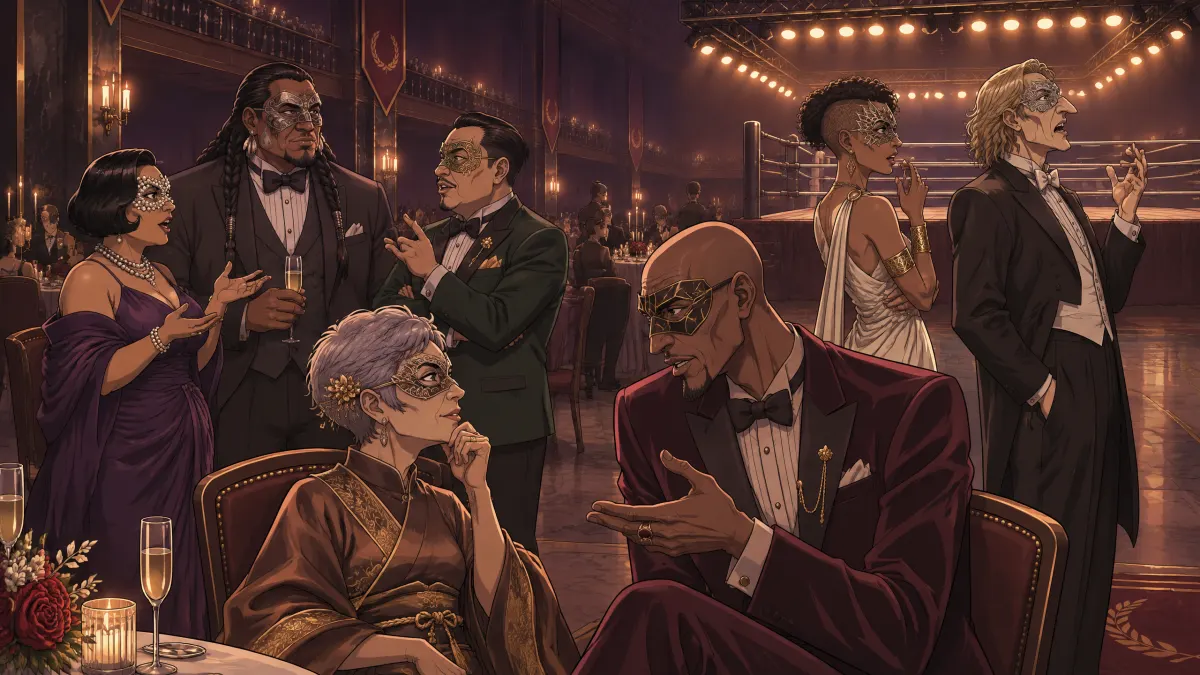
Banquet tables, a standing ensemble, a formal conversation, ringside reaction, the arrival aisle, foreground spectators, the corrected upper gallery.

  • Masked guests of the Black House in evening dress and jewel-tone gowns, in the ballroom.
  • Masked guests of the Black House in evening dress and jewel-tone gowns, in the ballroom.
  • Masked guests of the Black House in evening dress and jewel-tone gowns, in the ballroom.
  • Masked guests of the Black House in evening dress and jewel-tone gowns, in the ballroom.
  • Masked guests of the Black House in evening dress and jewel-tone gowns, in the ballroom.
  • Masked guests of the Black House in evening dress and jewel-tone gowns, in the ballroom.
  • Masked guests of the Black House in evening dress and jewel-tone gowns, in the ballroom.
  • Masked guests of the Black House in evening dress and jewel-tone gowns, in the ballroom.
  • Masked guests of the Black House in evening dress and jewel-tone gowns, in the ballroom.
  • Masked guests of the Black House in evening dress and jewel-tone gowns, in the ballroom.
  • Masked guests of the Black House in evening dress and jewel-tone gowns, in the ballroom.

Simplified

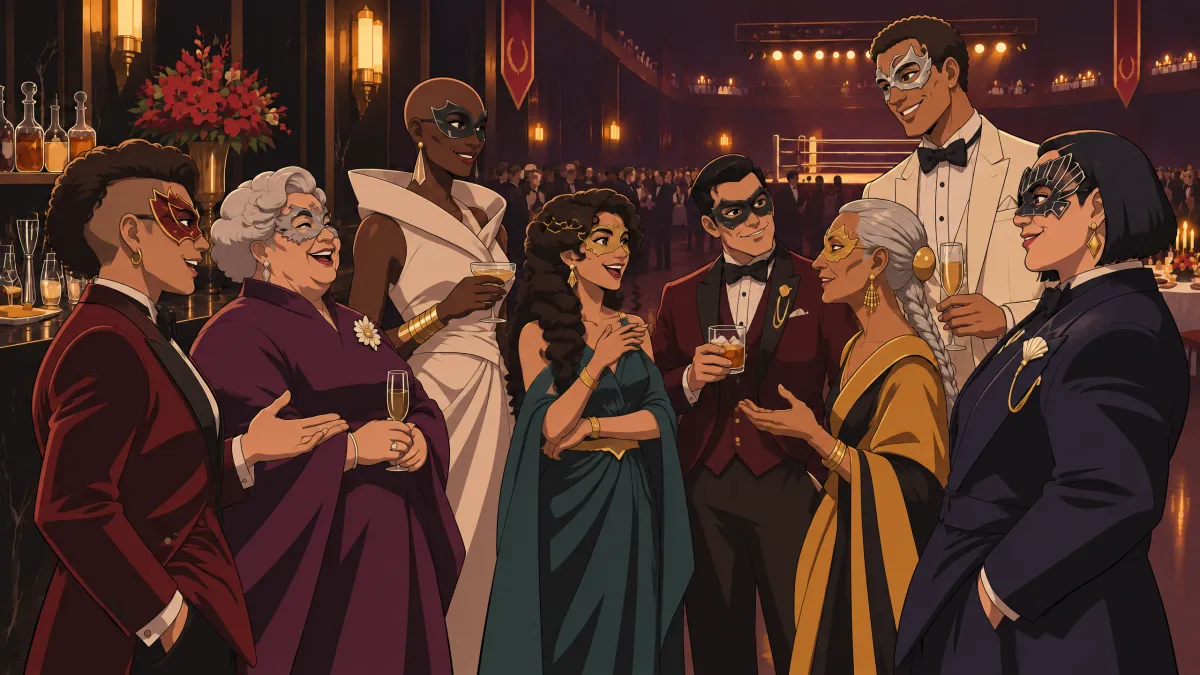
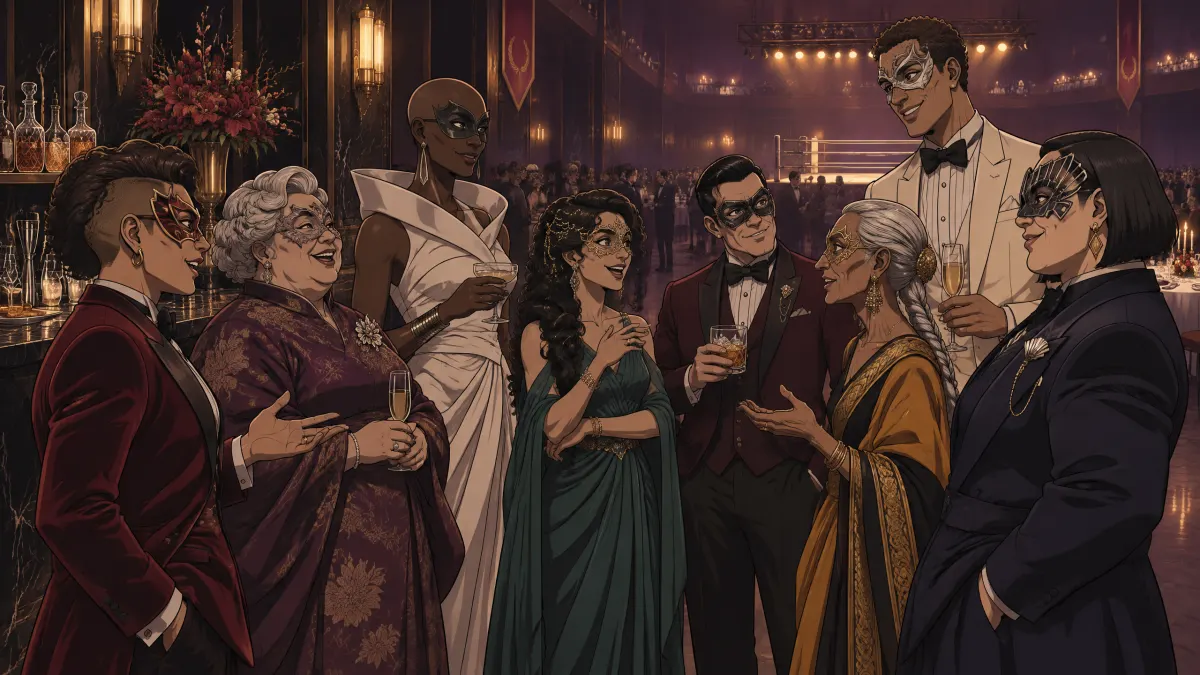
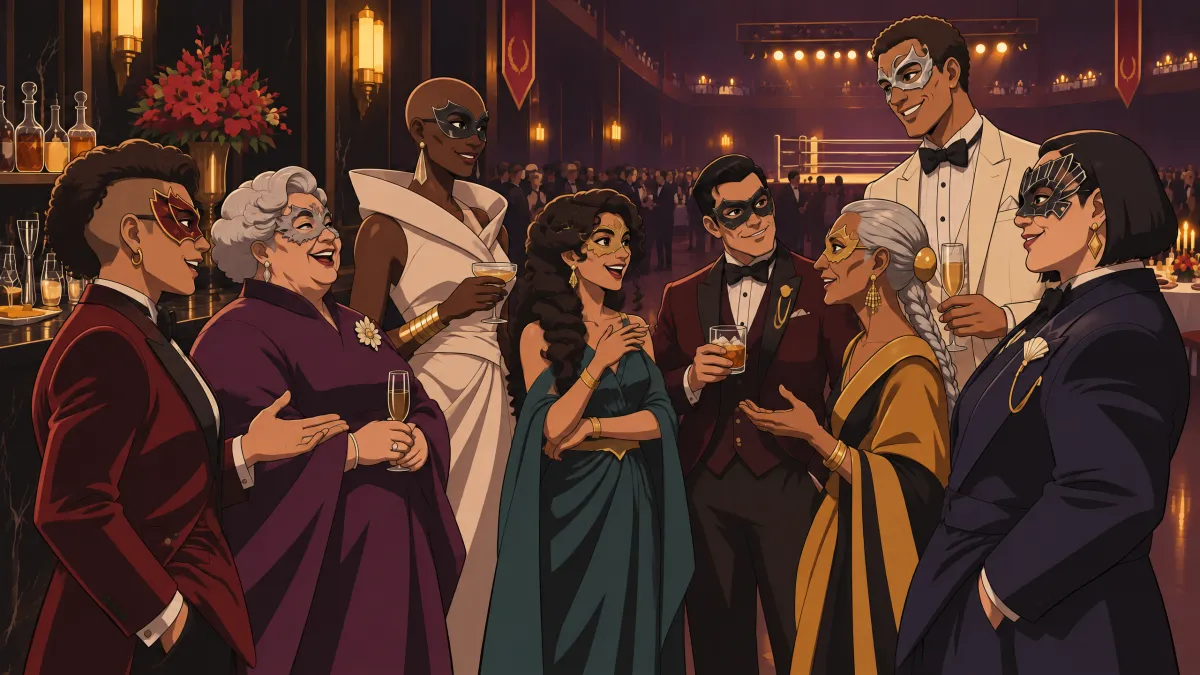
The gala is the one stretch of the film without Jet or Kiichi, so the crowd had to carry it. We designed the guests as striking characters with faces worth a close-up. They came back too detailed for the film’s 2D look, so we pared them back. These are the simplified plates.

Simplified: the same circle in flat cel shading: plain fills, hard shadows and fewer lines, the ring lit far behind.Detailed: the circle of masked guests by the bar, painted with soft shading, patterned fabrics and fine detail in every face.
  • A knot of masked guests talking by the bar: a woman in a plum gown laughing, others in velvet, teal, gold and a white tuxedo, drawn in flat cel shading.
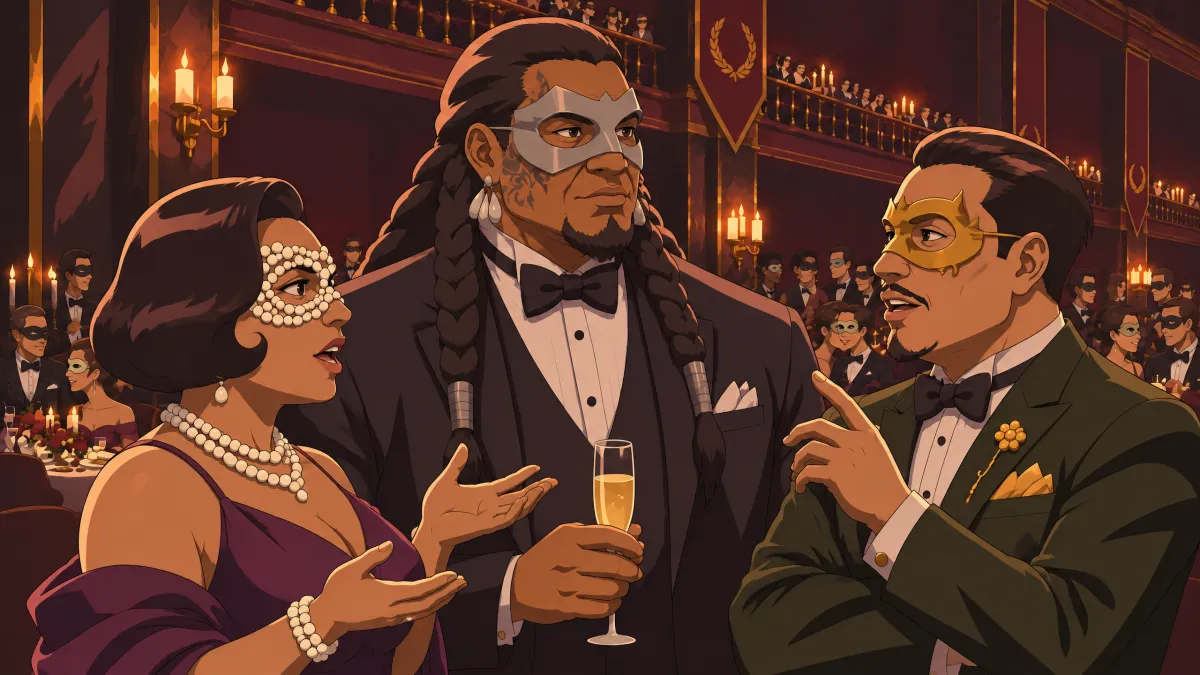
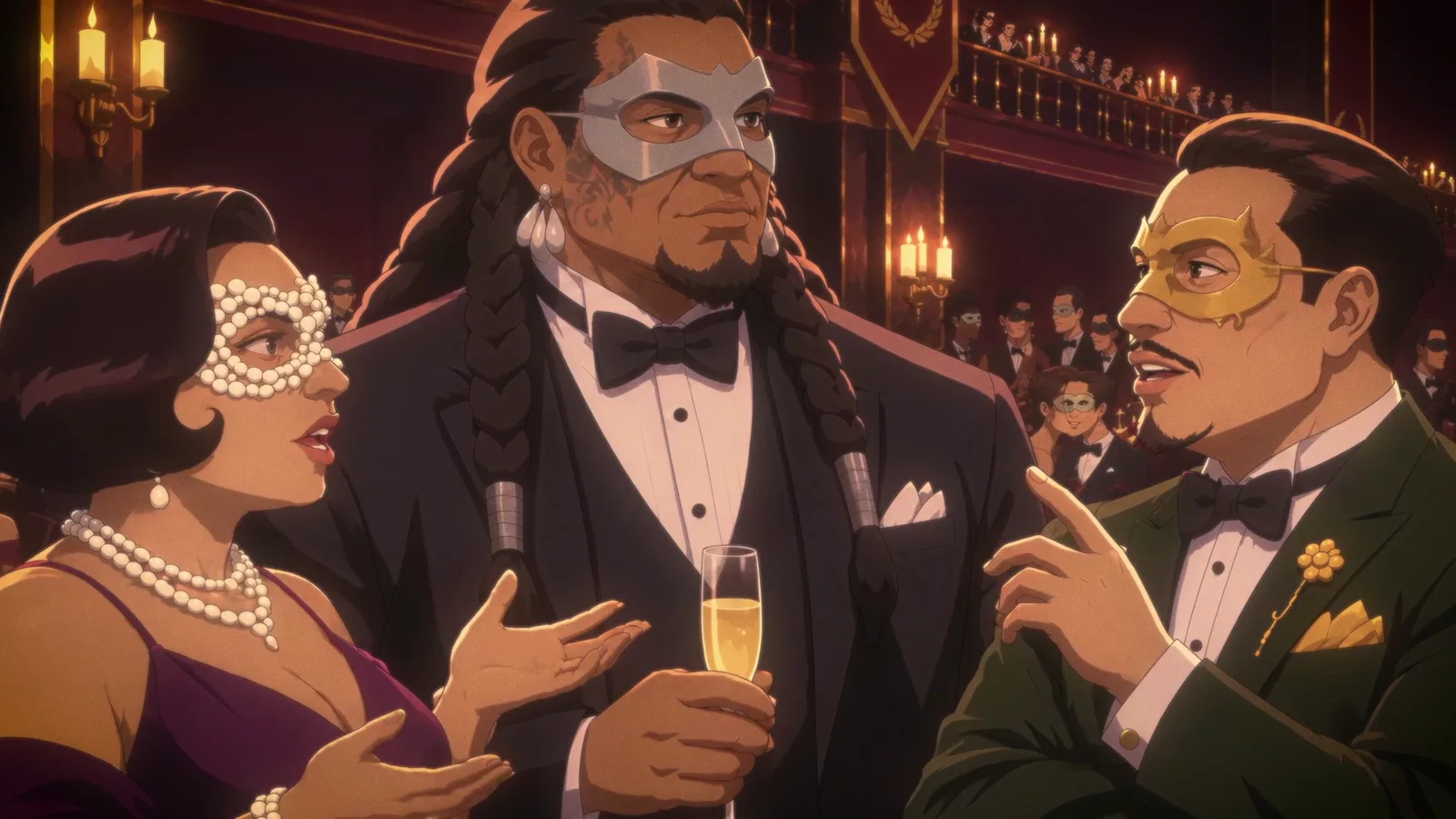
  • Three masked guests mid-conversation at the gala: a woman in pearls and a plum gown, a tall man with long braids, a man in an olive jacket pointing.
  • Close on a grey-haired guest in a plum gown and lace mask sipping champagne beside a guest in a red mask.
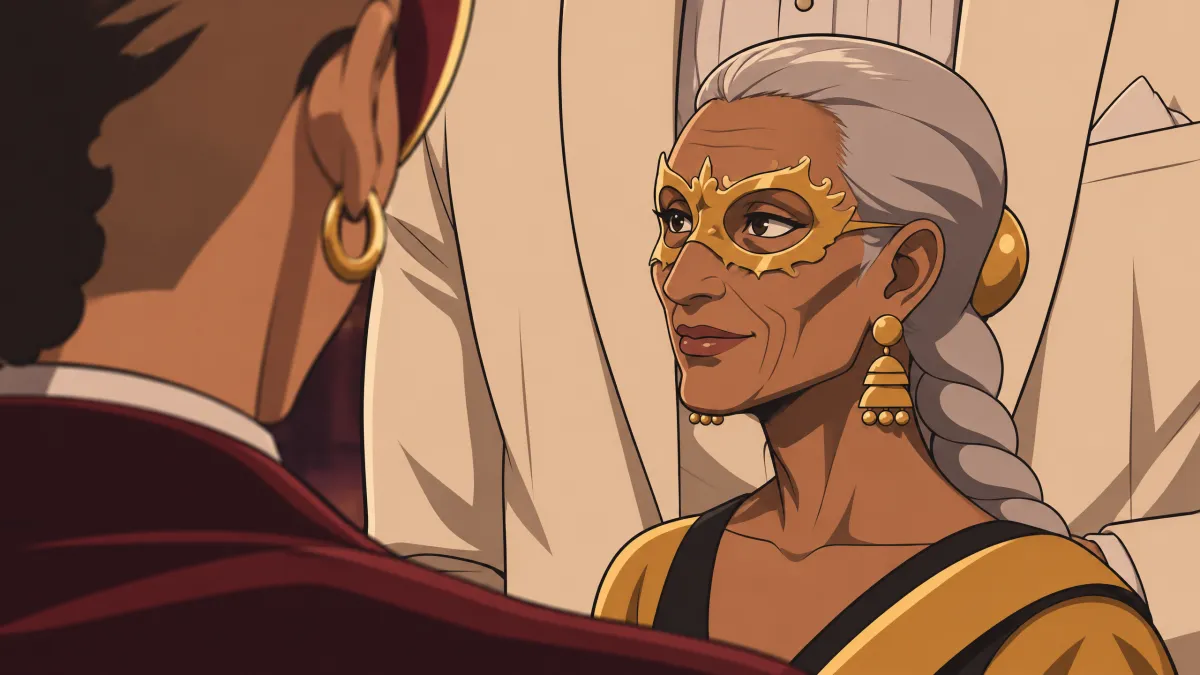
  • Close on an older guest with a long grey braid and a gold mask, looking past the shoulder of a guest in a dark red jacket.
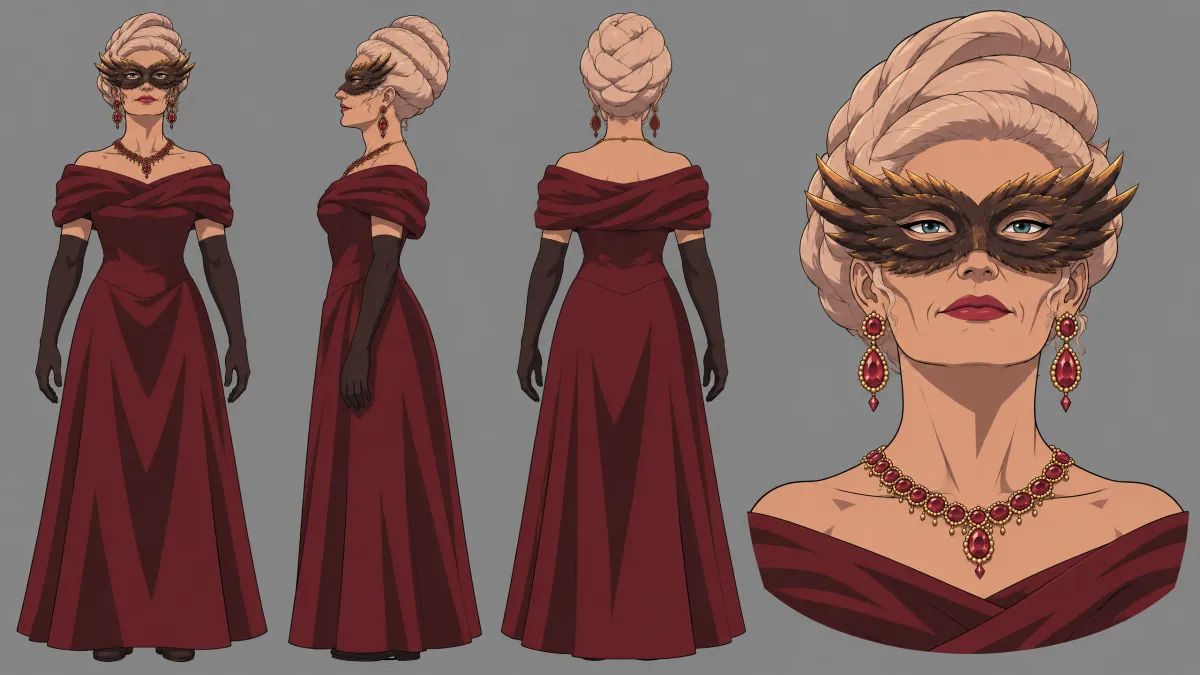
  • A simplified character sheet: an older guest in a burgundy off-shoulder gown and feathered mask, front, side and back, and a portrait.
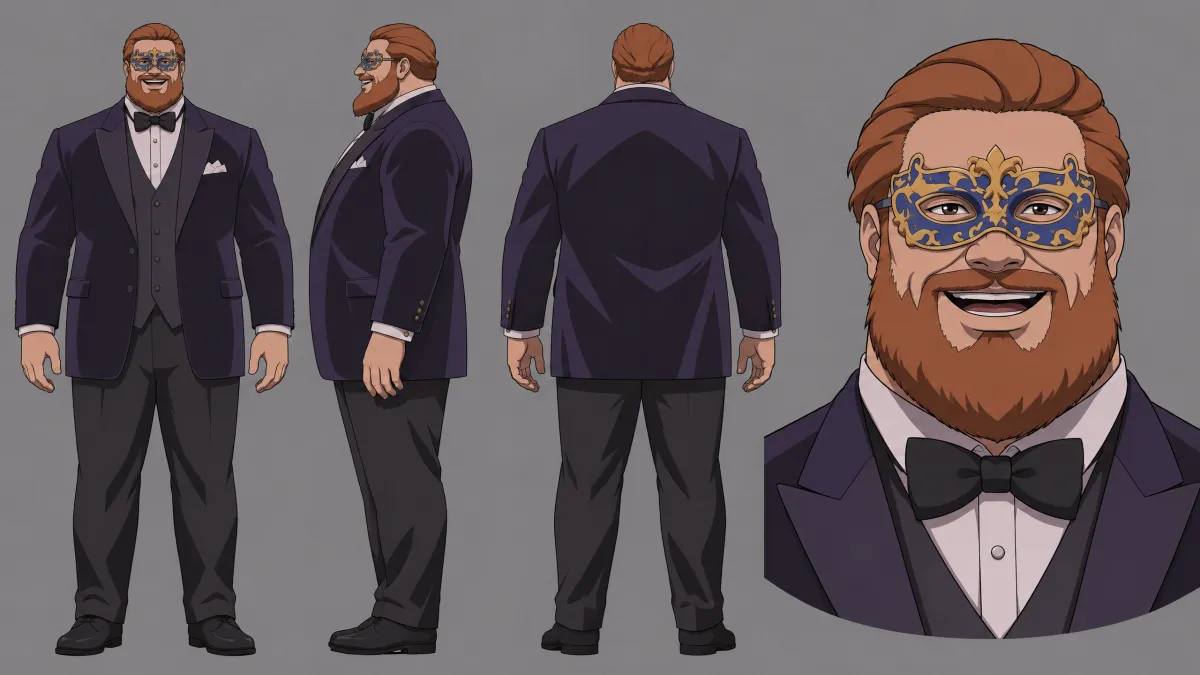
  • A character sheet: a broad red-bearded guest in a navy dinner suit and a blue and gold mask, front, side and back, and a laughing portrait.

Locations

One location, the Black House, outside and in, fixed on paper before a shot was made.

The house

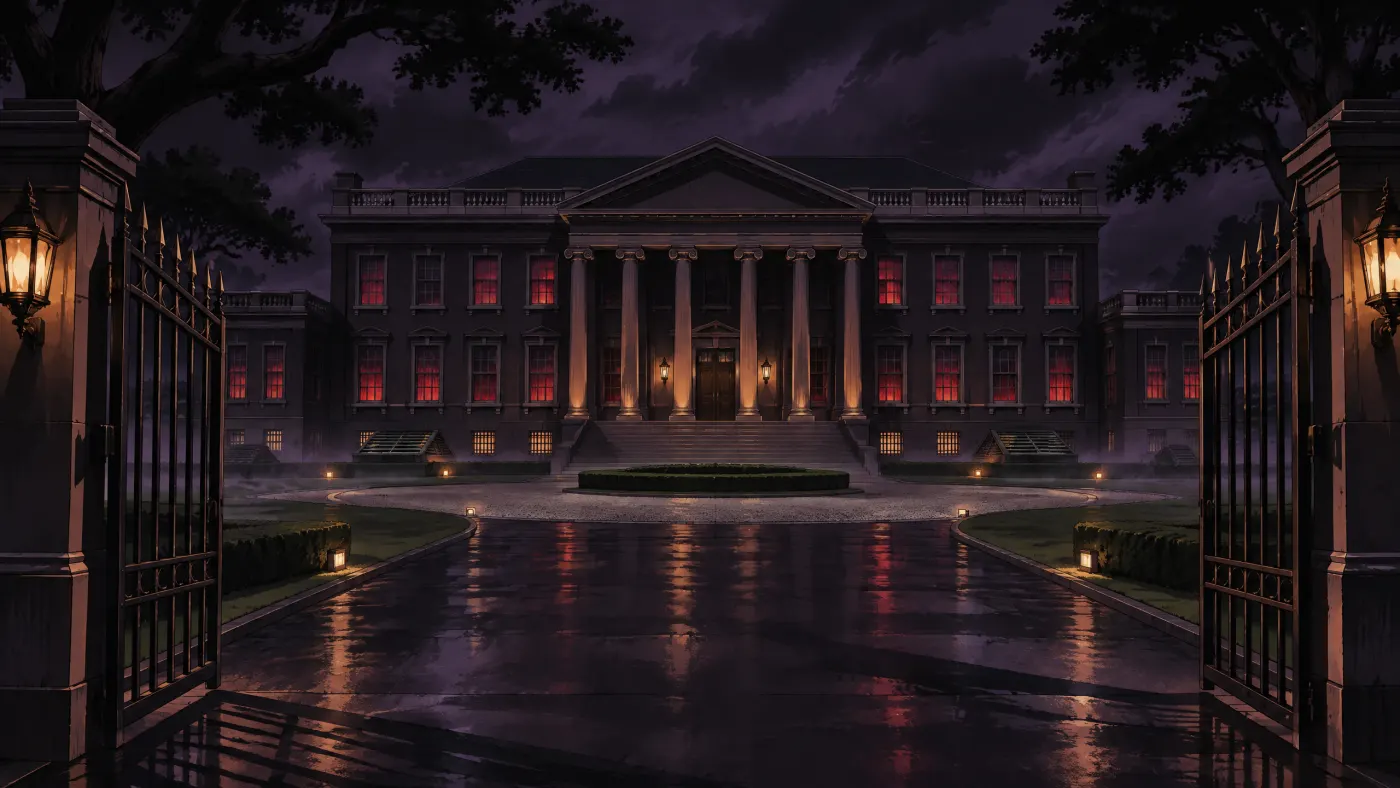
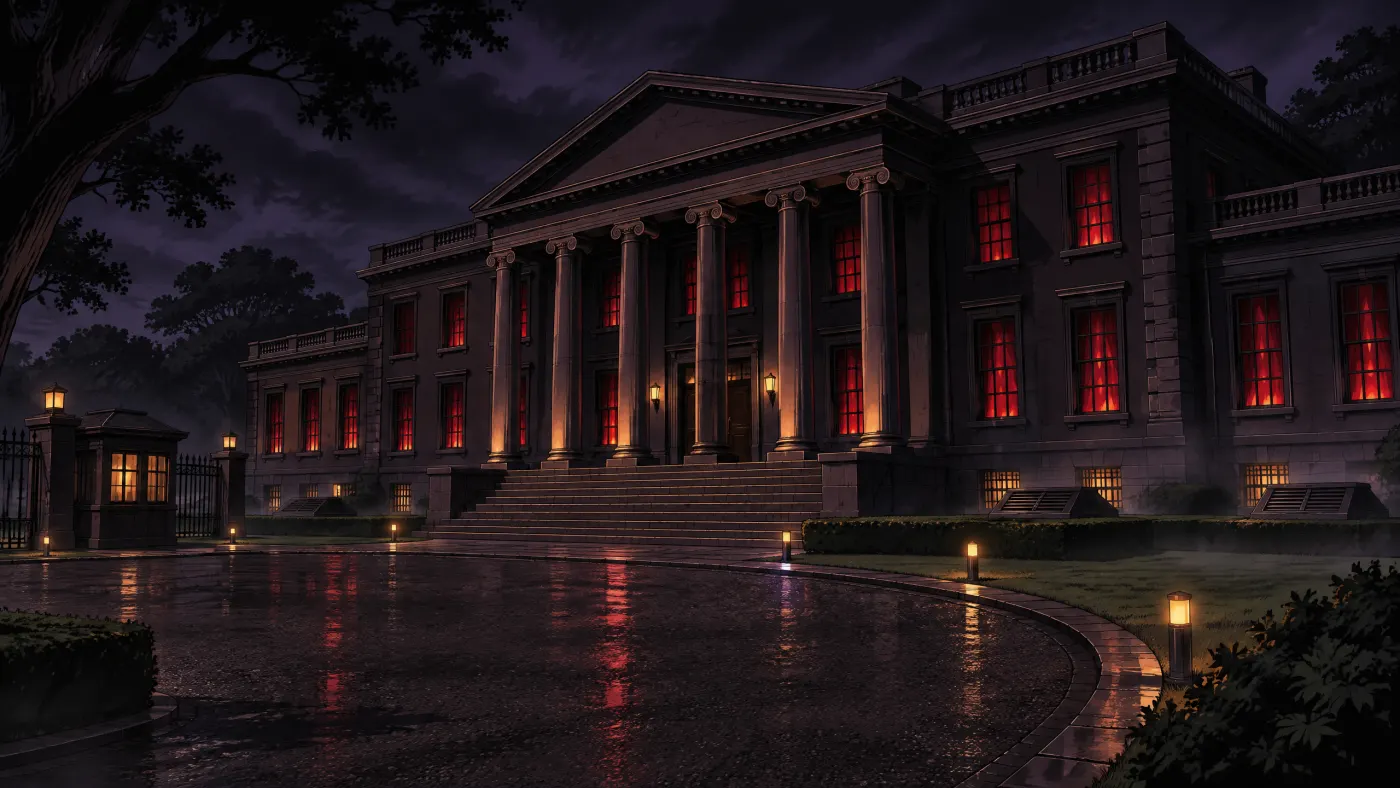
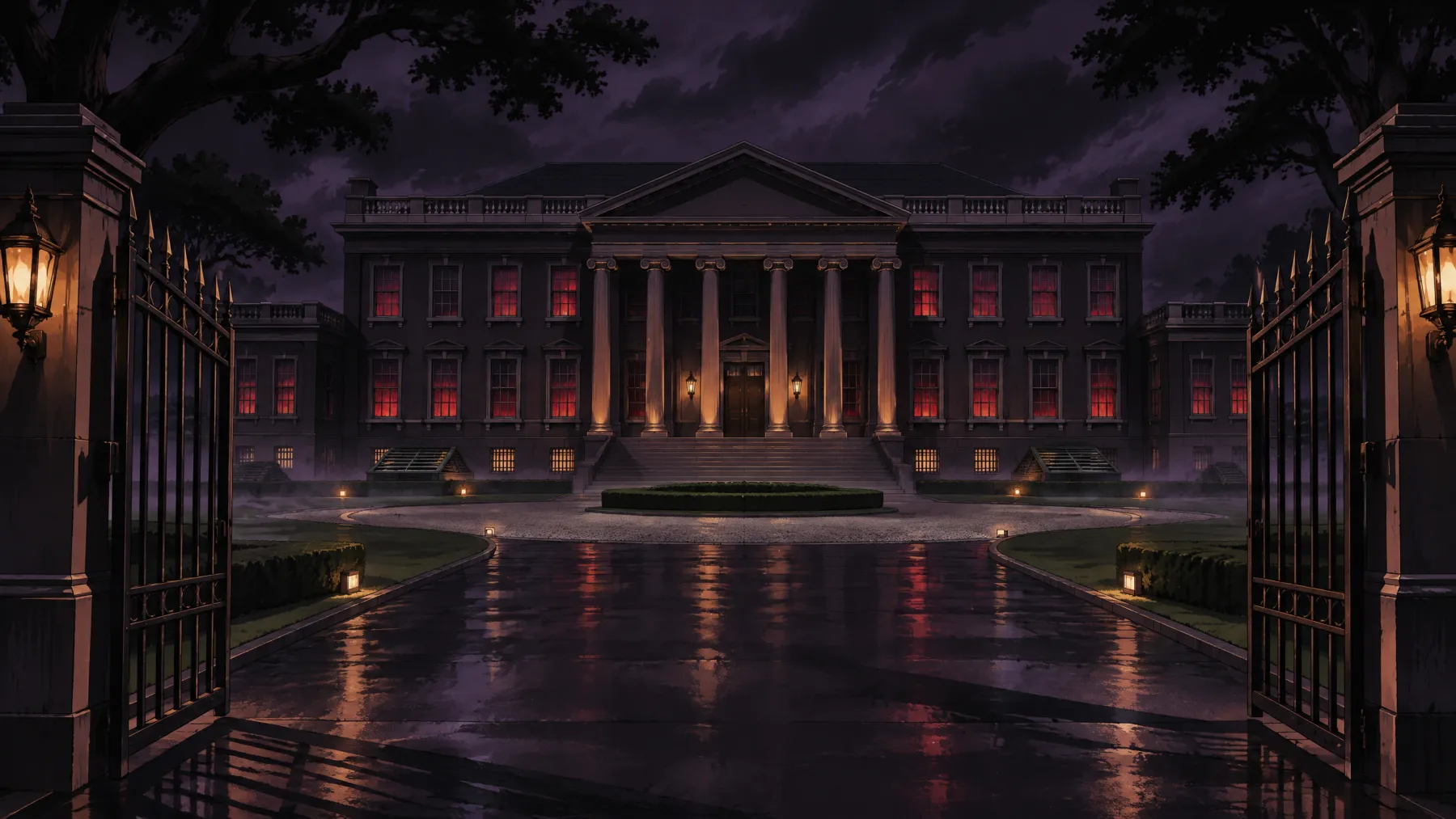
“The Black House, a dark copy of the White House, its windows lit red.” Beat script, S01

  1. The open iron gates on a wet night, the façade beyond with every window lit red.

    01The gates

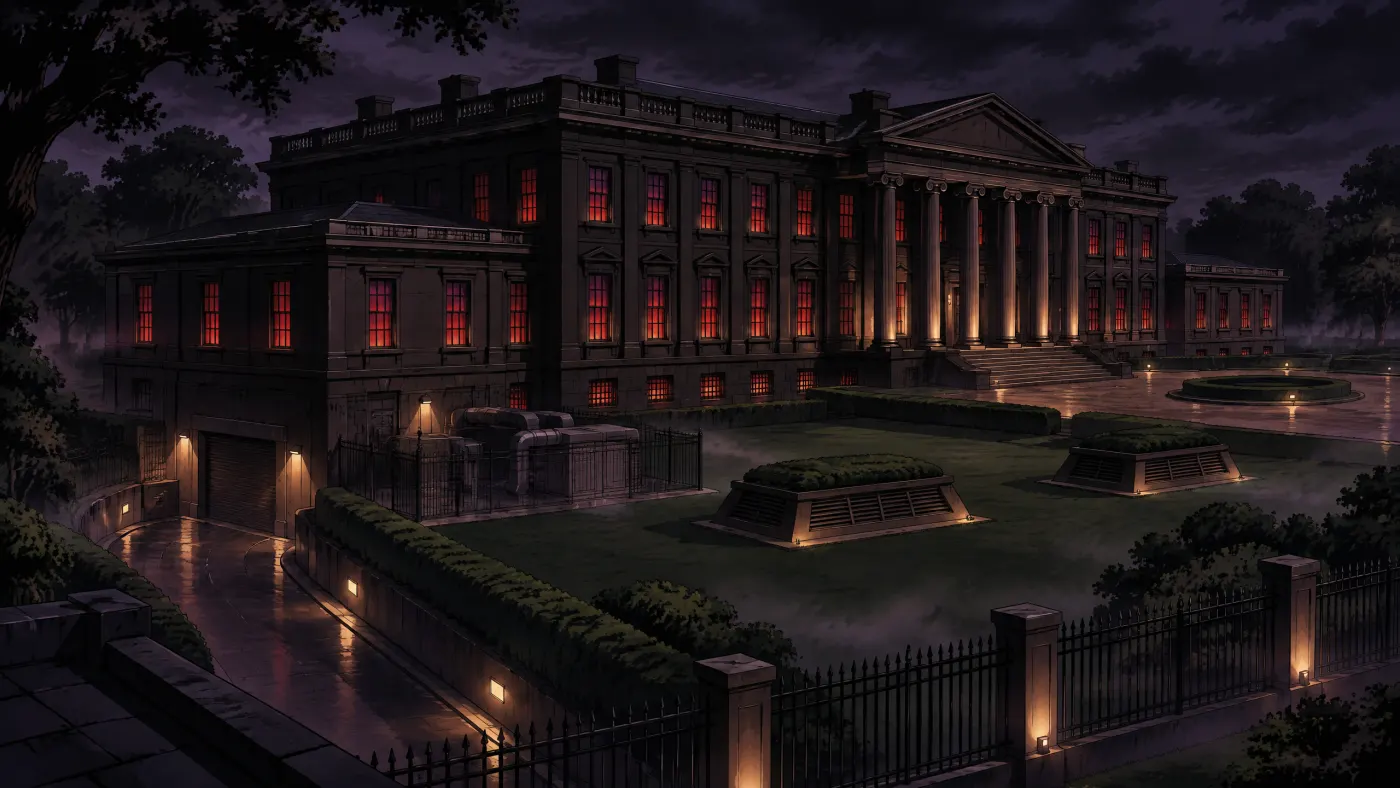
  2. The house across its dark lawns and terraces, lanterns along the paths.

    02The grounds

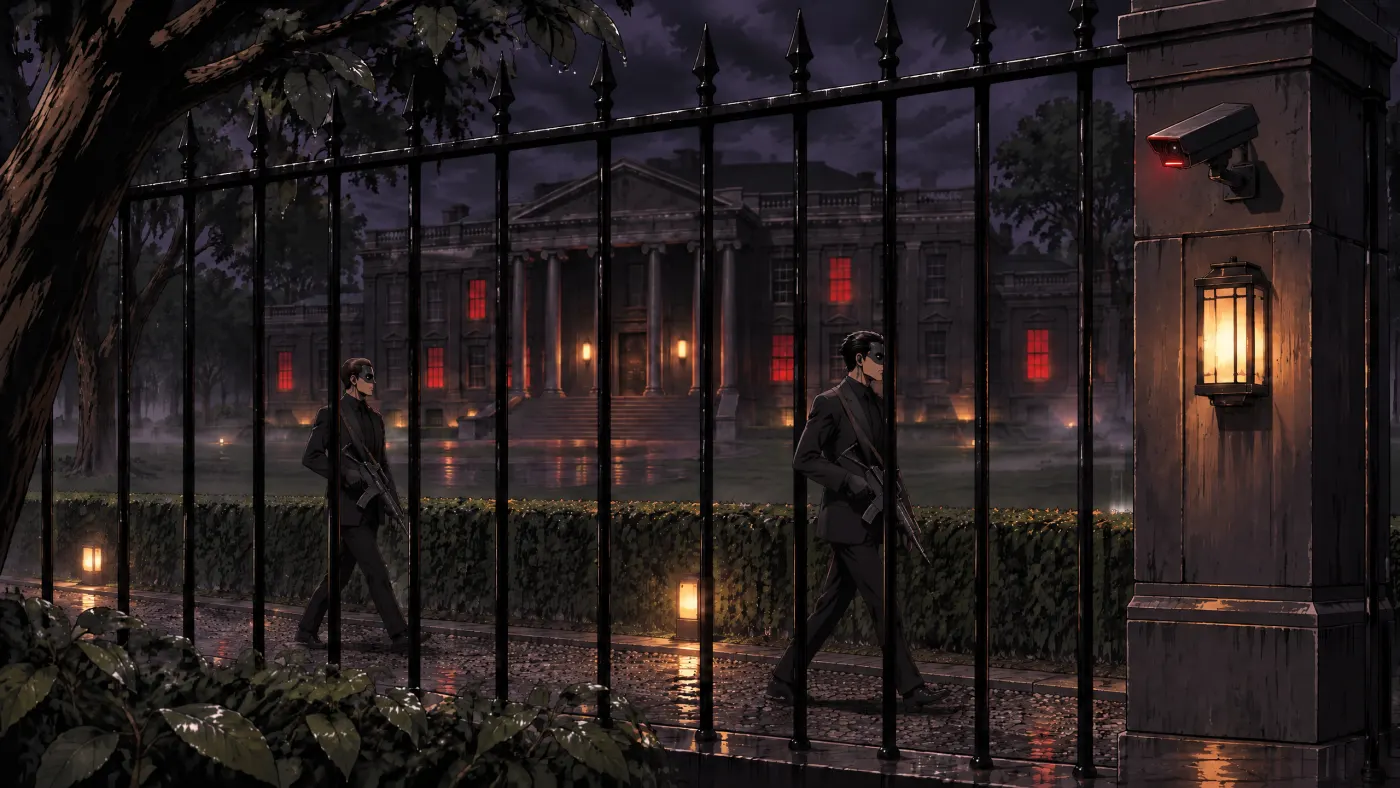
  3. Masked guards in black patrolling behind the iron fence, the house beyond.

    03The fence

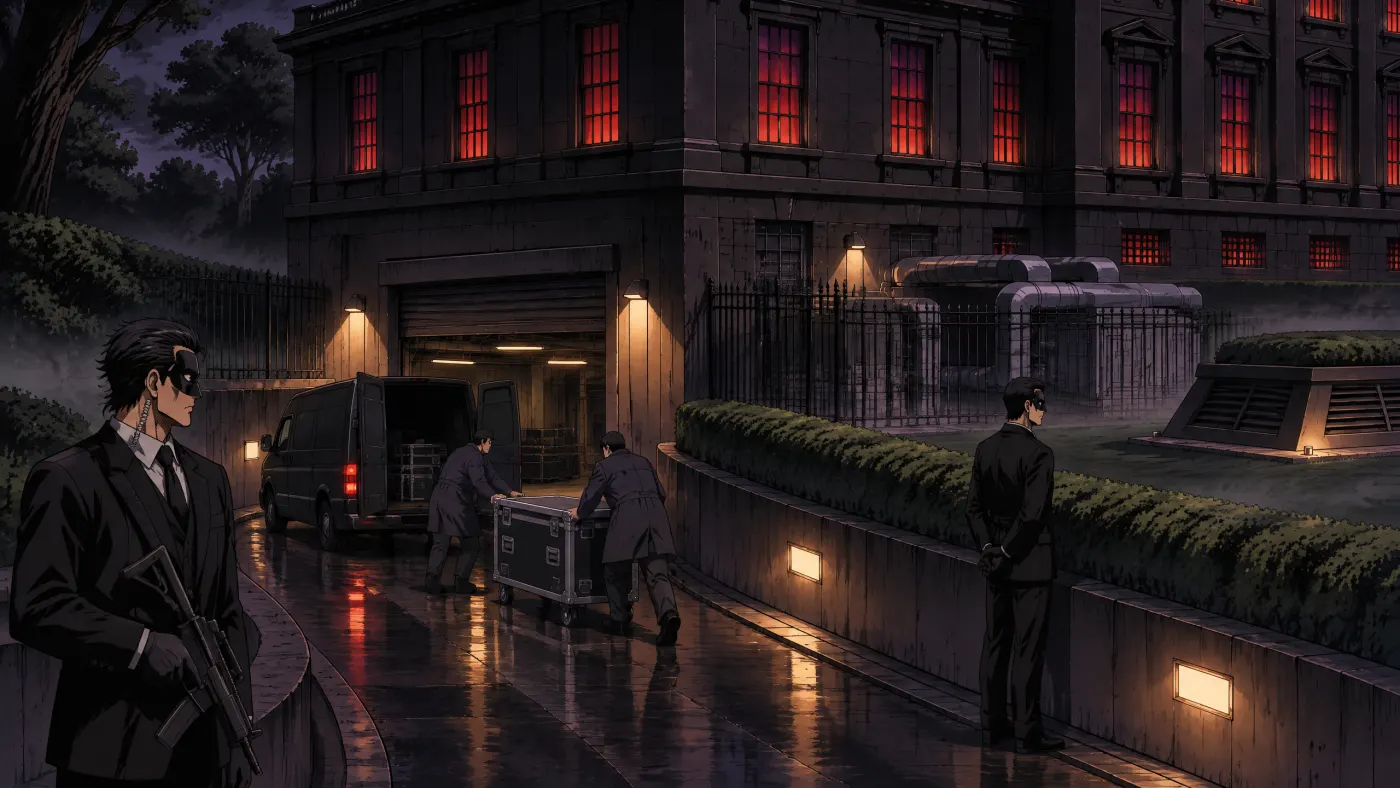
  4. A guard at the service entrance, a van backed up to the loading dock.

    04The service entrance

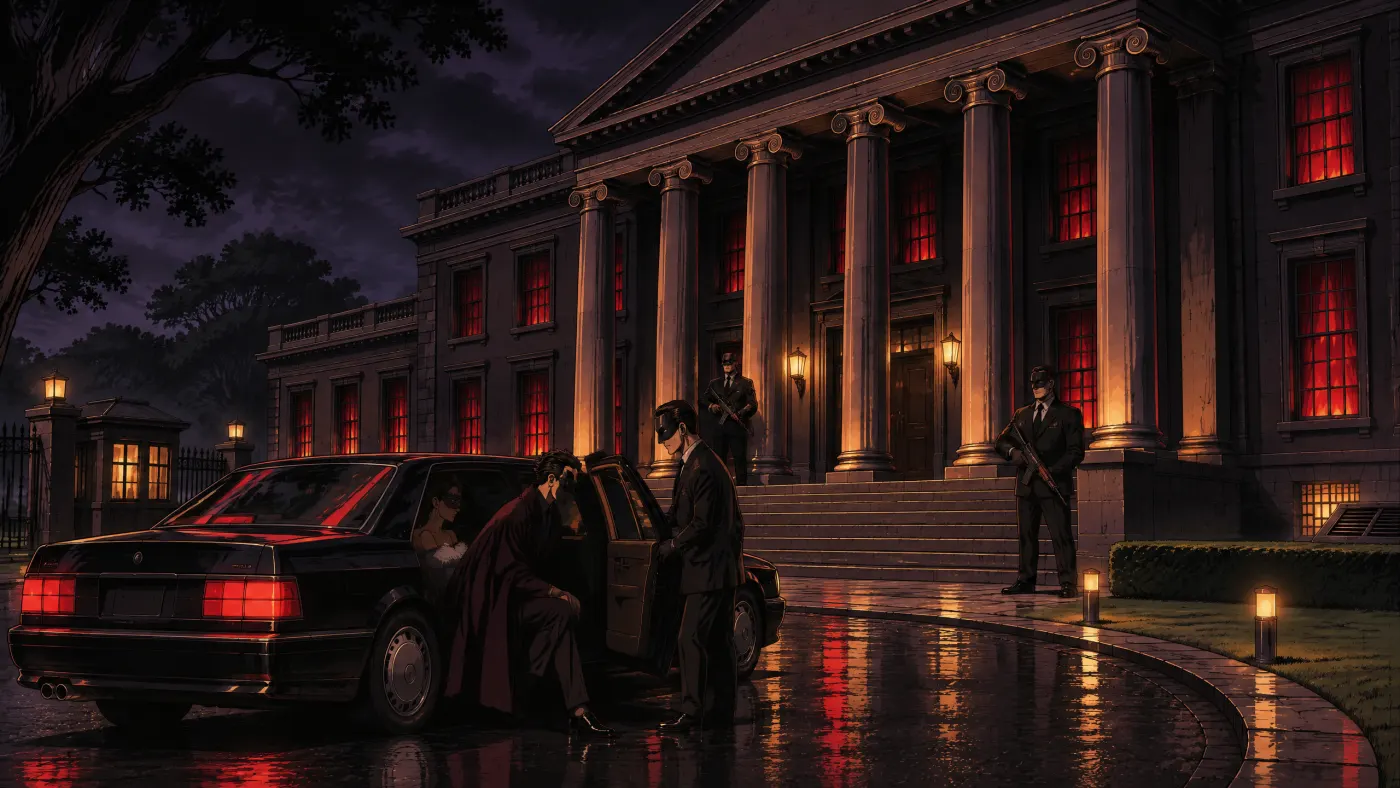
  5. A black car at the foot of the steps, a guard opening its door.

    05An arrival

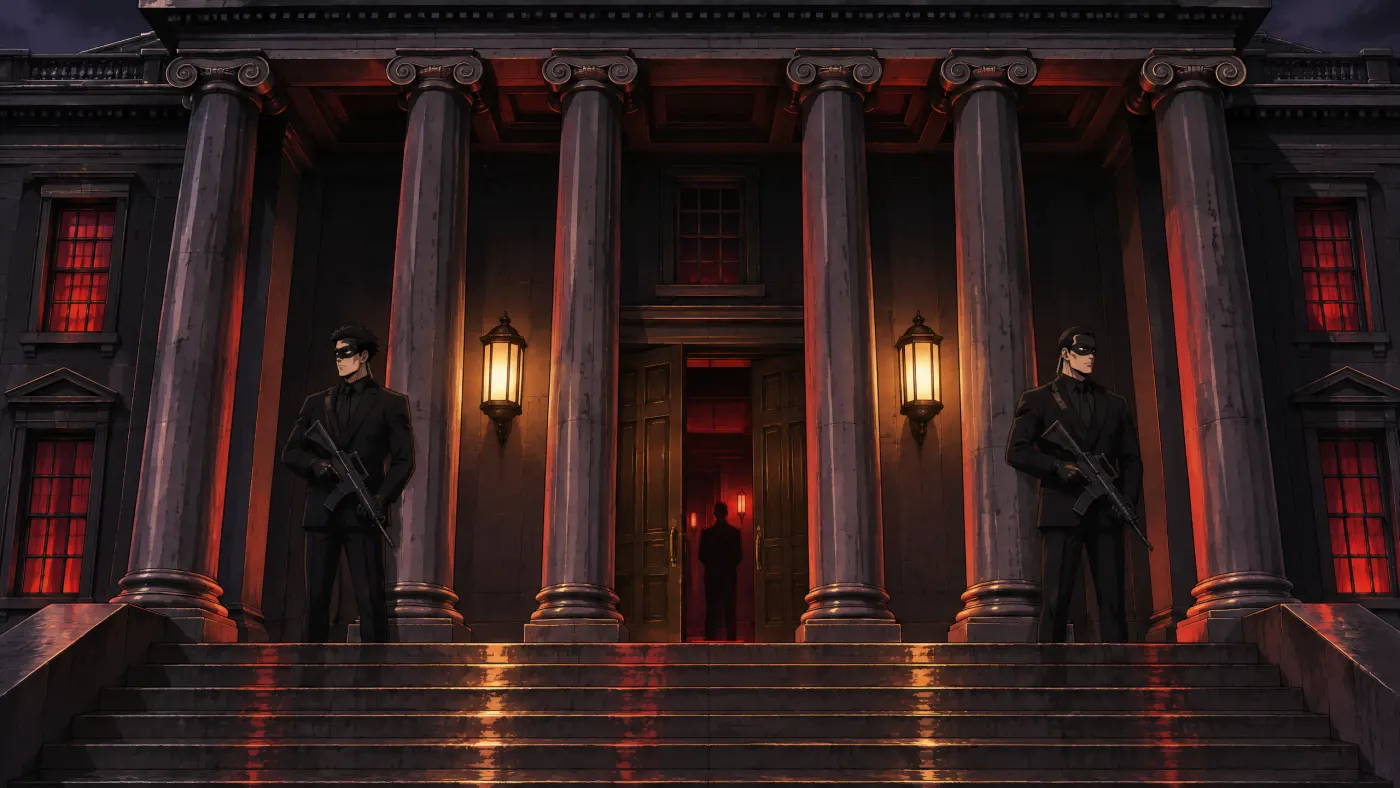
  6. Two armed guards at the columns either side of the lit doorway.

    06The portico

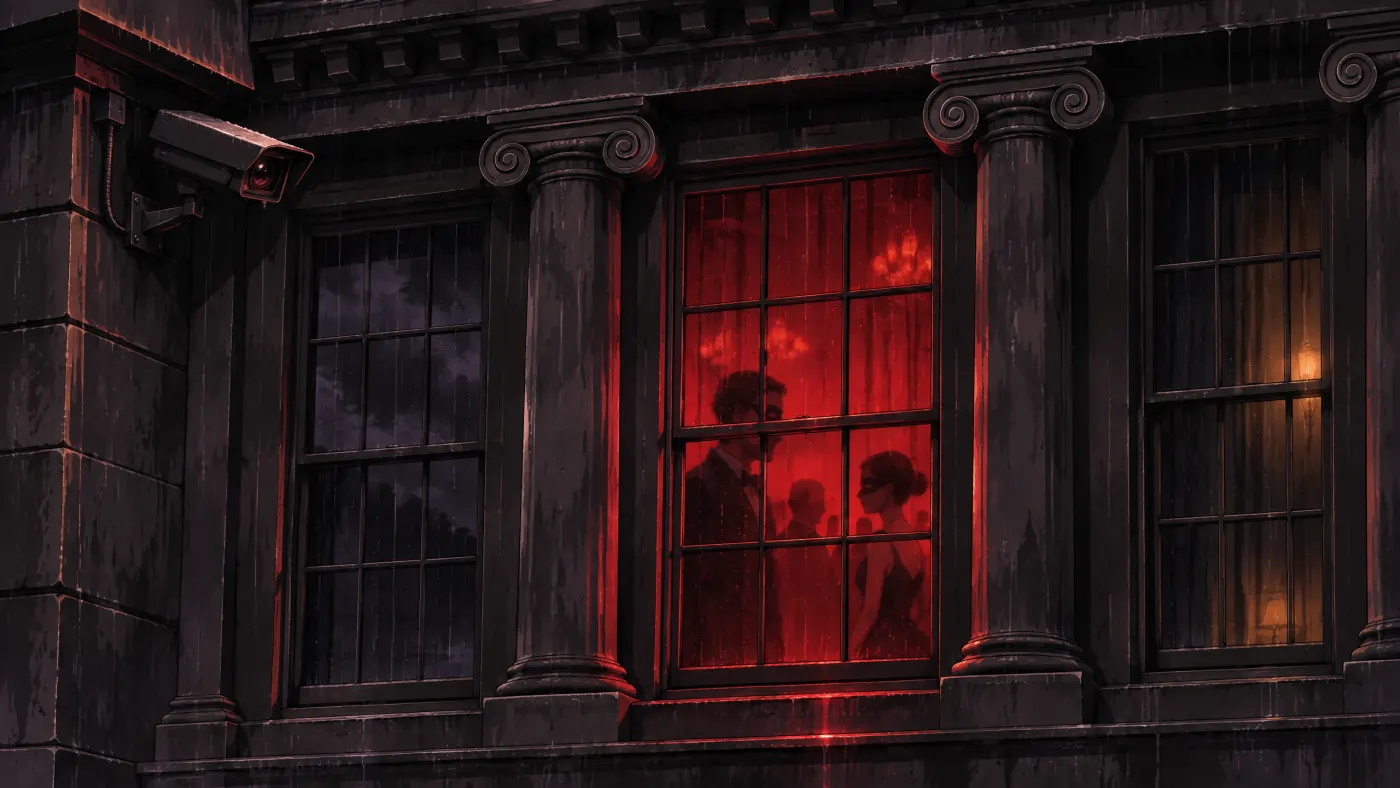
  7. One tall window lit red, figures moving behind the glass.

    07A window

  8. The colonnaded front of the house at night, its windows red.

    08The façade

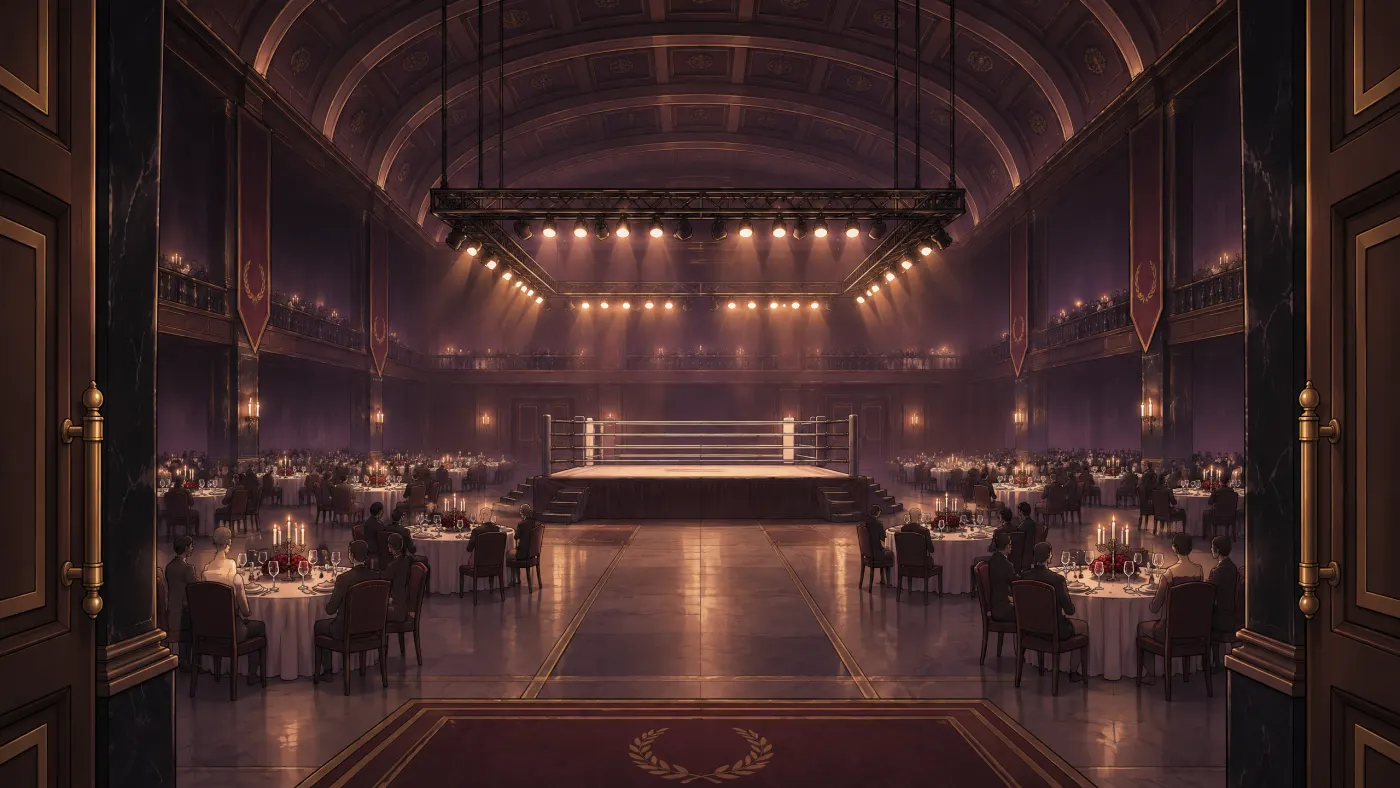
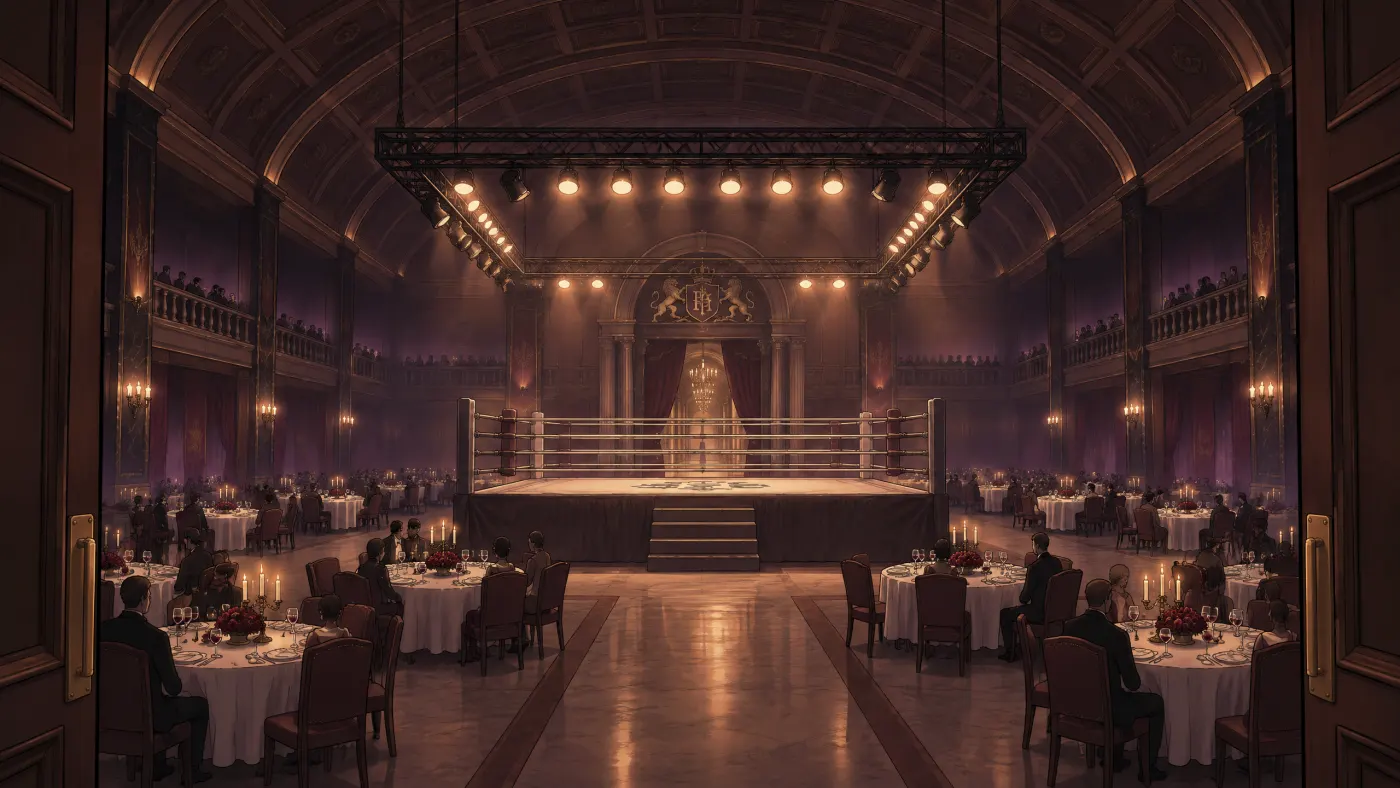
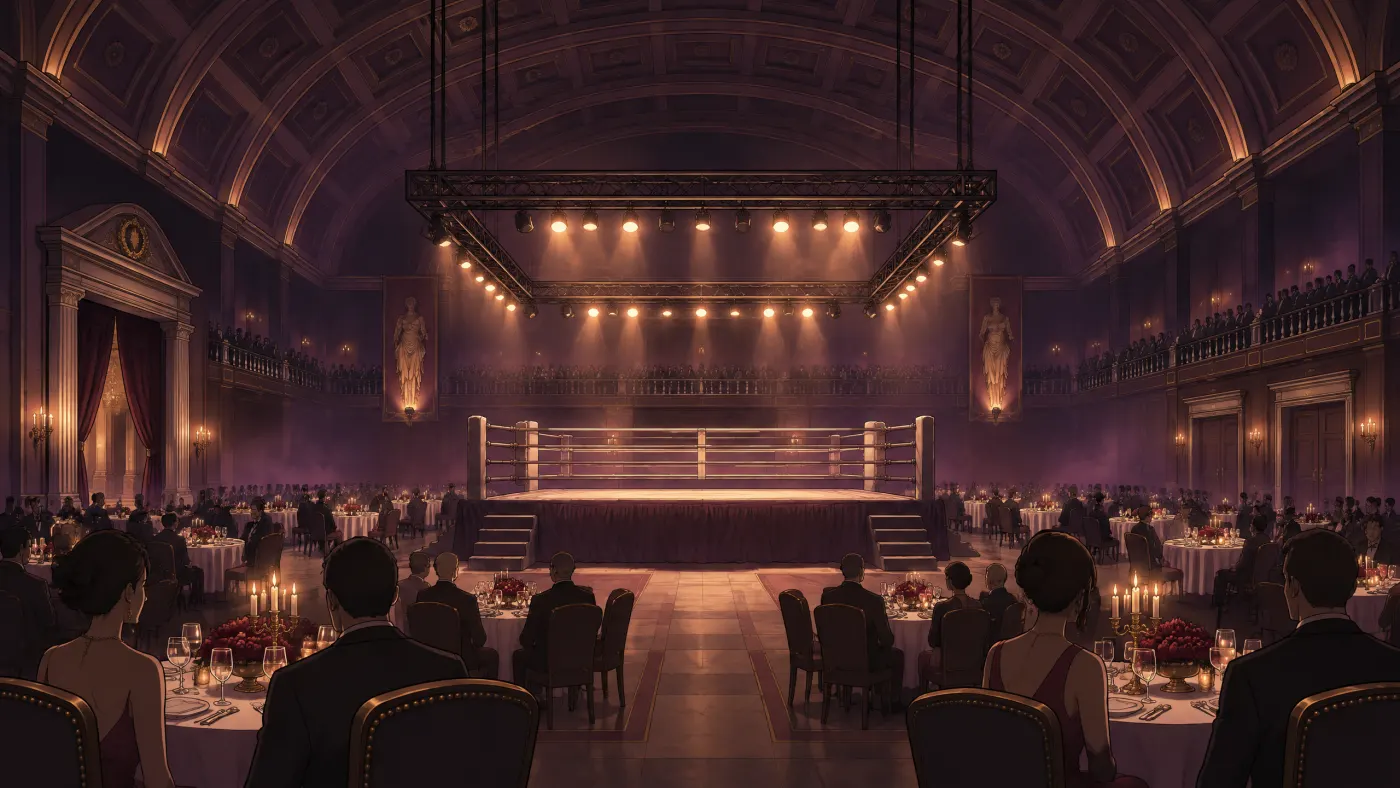
  9. Through the open doors: the ballroom, the carpet running to the ring.

    09Through the doors

  10. Down the ballroom’s centre aisle to the ring under its truss.

    10The axis

  11. From among the dining tables, the ring lit beyond the guests.

    11Among the tables

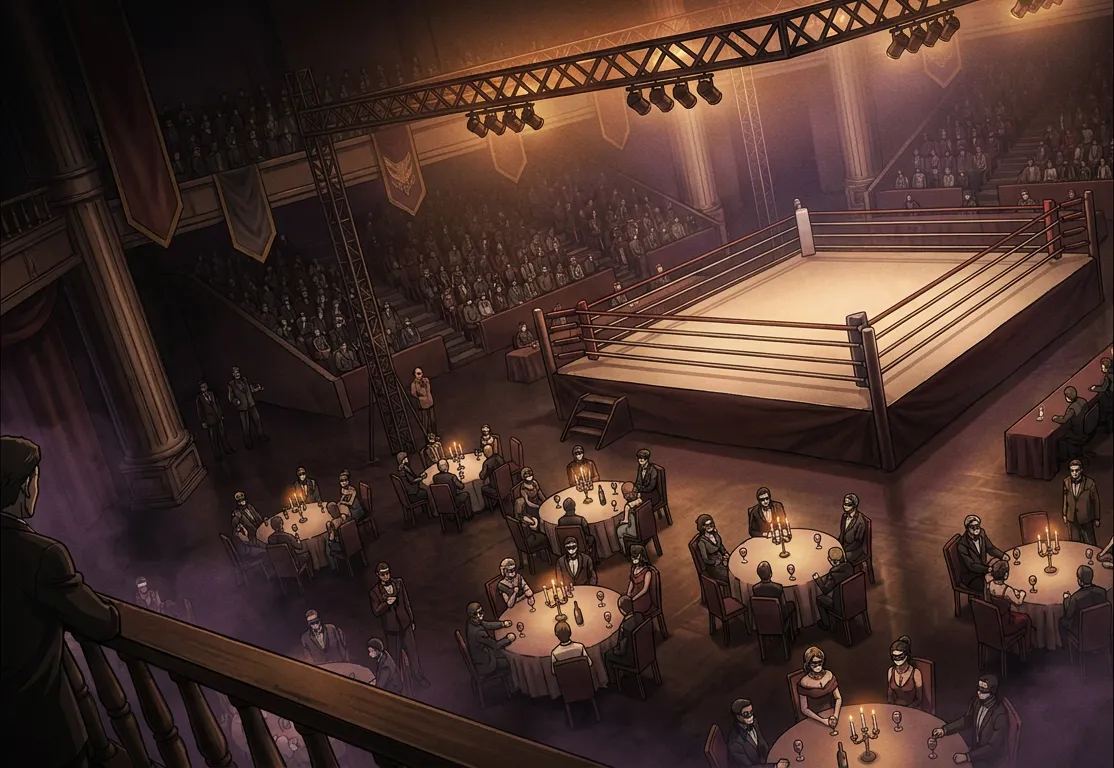
  12. From the upper gallery, over the tables to the ring under the truss.

    12From the balcony

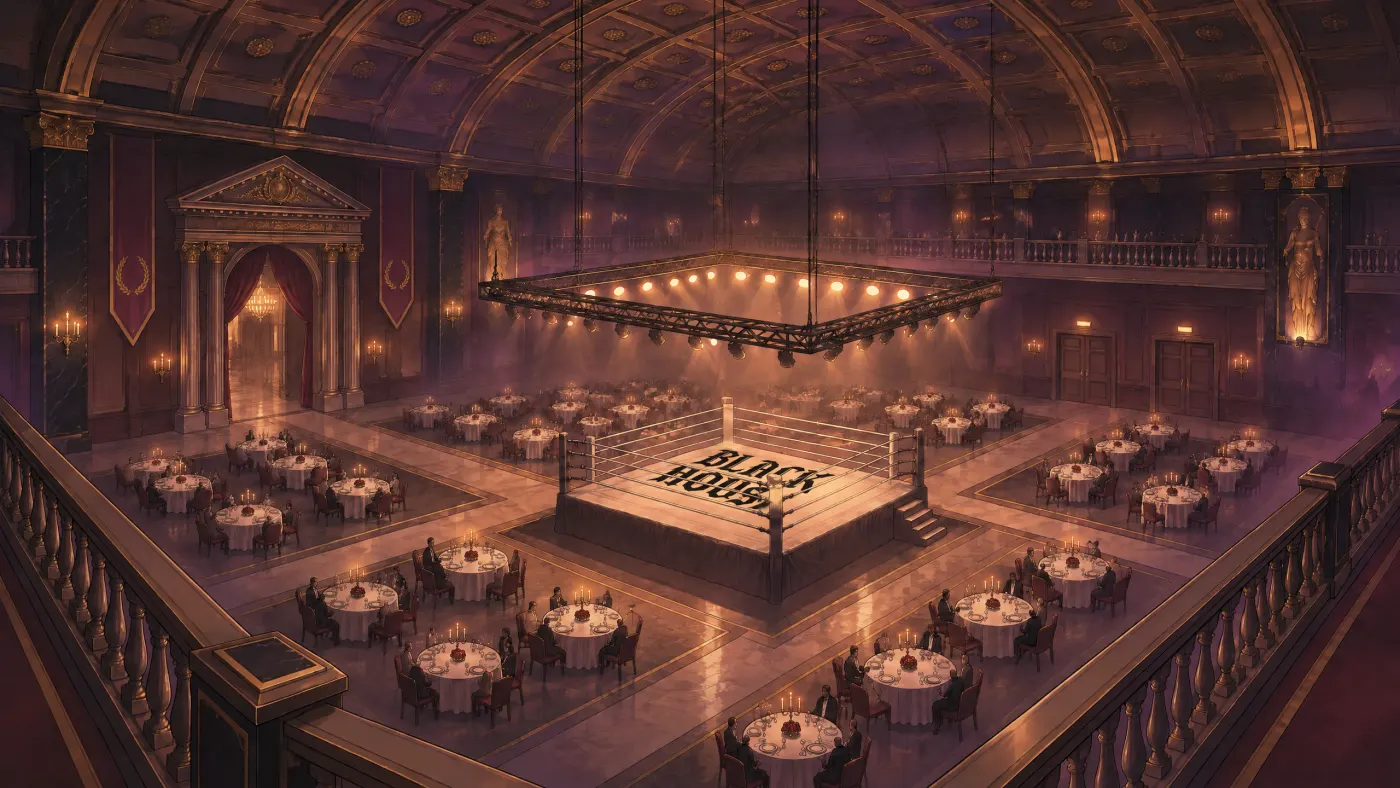
  13. The ballroom from high in a corner, the wordmark readable on the canvas.

    13High three-quarter

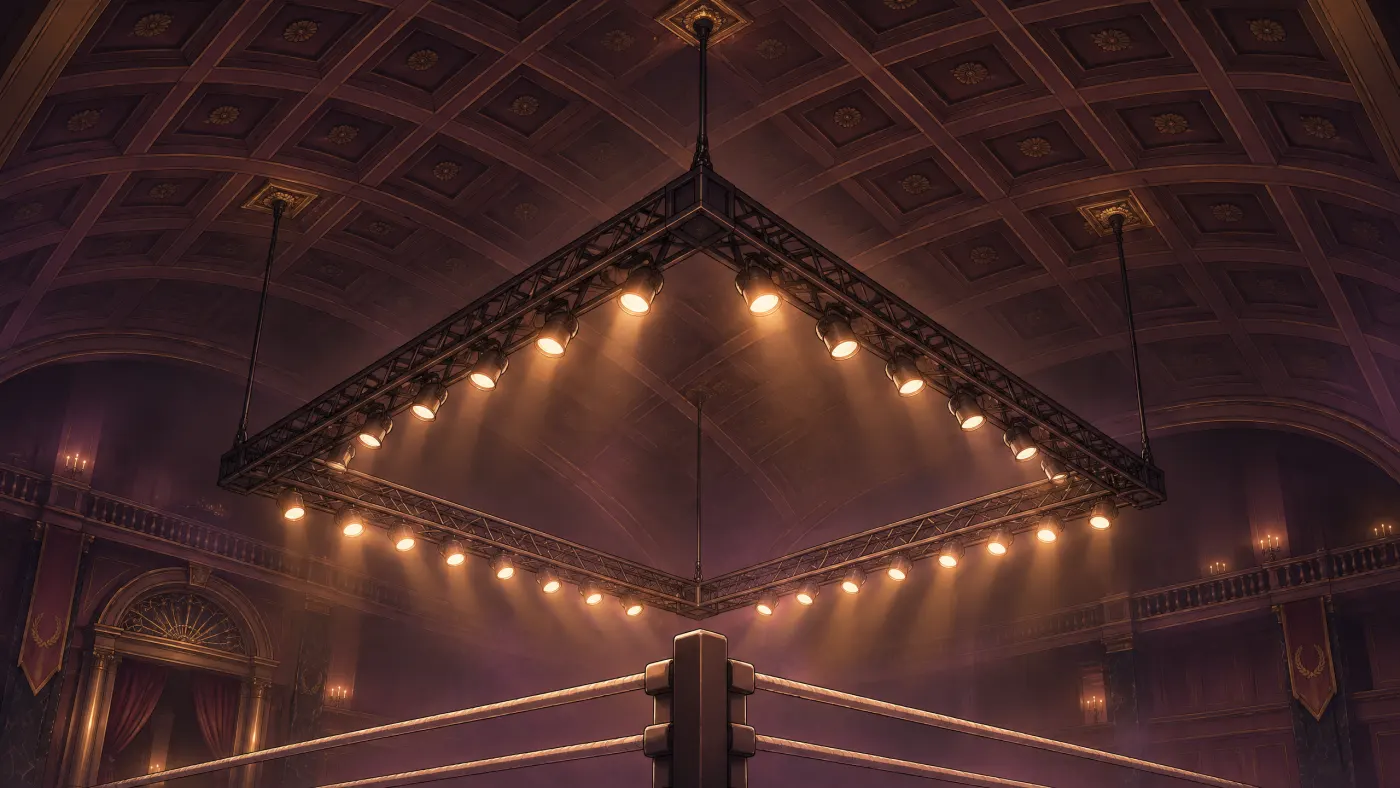
  14. The square lighting truss from below, the coffered vault above it.

    14The truss from below

The house as a set

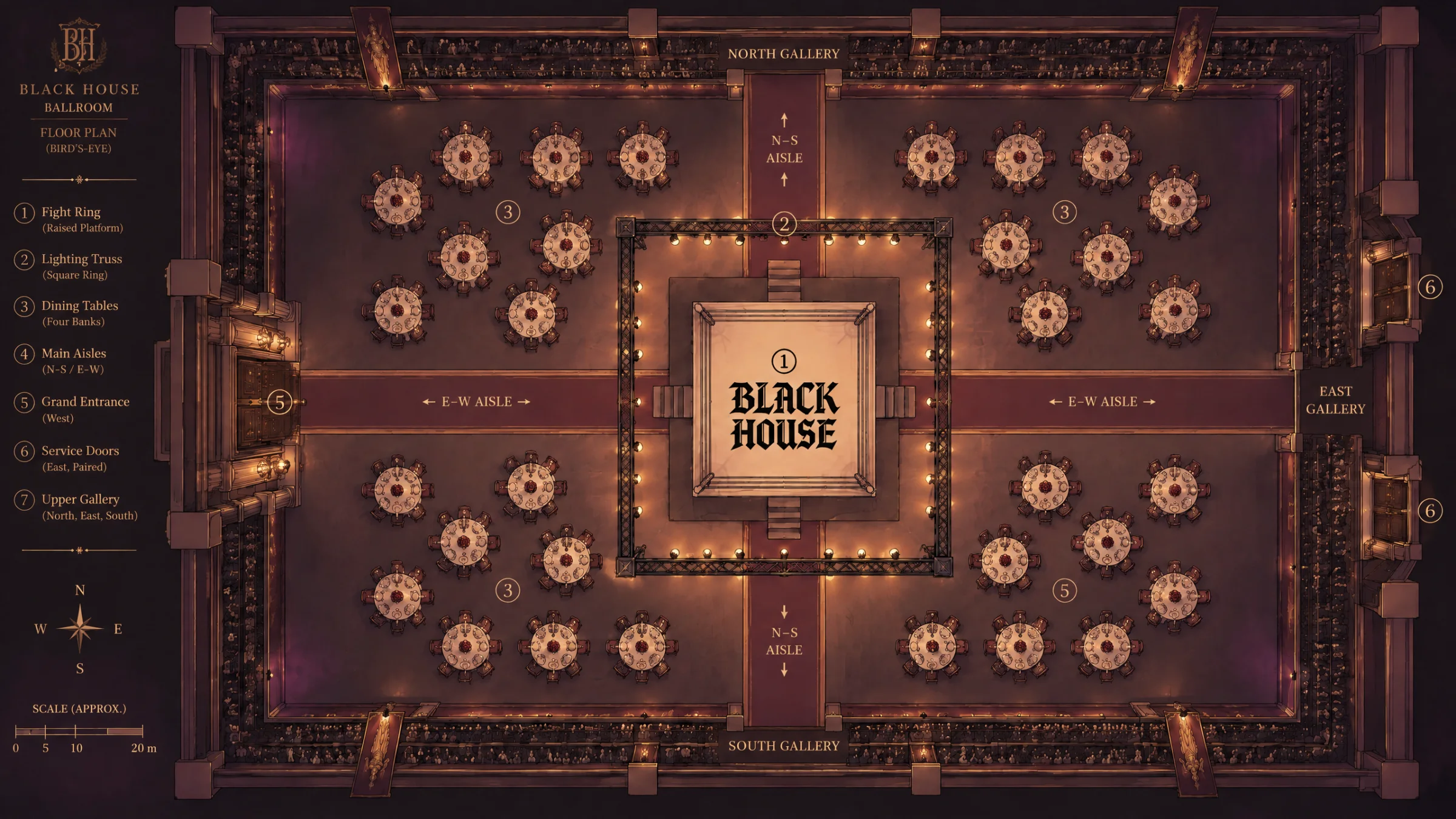
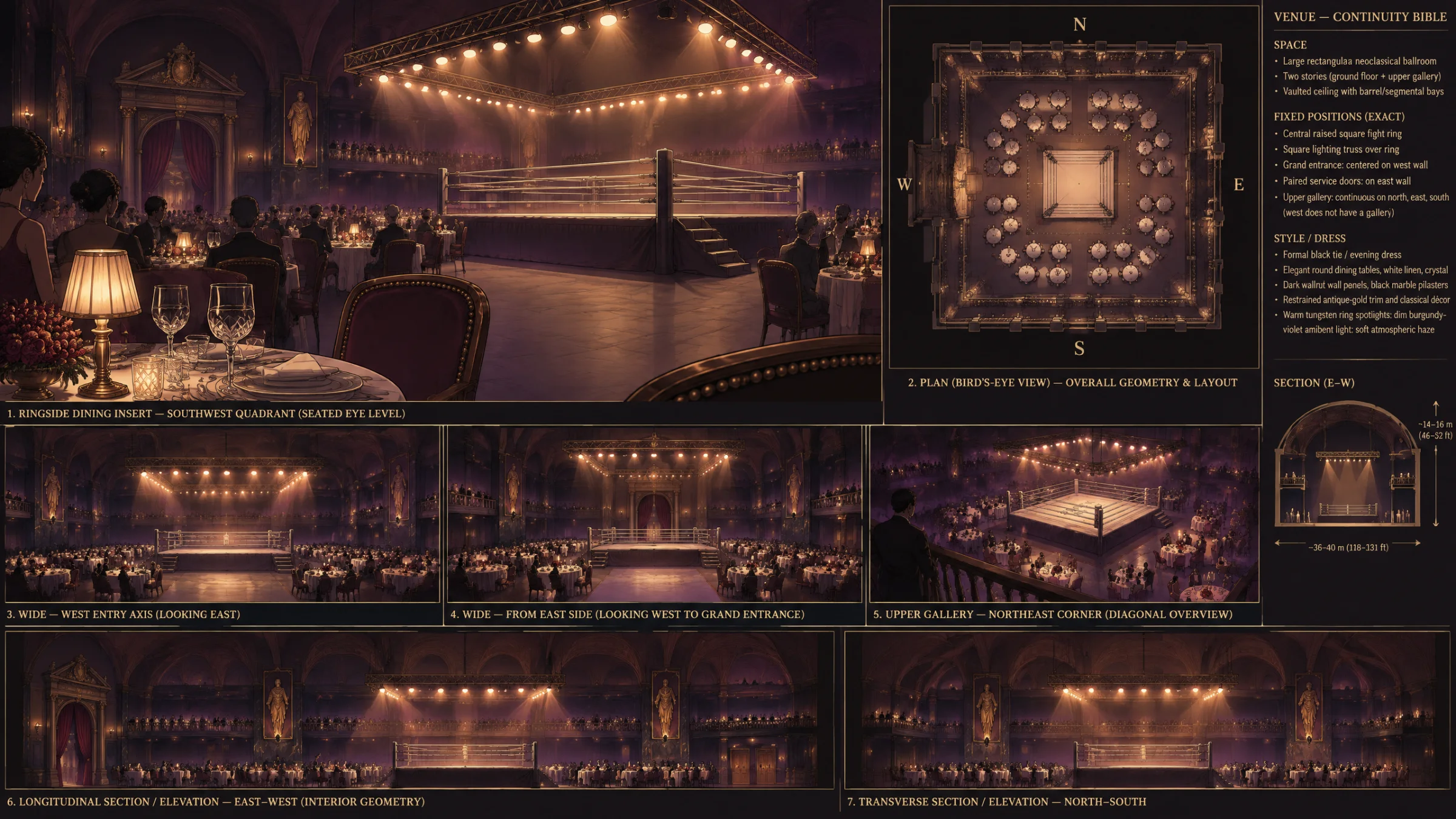
Before a shot is made, the house is fixed on paper. Matt, to PAI: “We need to have good details of the ceiling since there will be several camera angles where we’ll be looking up.”

The Black House ballroom floor plan from above: the ring at the centre under its square truss, four banks of round tables, the aisles crossing, the grand entrance on the west wall, paired service doors on the east, galleries north, east and south.
The venue continuity bible: a ringside view, the plan, wide views from the west entry and the east side, the upper gallery's corner, and long and cross sections of the ballroom, with the fixed positions listed beside them.
The venue continuity bible: the plan, an east–west section, seven numbered views and the fixed positions in words.

“Every upward angle must preserve the same ceiling structure, truss layout, and light positions.”

One correction on the way: the overhead masters were redone with the approved wordmark, and “earlier versions with incorrect ring lettering have been detached from the location.”

PAI’s handoff, November 10

Challenges

What stood between the pages and the film, what we tried, and how it went.

  1. Kiichi’s turnaround sheet: front, side and back, and a portrait.

    One look across many models

    13 · 20 · 7clips on style · minor drift · needing rework, of 40

    The film was rendered in PAI, shot by shot, and not every shot came from the same model. Each one draws the same two fighters a little differently: softer shading here, glossier skin there, a face that drifts off its sheet.

    What we triedCharacter sheets became the canon, and prompts stopped describing the fighters at all: they name Jet and Kiichi and say who stands where. Before the lock, PAI checked every clip in the cut against the sheets.

    How it wentPartly. The check counted 13 of 40 clips on style, 20 with minor drift and 7 that needed rework, and it traced most of the drift to the reference plates rather than the prompts. The drift is still visible in the cut.

    PAI’s style check of the final cut, November 22

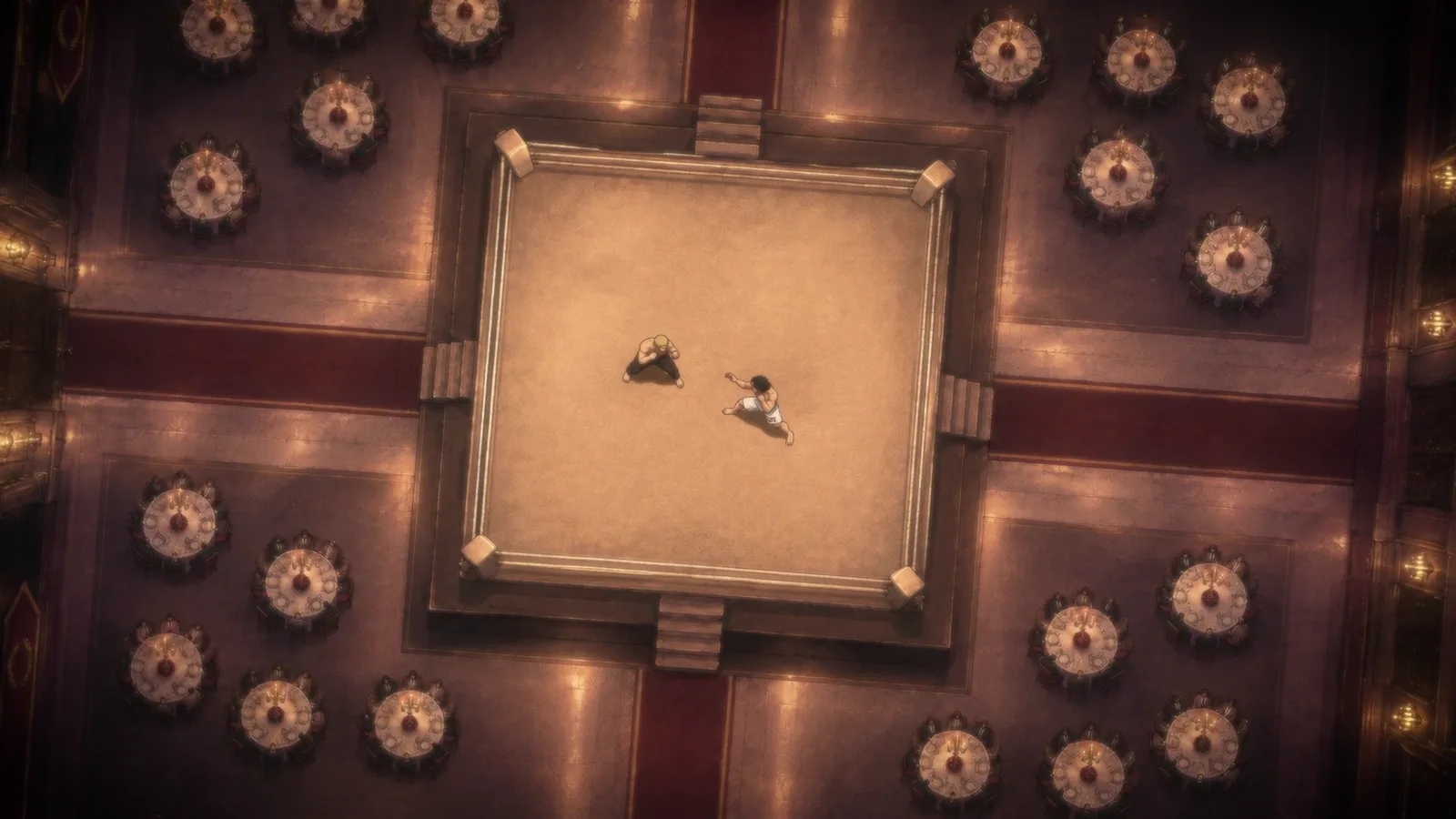
  2. Straight down from the ceiling: the square ring, two small figures on its canvas, the tables and their lamps around it.

    Roadblocks, model by model

    Every model had its own walls. Clips run to 30 seconds at most and 4 at least; a prompt tops out near 4,800 characters; some renders bake in a camera pan of their own that fights the camera added in post; and PAI sometimes declined the audio it had just generated.

    What we triedPrompts were written to the limits: a header, timed shots, an exact count of cuts and strict negatives. Shots meant for a post move were asked for with the camera locked off, and shots that needed no sound were rendered as picture only.

    How it wentMixed. The length and prompt limits could be written around. The baked-in pans kept coming back even when we asked for a locked camera, so on some gala shots we retimed the model’s own pan instead of removing it.

    The prompt rules and the moderation report of November 18

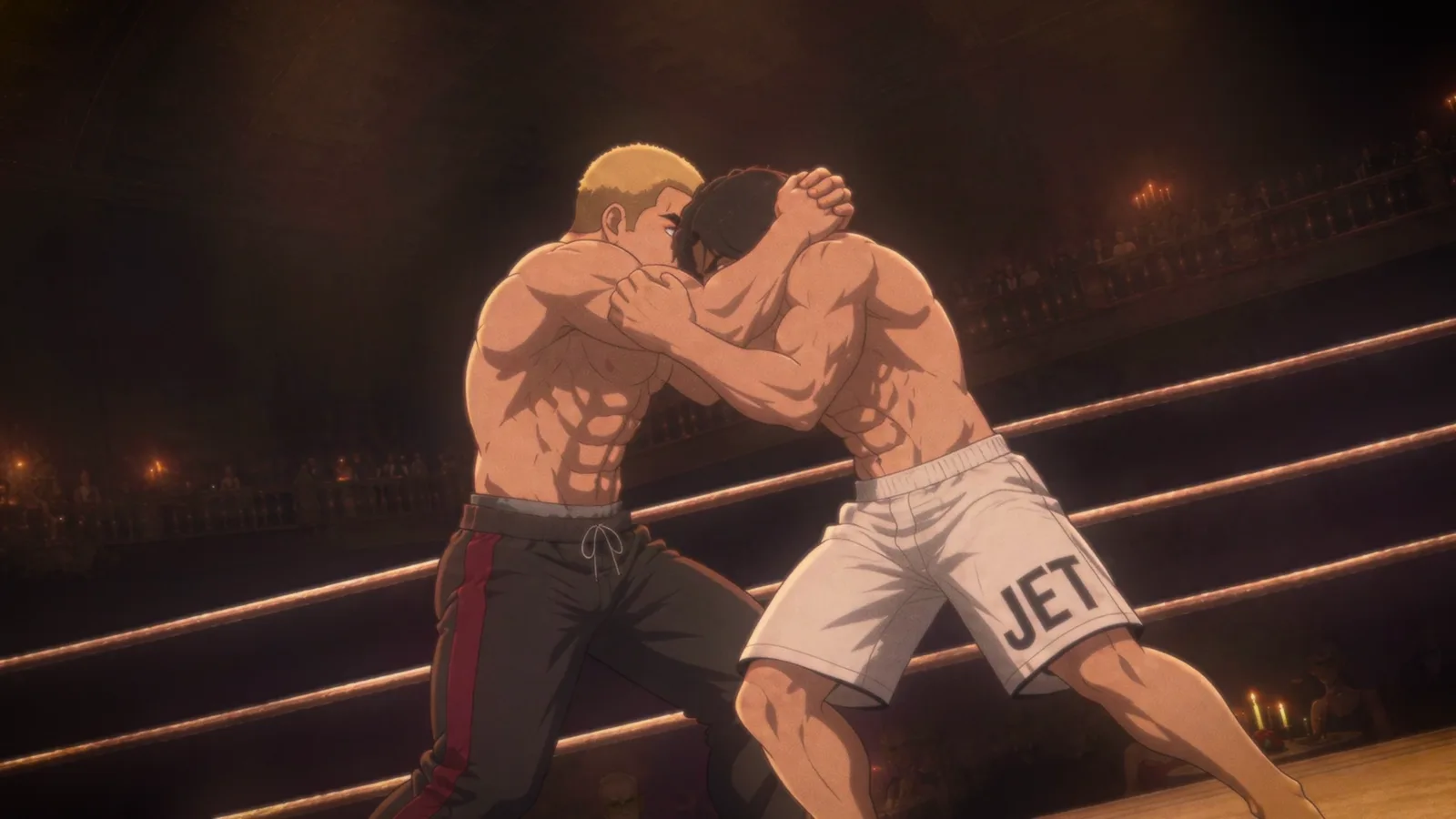
  3. Kiichi and Jet locked head to head in a clinch against the ropes.

    Looking too much like someone else’s work

    21 of 23blocked clips declined for resemblance, Nov 11–16

    Most declines gave one reason: the clip “may resemble existing copyrighted characters, artwork, or footage.” The check runs on the finished render, so the credits came back but the shot did not. The clearest pattern was a motion reference from real footage together with a grappling move: three in four blocked clips carried a video reference, against one in three that finished.

    What we triedVideo motion references were dropped from the fight, the action was described in words instead, and PAI was left to manage its own references.

    How it wentPartly. Two of the blocked shots were finished in other takes the same day. The check never said more than its one sentence, so each workaround was a guess, and the credits for every blocked render were spent.

    PAI moderation reports, November 17 and 18

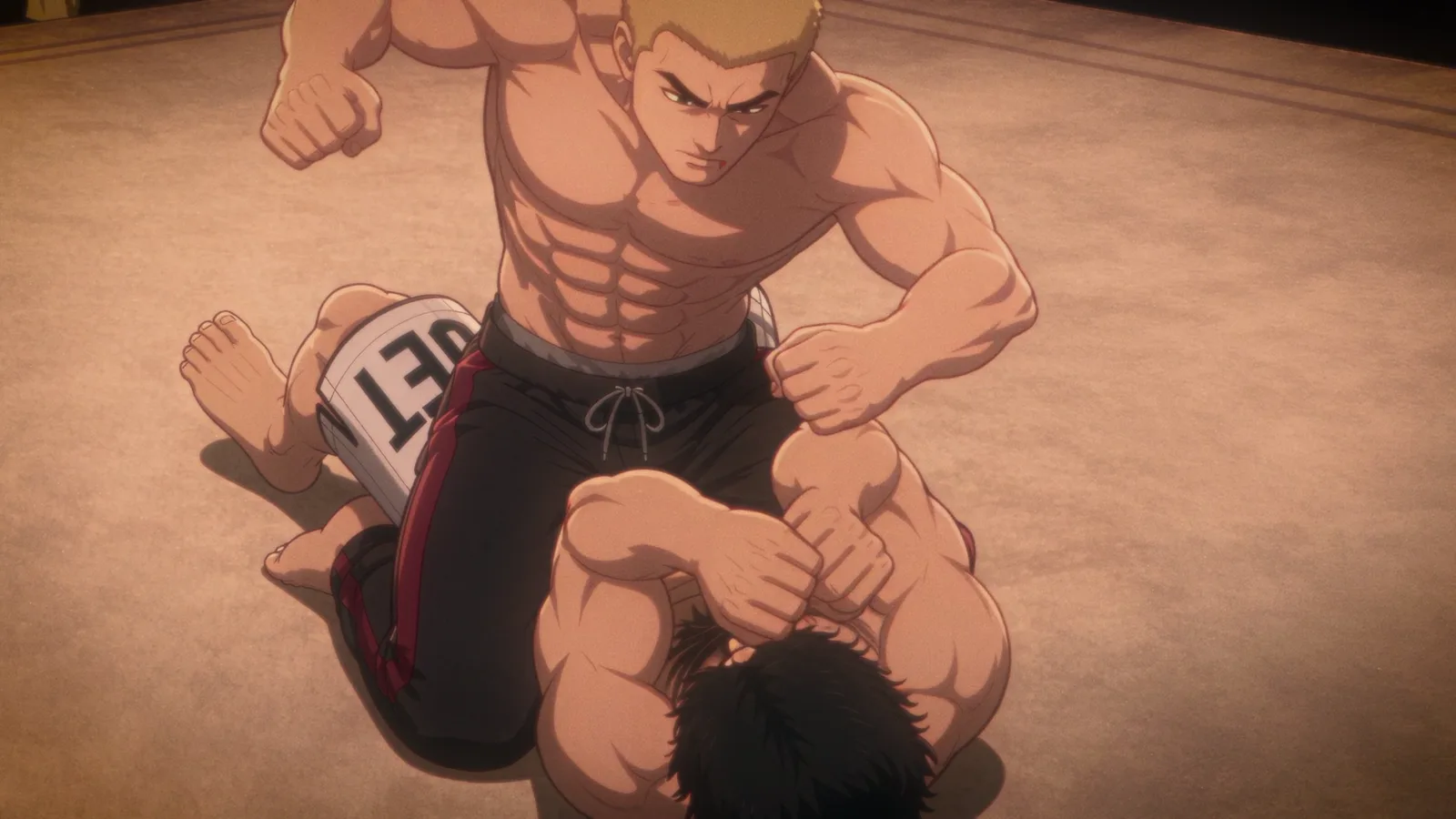
  4. From above, Kiichi kneels over Jet on the canvas, fists raised.

    Fight content, and the switch it forced

    A fight scene asks for strikes, chokes and blood, and those prompts drew declines. After a run of declines PAI quietly routed later clips to other models, which the interface does not show. So getting past a block often meant a different model, and a different model meant a new risk to the look.

    What we triedPrompts kept plain fight language and the fighters’ real names, which the records did not tie to the blocks, and every rerouted render went back through the same sheets, the same grade and the same style check as the rest.

    How it wentNot fully. We could not see or choose the model PAI switched to, so the drift it brought could only be caught after the render, not prevented.

    PAI moderation report, November 17

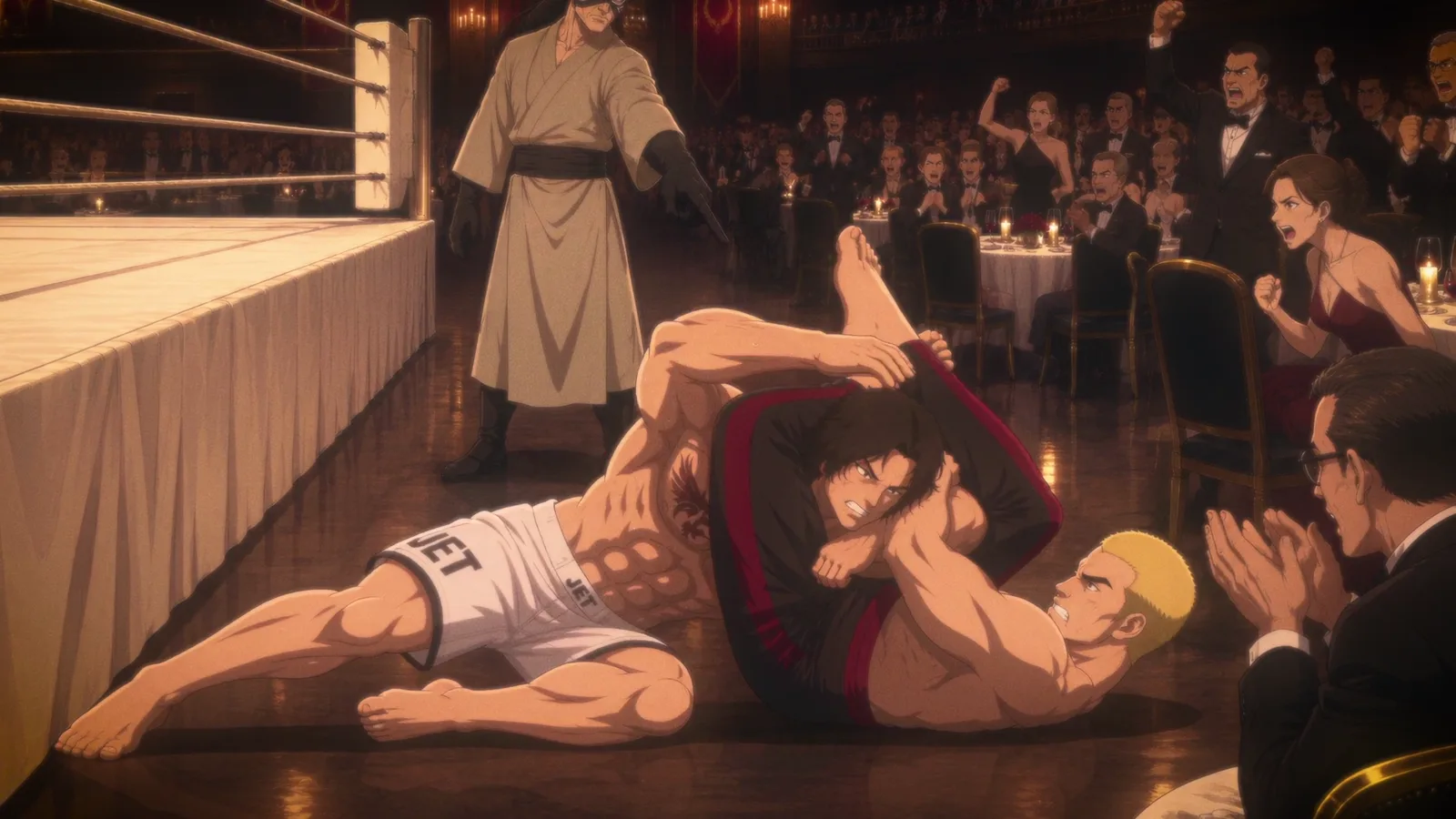
  5. Over the edge of the ring: Kiichi holds Jet in a triangle on the ballroom floor, the Battle King standing over them, the guests applauding.

    Grappling that holds together

    The source pages are a ground fight: a single-leg, the mount, a reversal, a side triangle and a fall out of the ring. Two bodies knotted together are where the models lose count of arms, merge limbs and over-model muscle, and where a choke close-up pulled Kiichi’s face off his sheet.

    What we triedThe motion prompts were cut back to the action and the key cuts, with the anatomy left to the sheets, and the dragon and the tiger were woven into the fight as spectacle. Jet stays active even when he is caught.

    How it wentPartly. Simpler prompts gave cleaner bodies, but the tightest grappling stayed the hardest thing to render, and the dragon and tiger inserts carry some of the moments the bodies could not.

    The beat script and the motion prompt notes

  6. Three masked guests in evening dress mid-conversation at the gala, a glass of champagne raised.

    Turning the page’s words into voices

    On the page, ringside commentary explains the fight as it happens, a narrator adds a few captions, Kiichi gets two cocky lines, and Jet never speaks. A film with no narrator has to put that exposition in someone’s mouth.

    What we triedThe commentary became the house itself: guests trading gossip at the gala, a ring announcer, and the crowd shouting what the page explains. Kiichi keeps his taunt. Jet stays silent.

    How it wentThis one worked. The voices are in the film, all in English, which was also the only language PAI voiced reliably.

    The beat script and Matt’s notes, November 18 and 22

The fight

How a fight shot was made, from a line of the script to the cut.

From a line to a shot

  1. 1

    Script

    A beat script of 41 shots, each with a permanent ID from S01 to S41, paced at 1.7 to 2 seconds a shot, close to the reference fights.

  2. 2

    Storyboard

    For every shot, a framing diagram and a blocking plan: who stands where, which way they face, where the camera sits.

  3. 3

    Prompt

    One form for every fight shot: a header, the animation, the setting, the camera and its lens, timed shots and strict negatives. Low angles looking up, a hard Dutch tilt.

  4. 4

    Render

    PAI renders the clip. It is sent the motion prompt only, and manages the house’s references itself: the character sheets and the location plates.

  5. 5

    Judge

    Every render is held against a rubric: pass, pass with notes, or fail.

  6. 6

    Post

    A 4K upscale for headroom, the grade for its scene, the virtual camera, then back down to 1080p at 24 frames a second.

A prompt, as sent

Describe the action, call out only the key cuts, and let the model fill in the rest.

Matt’s rule for motion prompts, from the second day. The camera asks for smooth moves only and states the exact number of cuts; whip pans, shake and speed lines are forbidden, because post adds the camera. This one is the shin check and throw, sent on November 18.

DRAGON & TIGER CLASH — KIICHI CHECKS THE KICK AND THROWS JET — 5 SECONDS — 16:9 — 24 FPS — PREMIUM 2D ANIME, HAND-DRAWN SAKUGA

ANIMATION: Premium hand-drawn 2D anime matching the start frame: clean linework, cel shading with hard shadows, detailed muscle anatomy, warm candlelit palette. Weighty, physical, full-frame animation. Not 3D, not CGI.

SETTING: Inside the ring on cream canvas, three tan-brown ropes all the same color; behind them, a dark candlelit ballroom out of focus.

CAMERA: 2 shots, exactly 1 cut. Smooth moves only. No whip pans, no spinning, no shake.

SHOT 1 (00:00–01:12) EXTREME CLOSE-UP on the lower legs, low angle near the canvas, slight Dutch tilt: Jet’s bare shin is crashing into Kiichi’s raised, checking shin. On impact, the calf muscles ripple and both feet flex. Kiichi’s checking leg immediately pulls back and plants as his hips start to pivot. Slow push in.

CUT.

SHOT 2 (01:12–05:00) LOW WIDE, 24mm, low angle looking up, hard Dutch tilt, both fighters full-body: Kiichi completes the pivot, catches Jet’s right wrist with both hands and redirects Jet’s forward momentum, flinging him off to the side. Jet stumbles across the canvas, staying on his feet, then turns back into his guard. …

The render and the final

Drag across each pair: PAI’s render on the left of the line, the finished shot on the right.

PAI renderFinal
Jet’s reversal and Kiichi’s triangle counter: Kiichi is on top, Jet turns it, and Kiichi locks his legs around him. The take in the cut; the final adds the fight grade and the virtual camera.
PAI renderFinal
The avatars: the tiger pounces on the dragon. Kiichi and Jet as the animals the source names them for, cut into the fight as spectacle.

Camera & FX

What happened to every shot after PAI: the virtual camera, the grade, and the finish.

The virtual camera

Snaps, roll and drift
A virtual camera moves over each clip after it is rendered. In the ring: quick snaps onto a hit, a little roll, a slow drift, an occasional subtle whip.
Blur at real speed
In the fight, directional motion blur rides every move, at the clip’s own speed. No hit-stop freezes, no slow motion in post, no negative flashes.
A handheld feel in the ring
Fight clips carry a light handheld shake, handheld 6. The gala is held smooth, handheld 0: gentle pushes, drifts and the occasional single pan.
Room to move
Every clip is upscaled to 4K first, so the camera can push in and reframe without losing the 1080p it is delivered at.
PAI renderFinal
Jet’s punch and Kiichi’s slip. PAI drew the action; the snaps, the roll and the blur are the camera pass, and the warmth is the fight grade it set for every fight shot.

The renders often carried a camera pan of their own, which fought the one added in post. Shots planned for a post move were asked for with the camera locked off; where a pan was already baked in, it was retimed instead.

Two pipelines

The gala

The smooth post camera: handheld 0, gentle pushes, drifts and the occasional single pan. Graded to the interiors key, the gala conversation; the exteriors take a cooler night.

  1. PAI render, 1080p
  2. 4K upscale
  3. Grade: interiors or exteriors
  4. Smooth camera, handheld 0
  5. Dialogue in English, cleaned
  6. Grain in the edit
PAI renderFinal
The interrupted conversation. PAI’s render panned on its own; the final holds still, then retimes that same pan into one fast move at the five-second mark.

The fight

The fight camera: snaps, roll, drift and subtle whips with directional motion blur at real speed, handheld 6. No hit-stop, no slow motion, no flashes. Graded to Jet’s punch; crowd shots cut into the fight take the fight’s look, not the gala’s.

  1. PAI render, 1080p
  2. 4K upscale
  3. Grade: the fight look
  4. Camera pass: snaps, whips, blur, handheld 6
  5. Avatars and inserts
  6. Grain in the edit
PAI renderFinal
Closing distance: a jab, a whip across the ring, Kiichi’s stare, then he shoots in on Jet’s leg. PAI drew the exchange; the snaps, the roll, the whips and their blur, and the handheld shake are the camera pass, at the clip’s real speed.

The finish

  1. TopFilm grain, added last, in the edit
  2. ThenBlur, bloom and halation, softening the highlights like film
  3. ThenContrast and a vignette, one adjustment over the whole cut
  4. UnderThe graded, camera-moved shots, on one timeline from the gate to the last white frame

Music

Music

The fight theme

Made for the fight in the style of a J-rock, post-hardcore anime opening, generated in Suno and picked over the first candidate, Street Drop. Two minutes.

0:00 / 2:00

If we did it again

Done again, the fight would start with more planning and less searching.

  1. Choose the model for the content, then the look.

    Before anything else, find the model with the fewest restrictions on fight content, and build the style on that model. Much of the churn, and the model switching that pulled the look apart, came from meeting the walls after the style was set.

  2. Block the fight before rendering it.

    Spend far more time on the blocking up front, so it is clear where the effort should go. Too often we hunted for clips that were at least coherent and worked the blocking out backwards from them.

  3. Plan the plates in layers.

    Design plates whose foreground and background separate, and animate them apart: the action in front of larger backgrounds, with the parallax and the background motion under our control. It takes time, but it is the same lesson: more structure at the start.

  4. The biggest one

    Draw the grappling first.

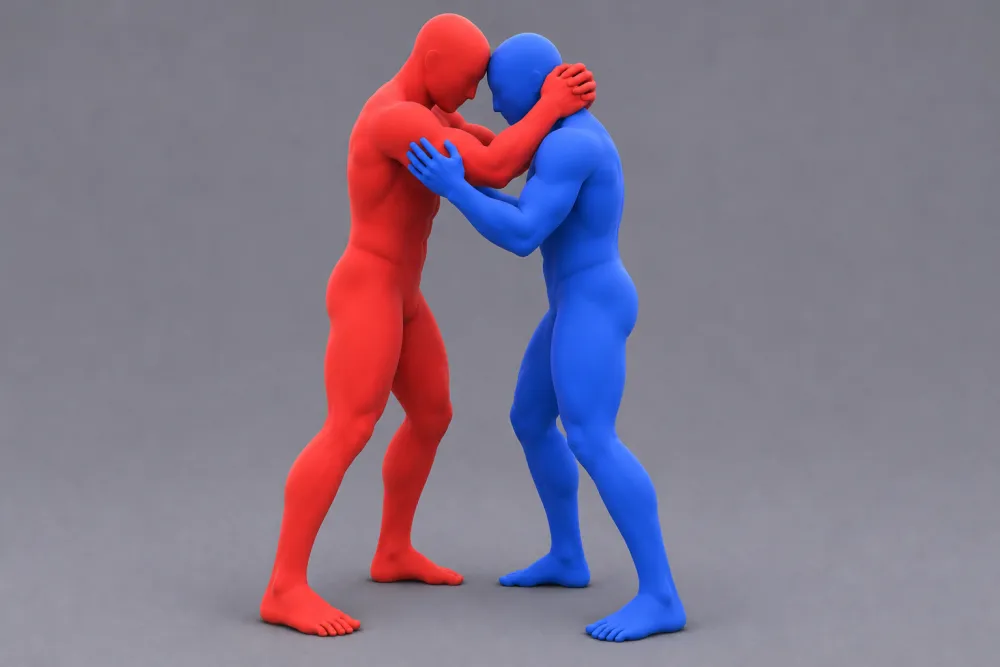
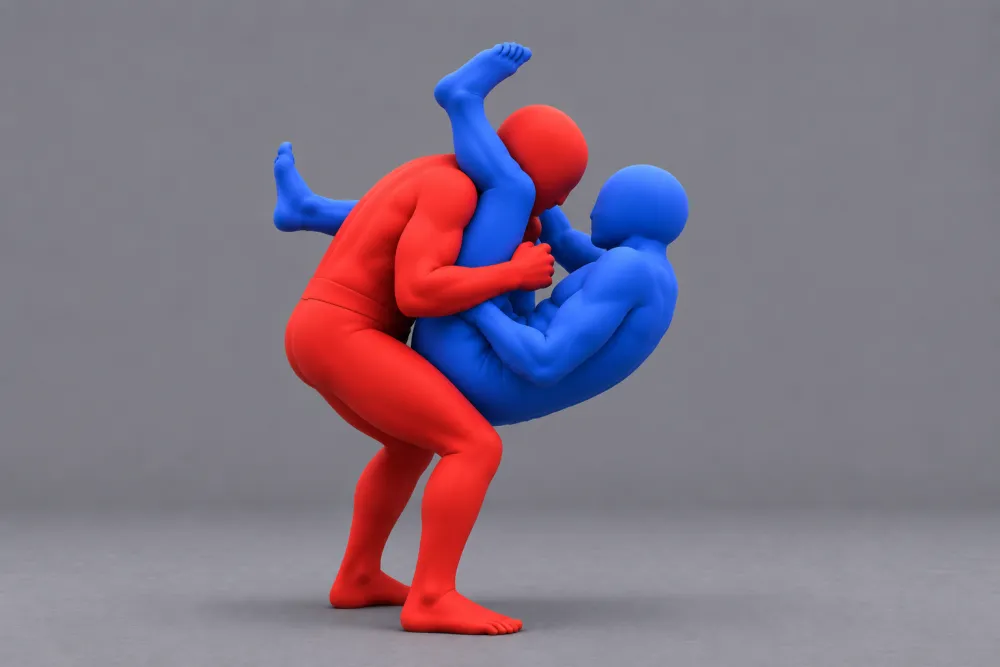
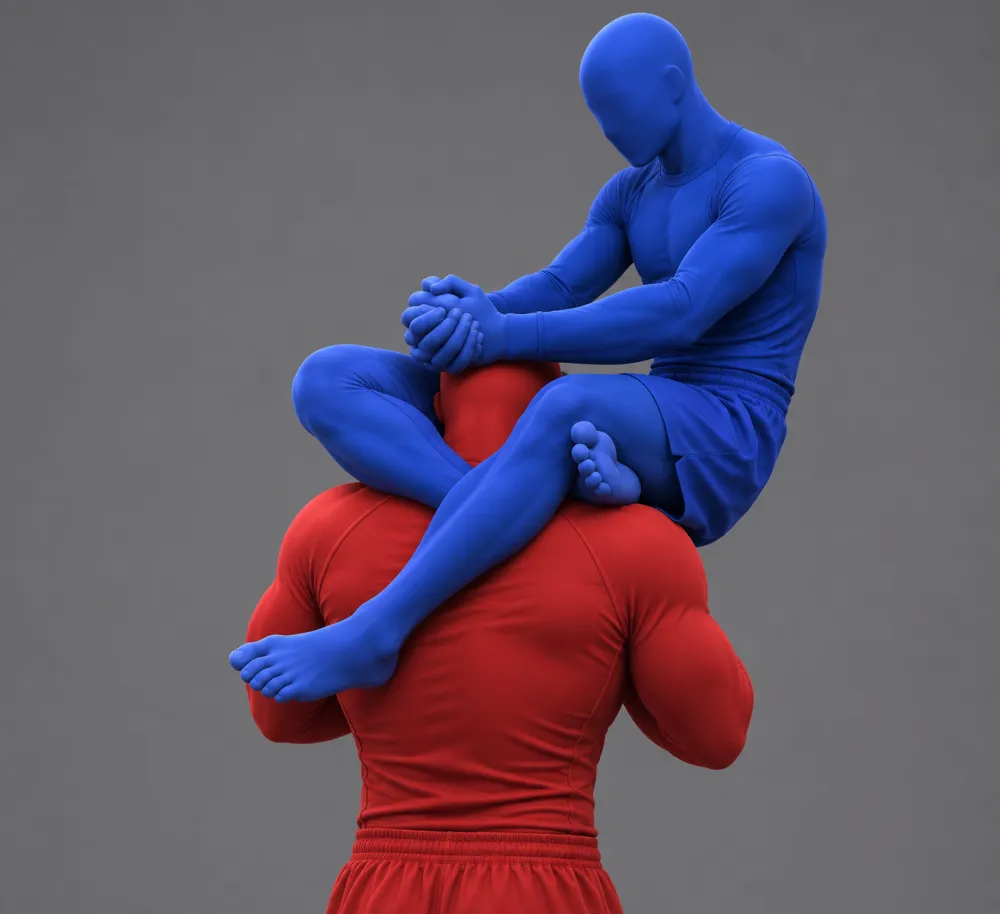
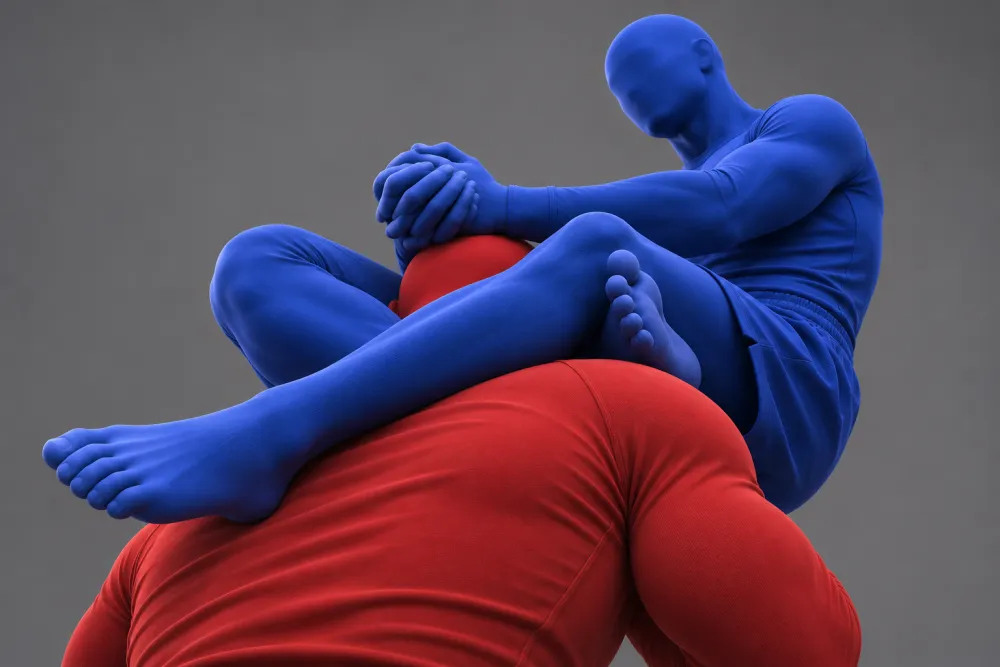
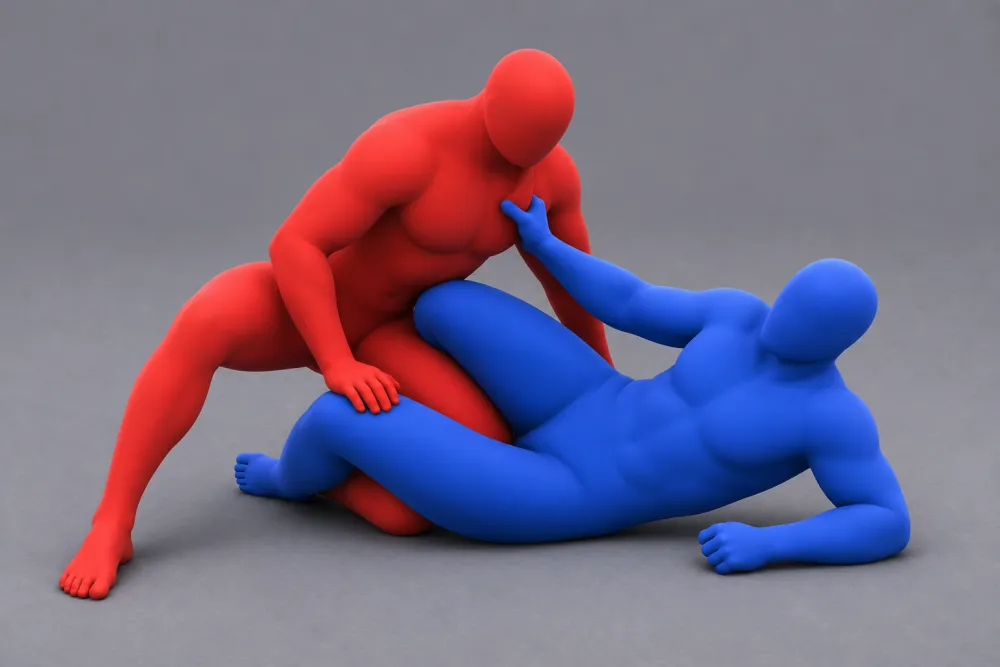
    We tried generating simple blocking mannequins with Astra, and they were only mildly effective: even the simplified figures were a chore to get right. Next time, a human illustrator would sketch every grappling pose as simple volume mannequins, with the proportions and the camera right, one fighter false-colored red and the other blue. Those drawings become the pose references the style is applied to, instead of asking another model to make the pose references, which is very hard for models. It is the surest road to technically accurate grappling, and the way we would build a series.

    • Red and blue mannequins standing head to head in a clinch, hands locked behind each other’s necks.
    • The red mannequin crouches and lifts the blue one off the floor, blue’s legs kicking up over red’s shoulder.
    • The blue mannequin sits on the red one’s shoulders, legs crossed around his head, hands clasped on top.
    • The same pose from a low angle: blue perched on red’s shoulders, legs wrapped around his head.
    • On the floor, the red mannequin straddles the blue one, who lies back on an elbow and pushes at red’s face.
    Blocking mannequins generated with Astra: mildly effective, and hard won.

Experiments

Tests made along the way, and the record of the work.

A · Frame rate: 24 or 12

The client’s partners asked how the film would feel at the frame rate anime is usually drawn at: twelve drawings a second, each held for two frames, instead of the film’s twenty-four.

The first test is the clinch, in four versions side by side. The point it makes: in anime the drawings step but the camera does not. Holding only the drawings keeps the camera’s moves smooth; holding whole frames steps the camera too, and reads as a stutter rather than a style.

24 fps, on 1s
A new drawing every frame, as in the film.
12 fps, on 2s
Each drawing held for two frames, the usual rate for anime. The camera still moves every frame.
8 fps, on 3s
Each drawing held for three frames: choppier, more like limited animation. Camera still smooth.
12 fps, naive
The whole frame held for two, camera and all. What you get by simply dropping frames from a finished shot.

Next: a longer comparison of about 45 seconds, from the Hajime call into the fight, on 1s against 2s (and perhaps 3s), with the camera kept at full rate.
The clinch, four ways. Watch the camera’s drift in the bottom right against the other three.
Each version on its own, full size: 1920×1080, 7 seconds, H.264, no audio.
B · What it took

Plates, then clips: what the fight took

We never went straight to video. Every clip started from plates, keyframes and style frames that fixed the look and the framing, so there were more plates than clips.

Plates and design · one scale for both groups

  • Shot plateskeyframes and style frames310
  • Character images44
  • Location images24

Video

  • Clips generated249
  • Used in the cut41
  • Blockedat least 20

Counts from the project’s PAI library, November 10 to 23; blocked clips from PAI’s records of the agent’s work, so that figure is a floor.

B · The log

November 23, 2026

  1. DriveDelivered: the master and two web copies, 2 minutes 47 seconds, mixed to −16 LUFS.
  2. DesktopThe Hajime title as a panel slam, and a clean cut through the stare.

November 22, 2026

  1. DesktopEvery shot in the cut traced back to its PAI original, and checked against the style.
  2. DesktopThe gala conversations redone, simpler, every word in English.
  3. DesktopOne timeline for the whole film; the separate gala and fight edits retired.

November 18, 2026

  1. PAIThe avatars: Jet as the dragon, Kiichi as the tiger, cut into the fight.
  2. DesktopThe crowd’s shouts move to English; crowd shots in the fight take the fight’s grade.

November 17, 2026

  1. DesktopOne prompt form for every fight shot: low angles, a hard Dutch tilt, the camera left to post.

November 16, 2026

  1. DesktopThe pipeline set: a 4K upscale, then the grade, then the camera; grain last, in the edit.

November 12, 2026

  1. DesktopThe fight’s camera made in post: snaps, roll and drift at real speed, no freezes, no slow motion.

November 11, 2026

  1. DesktopMotion prompts kept simple: the action, the key cuts, and the rest left to the model.

November 10, 2026

  1. PAIThe rest of the house came in: the outside at night, the floor plan, the continuity bible.
  2. DesktopA rubric for judging every rendered clip: pass, pass with notes, or fail.
  3. PAIThe 27 frames filed as blocking and framing references, and nothing else.
  4. Desktop27 clean frames pulled from the two reference fights.
  5. DesktopThe storyboard: all 41 shots, with a framing diagram and a blocking plan for each.
  6. DesktopThe prompt rules: one global block, one block per shot.
  7. PAIOne location, the Black House, outside and in, and a collection for its crowd.
  8. DesktopBeat script draft 3: 41 shots, 75.2 seconds.
  9. DesktopThe fact-check moved the scene back to the client’s own pages: a grappling sequence.
  10. DesktopThe reference fights counted: about one shot every 1.6 seconds. Our budget: 38 to 44 shots.
  11. DesktopTwelve rules for camera and cutting, from the reference board.
  12. DesktopTwo reference fights cut from a compilation.
  13. DriveThe first round’s material copied in: 21 source pages, the 2D and 2.5D frames and clips.
  14. DesktopThe scene got its title: the Dragon & Tiger Clash.
  15. DriveA project folder opened for the scene.